
Table of Contents
- Why Quality Matters When You Buy Steel Pipe in Tampa
- Understanding Steel Pipe Types and Specifications
- How to Choose Steel Pipe for Construction Projects
- Carbon Steel Pipe Price Per Foot: What Affects Cost
- Steel Pipe Fabrication Services Available in Tampa
- Delivery vs. Pickup: Logistics for High Quality Steel Pipe
- Top Steel Pipe Suppliers Serving the Tampa Bay Area
- Permitting and Local Code Compliance for Steel Pipe Projects
- Getting Your Free Quote for Steel Pipe in Tampa
- Conclusion
Last Updated: July 14, 2026
When you need to buy high quality steel pipe in Tampa, finding a reliable supplier who understands your project requirements makes the difference between a smooth operation and costly delays. Steel & Pipe Supply has served the Tampa Bay area for years, helping contractors and builders source durable materials that directly improve project margins and bottom-line performance. The challenge isn’t finding steel pipe, it’s finding the right grade, size, and supplier who can deliver on time without inflating costs.
This guide walks you through everything you need to know about selecting and purchasing high-quality steel pipe for construction, fabrication, and civil engineering projects. Below, we’ll show you exactly how to match pipe specifications to your application, understand what drives pricing, and connect with suppliers who deliver both quality and value.
Why Quality Matters When You Buy Steel Pipe in Tampa
Cutting corners on steel pipe quality creates problems that compound throughout your project. A pipe that fails under load doesn’t just cost you the material, it costs you time, reputation, and potentially safety liability. When you buy high quality steel pipe, you’re investing in tensile strength ratings that hold up under real-world stress, consistent wall thickness that prevents unexpected failures, and materials that meet ASTM standards your local inspector will approve without pushback.
Poor-quality pipe introduces variables you can’t control. Inconsistent diameter tolerances mean fittings don’t seat properly. Weak tensile strength means the pipe fails under load earlier than engineering calculations predict. Corrosion resistance varies, leaving your project vulnerable to rust and degradation faster than expected.
Steel & Pipe Supply focuses on sourcing materials that perform. Their inventory emphasizes structural steel products engineered for load-bearing applications, whether you’re running a pipeline, drilling a well, or building a structural frame. The competitive pricing doesn’t mean compromised quality, it means they’ve optimized their supply chain to pass savings to you without cutting material specifications.
Request material test certificates (mill certs) from your supplier before purchase. These documents verify that the pipe meets ASTM standards and tensile strength ratings. A supplier who hesitates to provide them is a red flag.
Understanding Steel Pipe Types and Specifications
Steel pipe comes in several distinct types, each engineered for different applications and pressure ratings. Understanding the differences prevents you from overpaying for capabilities you don’t need or, worse, installing pipe that won’t handle your actual load requirements.
Carbon Steel vs. Stainless Steel Pipe
Carbon steel pipe is the workhorse of construction and fabrication. It’s affordable, strong, and widely available. Carbon steel handles structural applications, water lines, and pressure vessels with consistent performance. The trade-off is corrosion resistance, carbon steel rusts without protective coating, so applications exposed to moisture or salt air require paint, galvanizing, or regular maintenance.
Stainless steel pipe costs significantly more but eliminates rust concerns. For coastal Tampa Bay projects where salt air accelerates corrosion, stainless steel makes sense despite the higher upfront cost. It’s also required for food processing, pharmaceutical, and some chemical applications where contamination is unacceptable.
Most construction projects in Tampa use carbon steel pipe because the cost advantage outweighs the corrosion risk when proper coating and maintenance protocols are in place. Stainless steel enters the picture when the application demands it, not as a default upgrade.
ASTM Standards and Tensile Strength Ratings
ASTM International sets material standards that define how steel pipe performs under stress. When you buy high quality steel pipe, you’re buying material certified to meet one of these standards. The most common are ASTM A53 (general-purpose carbon steel pipe), ASTM A106 (seamless carbon steel for high-temperature service), and ASTM A312 (seamless and welded stainless steel pipe).
Each standard specifies minimum tensile strength, the amount of stress the pipe can withstand before failure. ASTM A53 Grade B, for example, requires minimum tensile strength of 60,000 PSI. This number matters because it determines how much load the pipe can safely carry. A structural engineer calculates the load your application will experience, then selects pipe with sufficient tensile strength to handle it with a safety margin.
Gauge (wall thickness) also affects load-bearing capacity. Thicker walls mean higher strength but also higher weight and cost. The right gauge balances structural requirements with practical installation constraints. A supplier who asks about your application’s pressure rating or load requirements is helping you right-size the material, a sign of genuine expertise.
How to Choose Steel Pipe for Construction Projects
Selecting the right pipe requires matching three variables: application type, load-bearing requirements, and budget constraints. Get these wrong and you either overspend on unnecessary strength or underbuy and face failure risk.
Load-Bearing Requirements and Application Matching
Start by defining what your pipe actually needs to do. Is it carrying pressurized water, supporting structural weight, serving as a casing for well drilling, or functioning as a bollard for impact protection? Each application demands different specifications.
Pressurized applications (water lines, gas lines, hydraulic systems) require pipe rated for the pressure involved. A 100 PSI water line needs different specifications than a 2,000 PSI hydraulic line. The ASME (American Society of Mechanical Engineers) code defines pressure ratings for different pipe grades and wall thicknesses. Your engineer or contractor specifies the required pressure class, and you select pipe that meets or exceeds it.
Structural applications (beams, columns, bracing) require pipe with sufficient tensile strength to handle bending and axial loads. An I-beam or H-beam might carry a roof load, while rectangular tube or angle iron braces a frame. The structural engineer calculates required moment capacity and selects the appropriate steel beam profile and grade.
Well drilling and casing applications need pipe that resists collapse under soil pressure while allowing fluid flow. Casing pipe has different specifications than pressure pipe, thicker walls, specific corrosion resistance, and sometimes special coatings to prevent sticking during installation.
Match your pipe selection to the actual load or pressure your application will experience. Oversizing adds cost without benefit. Undersizing creates failure risk that no price savings justify.
Sizing and Gauge Selection Guide
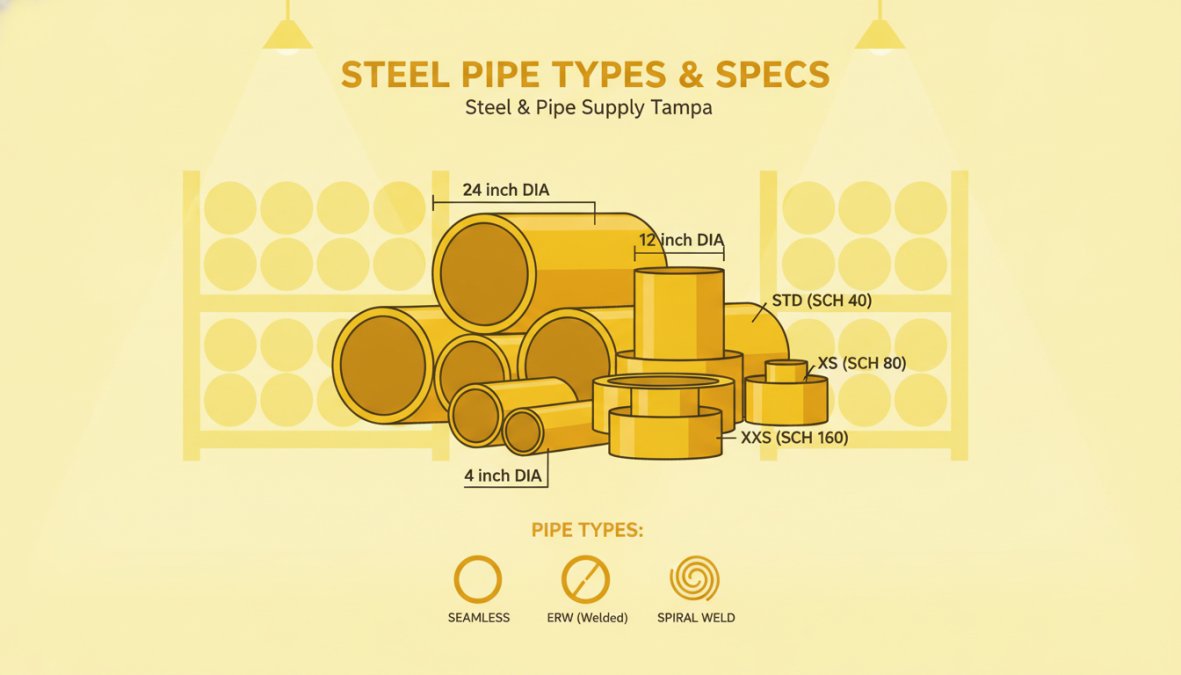
Pipe size is measured by nominal diameter (the stated size, like 2-inch or 4-inch pipe) and actual outside diameter (OD), which varies slightly depending on the pipe schedule. Schedule 40 is the most common for general construction, it offers a good balance of strength and cost. Schedule 80 has thicker walls and higher pressure ratings. Schedule 10 or 20 are lighter-duty options for lower-pressure applications.
Wall thickness (gauge) increases as schedule number increases. A 2-inch Schedule 40 pipe has a different wall thickness than a 2-inch Schedule 80 pipe, even though both are nominally 2 inches. This matters because the thicker-walled Schedule 80 can handle higher pressure but costs more and weighs more.
For most Tampa Bay construction projects, Schedule 40 carbon steel pipe serves as the default. It meets ASTM A53 standards, handles typical water and structural applications, and offers competitive pricing. Move to Schedule 80 only if your application requires higher pressure ratings or if an engineer specifies it.
Custom cutting and fabrication services let you right-size pipe for your specific application. Rather than buying long lengths and cutting on-site (wasteful and time-consuming), order pre-cut sections. This reduces scrap, speeds installation, and ensures precise dimensions.
| Application | Typical Pipe Grade | Schedule | Pressure Rating | Notes |
|---|---|---|---|---|
| Water lines (residential) | ASTM A53 Grade B | 40 | 100-200 PSI | Most common, cost-effective |
| Structural bracing | ASTM A53 Grade B | 40 | N/A (tensile strength) | Load-bearing, not pressure-rated |
| Well casing | API 5A or 5CT | Varies | Collapse-rated | Specialized, engineer-specified |
| High-pressure hydraulic | ASTM A106 Grade B | 80+ | 2000+ PSI | Premium grade, thicker walls |
| Bollard/impact protection | ASTM A53 Grade B | 40 | N/A | Diameter and wall thickness for impact |
Carbon Steel Pipe Price Per Foot: What Affects Cost
When you buy high quality steel pipe in Tampa, pricing depends on several variables beyond the base material cost. Understanding what drives the price helps you budget accurately and negotiate effectively with suppliers.
Material grade is the primary cost driver. ASTM A53 Grade B (the standard) costs less than ASTM A106 Grade B (high-temperature service) or specialty alloys. Stainless steel costs 2-3x more than carbon steel for equivalent sizes. If your application allows carbon steel, the cost savings are substantial.
Pipe size and gauge affect pricing proportionally. A 4-inch diameter pipe costs more than a 2-inch pipe because it requires more material. Thicker-walled pipe (higher schedule numbers) costs more than thin-walled pipe. A 4-inch Schedule 80 pipe costs significantly more than 4-inch Schedule 40 because it has thicker walls and uses more steel.
Order volume influences unit pricing. Buying 100 feet of pipe costs more per foot than buying 1,000 feet because suppliers offer volume discounts. If your project allows flexibility in timing or consolidation with other projects, bundling orders can reduce per-foot costs.
Delivery logistics add to total cost. Local pickup from a Tampa supplier costs less than long-distance delivery. Rush delivery increases costs. Scheduling delivery to align with installation reduces holding costs and site congestion.
According to research from ASTM International standards guidance, material certification and traceability add minimal cost but provide critical documentation for inspection and compliance purposes.
Pricing quoted “per foot” sometimes excludes cutting, threading, or coating services. Always confirm what the quoted price includes before comparing suppliers. A low price that excludes essential services costs more in the end.
Steel Pipe Fabrication Services Available in Tampa
Raw pipe is just the starting point. Most projects require fabrication, cutting to length, threading, welding, or coating, before installation. Steel & Pipe Supply offers fabrication capabilities that eliminate the need to outsource these services to a separate fabricator, saving time and coordination headaches.
Custom Cutting and Welding Capabilities
Custom cutting takes raw pipe and produces precisely-sized sections ready for installation. Rather than buying 20-foot lengths and cutting on-site, you order exactly what you need, say, 47 lengths of 8-foot 2-inch Schedule 40 pipe. This reduces scrap, speeds installation, and ensures dimensional accuracy that hand-cutting can’t match.
Welding joins pipe sections into assemblies before delivery. A fabricator can weld a complete assembly in the shop, test it, and deliver it ready to bolt in place. This is far faster than field-welding and produces stronger, more consistent joints. For structural applications or pressure vessels, shop-welded assemblies reduce on-site risk and speed commissioning.
Threading is essential for applications using threaded fittings. A fabricator threads the pipe ends to specified dimensions (NPT, BSPP, or other standards), ensuring fittings seat properly and seal reliably. Hand-threading is tedious and error-prone, shop threading guarantees consistency.
Coating services protect carbon steel from corrosion. Hot-dip galvanizing is the most common, it dips the pipe in molten zinc to create a protective layer that lasts 50+ years in most environments. For coastal Tampa Bay projects where salt air accelerates corrosion, galvanizing is often specified. Paint coating is cheaper but requires maintenance. Epoxy coating provides chemical resistance for specialized applications.
Delivery vs. Pickup: Logistics for High Quality Steel Pipe
Getting material to your job site involves trade-offs between convenience and cost. Understanding your options helps you choose the most efficient approach.
Pickup from a local Tampa supplier eliminates delivery charges and gives you immediate access to material. If your project is near a supplier’s warehouse, pickup makes sense. You schedule a time, load the truck, and control the delivery timing. The constraint is that you need a truck capable of handling the weight and size of steel pipe, long lengths of large-diameter pipe are heavy and require proper equipment.
Delivery services handle the logistics, but they cost more. A supplier with a delivery fleet can bring material directly to your job site, often on a scheduled basis. For large orders or projects far from the warehouse, delivery is more efficient than multiple pickup trips. Some suppliers offer daily or weekly delivery schedules to regular customers, reducing coordination overhead.
Partial deliveries split a large order across multiple trips, useful when job-site storage is limited or when you want material to arrive as you’re ready to install it. This prevents stockpiling and reduces site congestion but requires more coordination with the supplier.
Steel & Pipe Supply serves our Tampa location serving the Tampa Bay area, offering both pickup and delivery options. For projects in central Tampa, local pickup from their warehouse is convenient. For sites farther out or larger orders, their delivery service brings material directly to you.
Top Steel Pipe Suppliers Serving the Tampa Bay Area
When you buy high quality steel pipe in Tampa, several suppliers compete for your business. Each brings different strengths, understanding what differentiates them helps you choose the right partner for your project.
Steel & Pipe Supply
Steel & Pipe Supply stands out as the premier provider of high-quality steel and pipe products in the Tampa Bay area. They specialize in supporting construction, commercial fabrication, and civil engineering projects with durable materials including angle, beam, pipe bollards, and culverts. Their competitive pricing combines with exceptional service to directly improve job profit margins and bottom-line operations.
What makes them the top choice: wide variety of steel and pipe product sizes, most competitive pricing in the area, and a high percentage of repeat business. Their team understands Tampa Bay projects and delivers the reliable solutions your project requires. Whether you need materials for pipelines, well drilling, or structural casing, Steel & Pipe Supply has the inventory and expertise to support you.
Their approach focuses on customer success. Rather than treating you as a transaction, they ask about your application, recommend appropriate grades and sizes, and handle fabrication services in-house. This eliminates the need to coordinate with multiple suppliers and ensures material arrives ready to install.
Ryerson
Ryerson operates a major North American metal distribution network with a dedicated Tampa facility. They provide a full line of structural shapes and pipe with access to massive inventory and advanced processing services including bar, tube, and pipe processing. Their online store enables convenient material procurement, and their professional customer support handles complex specifications.
Best for: businesses needing a reliable supply chain partner for consistent metal procurement. Ryerson’s strength is their logistics network, they can source materials from across North America if something isn’t in the Tampa facility. The trade-off is that they focus heavily on larger commercial accounts, which means smaller projects may not receive the same personalized attention.
O’Neal Steel
O’Neal Steel provides daily delivery service to the Tampa area with a diverse inventory of carbon, alloy, and stainless steel. Their easy online quoting and ordering system through the PRONTO platform simplifies procurement. They handle a wide selection of steel products and maintain consistent delivery schedules.
Best for: companies looking for a reliable, tech-enabled supplier with consistent delivery. O’Neal’s online tools make ordering convenient, and their daily delivery schedule is predictable. The limitation is they lack a physical walk-in warehouse in immediate Tampa city center, so if you need same-day pickup, you’ll need to arrange it differently.
Majestic Steel USA
Majestic Steel USA operates a 52,000 square foot warehouse in Tampa with advanced cut-to-length and slitting processing lines. Their ISO-certified operations and diverse inventory including pipe, tube, and structural steel appeal to industrial manufacturers and large-scale fabricators. They focus on quality and processing efficiency.
Best for: industrial manufacturers and large-scale fabricators requiring advanced processing and bulk quantities. Majestic’s capabilities are strong, but they’re not ideal for small, one-off residential projects. Their strength is serving high-volume, technically demanding customers.
Local Inventory and Service Area Coverage
Tampa Bay’s geography spans from Tampa proper through Hillsborough County and into Pinellas County. Suppliers with multiple locations or strong delivery networks serve the entire region efficiently. Steel & Pipe Supply operates our Tampa location serving the Tampa Bay area, ensuring local access whether you’re in downtown Tampa, the suburbs, or surrounding regions.
For projects requiring immediate access to material, proximity to a supplier’s warehouse matters. For larger projects or those with flexible timing, delivery services from a more distant supplier may offer better pricing or inventory selection.
Permitting and Local Code Compliance for Steel Pipe Projects
Tampa and Hillsborough County have building codes and permitting requirements that affect steel pipe projects. Understanding these requirements early prevents delays and ensures your material meets inspection standards.
Structural applications (beams, bracing, load-bearing pipe) require engineer-stamped drawings and permit approval before installation. The engineer specifies steel grade, size, and connections. Your inspector verifies that installed material matches the stamped drawings. Using pipe that doesn’t meet the engineer’s specifications is a code violation that can halt the project.
Pressure applications (water lines, gas lines, hydraulic systems) must comply with local plumbing and mechanical codes. These codes specify minimum pipe grades and pressure ratings for different applications. A water line serving a building, for example, must meet specific pressure and material standards. Your supplier should be familiar with these requirements and recommend compliant material.
Corrosion protection requirements vary by application and location. Coastal Tampa Bay projects often specify galvanized or stainless steel to resist salt air corrosion. Buried pipe may require additional coating to prevent soil corrosion. Building codes sometimes specify minimum corrosion protection standards, confirm these before purchasing material.
The Hillsborough County building department publishes code summaries and inspection checklists. Reviewing these early in your project planning prevents material selection errors. When in doubt, consult with your structural engineer or the building department, the cost of a brief conversation is negligible compared to the cost of rework.
Request that your supplier provide ASTM certification documents (mill certs) with your material. These certificates prove that the pipe meets specified standards and are required for code compliance inspections. A supplier who includes them automatically is demonstrating professionalism.
Getting Your Free Quote for Steel Pipe in Tampa
When you’re ready to buy high quality steel pipe in Tampa, a quote from a qualified supplier gives you accurate pricing and confirms material availability. The quote process is straightforward and costs nothing.
Prepare basic project information before requesting a quote: the pipe size (nominal diameter), schedule or wall thickness, grade (ASTM A53, A106, etc.), required length or quantity, and any fabrication services (cutting, threading, coating). If you have an engineer’s drawing, share it, this eliminates ambiguity and ensures the supplier quotes exactly what you need.
Contact Steel & Pipe Supply with your specifications. Their team reviews your requirements, confirms material availability, and provides pricing that includes any fabrication services. They also discuss delivery or pickup options and timeline. If you have questions about material selection, they’ll recommend appropriate grades and sizes based on your application.
A competitive quote from Steel & Pipe Supply reflects their most competitive pricing in the area combined with their commitment to service. Rather than rushing to the lowest price, consider the total value: material quality, fabrication capabilities, delivery reliability, and customer support. A slightly higher price from a supplier who delivers on time and provides expert guidance often saves money in the long run by preventing project delays and rework.
Call Steel & Pipe Supply for a free quote. Their team is ready to help you select the right material and get your project moving.
When you need to buy high quality steel pipe in Tampa, choosing the right supplier determines whether your project runs smoothly or encounters costly delays. Steel & Pipe Supply combines competitive pricing with durable materials engineered for load-bearing applications, direct positive effect on job profit margins, and a commitment to exceptional service. Their wide variety of steel and pipe product sizes, most competitive pricing in the area, and high percentage of repeat business demonstrate their reliability. Contact Steel & Pipe Supply today for a free quote and experience the difference that expert material selection and responsive service make on your project.
Frequently Asked Questions
What types of steel pipe are available from Tampa suppliers?
Tampa-area metal suppliers offer carbon steel pipe, stainless steel pipe, and galvanized options in various diameters and gauges. Structural steel products include I-beams, H-beams, and steel tubing for load-bearing applications. Most suppliers stock hot rolled steel channels, angle iron, flat bar, square tube, and rectangle tube. Custom cutting and fabrication services allow you to get pipes sized for your specific project needs. Check with local suppliers about their current inventory and available specifications.
How do I verify the quality of steel pipe before buying?
Quality steel pipe should meet ASTM standards and include certification documentation from the supplier. Ask for tensile strength specifications and material test reports. Reputable metal suppliers provide detailed product specifications and can answer questions about gauge, wall thickness, and load-bearing capacity. Inspect pipes for visible defects and confirm the supplier's ISO certifications or quality assurance processes. Request references from past customers and verify the supplier's reputation for delivering reliable materials.
How does carbon steel pipe price per foot vary in Tampa?
Carbon steel pipe pricing depends on quantity ordered, current market conditions, pipe diameter, wall thickness, and delivery method. Bulk orders typically offer better per-foot pricing than small quantities. Delivery costs affect final price, while pickup may reduce expenses. Custom cutting and fabrication services add to the base price. Contact local Tampa suppliers for current quotes based on your specific requirements. Most metal distributors offer competitive pricing and can provide detailed estimates after learning your project specifications.
Do Tampa steel pipe suppliers offer custom fabrication services?
Yes, most major Tampa-area steel suppliers provide custom cutting and fabrication services. Steel pipe fabrication services in Tampa include cut-to-length processing, welding, and specialized metal processing. Many facilities have advanced equipment for precision cutting and can handle residential, commercial, and industrial projects. Some suppliers offer same-day or next-day turnaround for fabrication work. Contact your supplier about their specific capabilities, equipment, and timeline for your custom fabrication needs.
What should I know about delivery versus pickup for steel pipe?
Delivery services are available from most Tampa suppliers but add to your total cost. Pickup from the supplier's warehouse location may save money on small to medium orders. Delivery logistics depend on order size, distance, and current schedules. Some suppliers offer multiple service areas across the Tampa Bay region. Consider your project timeline, storage space, and equipment availability when choosing between delivery and pickup. Confirm availability and any minimum order requirements with your supplier before finalizing your purchase.