
Table of Contents
- Steel Pipe Supply for Drainage Projects: What You Need to Know
- Quick Comparison: Top Steel Pipe Options for Drainage
- Types of Steel Pipes for Drainage Systems
- Advantages of Steel Pipes in Drainage Systems
- Key Factors When Choosing Steel Pipe Suppliers
- Cost of Steel Pipes for Drainage Projects
- Maintenance and Long-Term Performance
- Real-World Applications: Stormwater and Wastewater Systems
- How to Get Started with Your Steel Pipe Supply
- Conclusion: Making the Right Choice for Your Drainage Project
Last Updated: July 21, 2026
When municipalities plan stormwater systems or contractors bid on culvert projects, material choice determines whether infrastructure lasts 30 years or 75 years. Steel pipe supply for drainage has become critical as aging water systems require replacement across North America. According to American Water Works Association infrastructure report, more than 2 million miles of water and sewer pipes exist in the United States, with significant portions reaching end-of-life. This guide covers selecting, sourcing, and installing corrugated steel pipes and other steel drainage solutions that deliver durability and reliability.
The decision between corrugated steel pipe, galvanized options, and polymer-coated alternatives depends on soil conditions, flow requirements, and budget constraints. Below, we’ll show you how to evaluate steel pipe supply, compare manufacturers, and make the right choice for your infrastructure needs.
Quick Comparison: Top Steel Pipe Options for Drainage
| Pipe Type | Best For | Durability | Installation Speed | Cost Profile |
|---|---|---|---|---|
| Corrugated Steel Pipe (CSP) | High-capacity culverts, stormwater | 50-75 years | Fast | Moderate |
| Galvanized Steel | Standard drainage, moderate corrosion risk | 40-60 years | Moderate | Moderate-High |
| Aluminized Steel | Aggressive soil environments | 60-80 years | Moderate | Moderate-High |
| Polymer-Coated Steel | Severe corrosion, chemical exposure | 75-100 years | Moderate | High |
| Spiral Rib CSP | Maximum hydraulic efficiency | 50-75 years | Fast | Moderate-High |
Types of Steel Pipes for Drainage Systems
Selecting the right steel pipe type depends on your project’s hydraulic demands, soil chemistry, and budget. Each variant offers distinct advantages for different applications.
Corrugated Steel Pipe (CSP)
Corrugated steel pipe remains the industry standard for culverts, stormwater management, and flood control. The corrugated profile provides exceptional rigidity, allowing pipes to handle heavy earth loads and traffic without deformation. CSP is manufactured in diameters from 6 inches to 144 inches, accommodating everything from residential drainage to major highway culverts.
The corrugation pattern adds structural stiffness while creating turbulence that improves flow characteristics. St. Regis Culvert and TrueNorth Steel manufacture CSP to ASTM and AASHTO standards. Pipe arch configurations are available for applications where headroom is limited, particularly useful in retrofit projects.
When specifying CSP, confirm the corrugation pattern (2⅔ x ½ inch is most common) and wall thickness with your engineer. Thicker walls extend service life in aggressive environments. Most projects use 16-gauge or 14-gauge steel for standard applications.
Galvanized and Aluminized Steel Options
Galvanized steel pipes feature a zinc coating that resists corrosion in neutral to slightly alkaline soils, providing passive corrosion defense for 40-60 years depending on soil pH and moisture. Galvanized CSP works well in regions with moderate soil corrosivity.
Aluminized steel (Type 2) offers superior corrosion resistance in acidic or chemically aggressive soils, extending design service life to 60-80 years. Projects in coastal areas, industrial zones, or regions with acidic groundwater benefit significantly from aluminized specifications. Both coatings are applied after manufacturing and are widely available through regional steel pipe supply networks.
Polymer-Coated Steel Pipes
When standard coatings won’t suffice, such as in sewage treatment plants, industrial wastewater systems, or landfill leachate collection, polymer-coated steel pipes deliver maximum corrosion resistance. These pipes feature a polyethylene or polyurethane coating that resists aggressive chemicals, sulfides, and biological attack.
Polymer-coated options extend design service life to 75-100 years in harsh environments. The smooth interior surface also reduces friction losses, improving hydraulic efficiency. Projects with known chemical exposure should specify polymer-coated steel pipes despite higher initial costs.
Advantages of Steel Pipes in Drainage Systems
Steel remains preferred for major drainage infrastructure because it delivers performance characteristics that plastic and concrete alternatives cannot match.
Durability and Corrosion Resistance
Steel pipes installed properly last 50-100 years depending on soil conditions and coating selection. Unlike concrete pipes that deteriorate from sulfide attack or plastic pipes that degrade under UV exposure, steel maintains structural integrity across decades. When protected with galvanized, aluminized, or polymer coatings, steel resists chemical and biological forces that compromise other materials.
Steel’s inherent strength allows installation in rocky soils, subsidence zones, and areas with heavy surface loading without cracking or deforming. Maintenance requirements remain minimal once installed.
Steel’s advantage over plastic: it doesn’t degrade under ultraviolet exposure or thermal cycling. Over 75 years, this eliminates replacement costs versus multiple plastic pipe replacements.
Hydraulic Efficiency and Flow Capacity
Corrugated steel pipe, particularly spiral-ribbed variants, delivers hydraulic efficiency comparable to smooth-wall pipes while maintaining structural strength. The Manning’s n coefficient for standard CSP ranges from 0.024 to 0.030, while spiral-ribbed designs achieve 0.012, matching smooth PVC performance.
Better hydraulic efficiency means smaller diameter pipes can achieve the same flow capacity, reducing material and installation costs. For stormwater systems handling peak flows during 25-year or 100-year storm events, hydraulic efficiency directly affects whether a system can handle design storms without overflow.
Installation Flexibility and Customization
Steel pipe supply offers unmatched flexibility in sizing, configuration, and customization. Manufacturers can fabricate pipe arch configurations, tapered sections, and custom-length segments to fit exact project requirements. Fittings, elbows, tees, and headwall assemblies are readily available, reducing field fabrication and installation time.
This flexibility matters for retrofit projects where existing constraints demand non-standard solutions. TrueNorth Steel and Lane Enterprises both offer custom fabrication services, allowing engineers to design drainage systems that fit real-world constraints.
Key Factors When Choosing Steel Pipe Suppliers
Choosing the right supplier affects project timeline, cost, and material quality.
Stock Availability and Lead Times
A supplier holding inventory of common CSP sizes (18 inches through 48 inches) can deliver within days rather than weeks. Steel & Pipe Supply maintains multiple stocking locations, ensuring competitive lead times on standard sizes. Larger diameter pipes (60 inches and above) typically require longer lead times since they’re manufactured to order.
Verify availability during design, not during bid. If your project needs 96-inch CSP, a 12-week lead time can derail your schedule.
Quality Standards and Certifications
Verify that suppliers provide material certifications confirming compliance with ASTM A760 (for CSP) or ASTM A929 (for aluminized steel). These standards define minimum material properties, coating thickness, and dimensional tolerances. Reputable manufacturers publish mill test reports and coating thickness documentation. Insist on these certifications before accepting delivery.
Local vs. National Suppliers
National suppliers like Contech and TrueNorth offer broad product selection and established distribution networks. Local suppliers like Steel & Pipe Supply provide personalized service, faster response times, and deep familiarity with regional soil conditions.
For standard projects, either approach works. For specialized applications, aggressive soil conditions, or tight schedules, local suppliers often provide better service. Steel & Pipe Supply’s regional expertise means we understand local acidic soils and high water tables, allowing us to recommend the right coating and specifications.
Cost of Steel Pipes for Drainage Projects
Budget planning requires understanding not just upfront material cost, but total cost of ownership across installation, maintenance, and service life.
Material Cost Breakdown by Pipe Type
Base material pricing varies by pipe diameter, wall thickness, and coating specification. For a typical 36-inch diameter pipe:
- Standard Galvanized CSP (16-gauge): $45-$65 per linear foot (baseline)
- Aluminized Type 2 CSP (16-gauge): $60-$85 per linear foot (+30-35% premium)
- Polymer-Coated CSP (16-gauge): $85-$120 per linear foot (+85-100% premium)
- Spiral-Rib CSP (improved hydraulics): $55-$75 per linear foot (+15-20% premium)
Order volume dramatically affects unit pricing. A project purchasing 10,000 linear feet receives 15-25% volume discounts compared to a 500-foot order. Seasonal timing also matters: spring typically sees 5-10% price premiums due to peak construction demand, while winter orders often include 5-15% discounts.
Request tiered pricing from suppliers for your full project volume. A 5,000-foot project might justify aluminized coating if volume discounts reduce the net cost increase to 15-20%, improving durability without proportional cost impact.
Installation and Labor Cost Considerations
Material cost represents only 40-55% of total installed pipe cost. Installation expenses include excavation, bedding preparation, pipe laying, backfill, and compaction. Labor costs vary by region and site conditions:
- Standard soil conditions: $15-$30 per linear foot
- Rocky or difficult soil: $25-$45 per linear foot
- Wet conditions or high water table: $35-$60 per linear foot
- Urban congestion or utility conflicts: $40-$75 per linear foot
Steel pipe installation typically runs faster than concrete pipe because CSP is lighter and requires less precision in joint alignment. A crew can install 200-300 linear feet of 36-inch CSP per day under normal conditions, compared to 150-200 feet for concrete pipe.
Lifecycle Cost Analysis: Why Coating Selection Matters
The true cost advantage of steel emerges over 50-75 years of service life. In acidic soil (pH 5.5-6.5, common in many regions), consider a 5,000-foot stormwater system:
Galvanized CSP scenario:
- Material + installation: $350,000
- Inspection and repairs (years 20-40): $15,000
- Coating failure and corrosion (years 40-50): $45,000
- Replacement (year 50-60): $280,000
- Total 60-year cost: $690,000
Aluminized CSP scenario:
- Material + installation: $420,000 (20% premium)
- Inspection only: $8,000
- Total 60-year cost: $428,000
The aluminized option costs $262,000 less over 60 years despite a $70,000 higher upfront investment, a 38% lifecycle savings that justifies the material premium in corrosive soil.
In acidic or chemically aggressive soil, aluminized or polymer-coated steel typically delivers 30-50% lower total cost of ownership than galvanized pipe, even though material costs 20-50% more initially.
Locking in Costs and Managing Price Risk
Steel commodity prices fluctuate 10-20% annually. For projects with long procurement windows, price volatility creates budget risk. Strategies to manage this:
-
Fixed-price quotes (30-60 days): Request supplier quotes with locked pricing for 30-60 days. Most suppliers honor 30-day locks; 60-day locks may include a 2-3% price adjustment clause.
-
Staged delivery: Split large orders into multiple deliveries. This reduces upfront commitment and allows you to lock in current pricing for the first tranche while negotiating the second based on market conditions.
-
Material price escalation clauses: For projects with 6+ month timelines, negotiate escalation clauses tied to published steel indices. This shares price risk between buyer and supplier.
-
Volume commitments: Committing to annual volumes often unlocks 10-15% volume discounts and priority allocation during tight supply periods.
Steel & Pipe Supply provides transparent cost breakdowns and can lock pricing for your project timeline.
Maintenance and Long-Term Performance
Steel drainage systems require minimal maintenance when properly installed, but understanding routine care and repair strategies maximizes service life.
Routine Inspection and Preventive Maintenance
Regular inspection is the foundation of long-term performance. Most practitioners recommend visual inspection every 5-10 years for standard applications, with more frequent checks in aggressive environments or for critical infrastructure.
Inspection checklist for steel drainage pipes:
- Coating integrity: Look for rust staining, white corrosion products, or exposed steel at joints and seams. Minor surface oxidation is normal; active rust indicates coating failure.
- Sediment and debris accumulation: Inspect for silt, gravel, or debris blocking flow. Stormwater pipes may require cleaning every 3-5 years to maintain hydraulic capacity.
- Joint separation or movement: Check for gaps at pipe joints. Separation greater than ¼ inch may indicate structural movement requiring investigation.
- Deformation or buckling: Visually confirm pipes maintain round shape or designed arch profile. Localized denting is cosmetic; significant deformation suggests installation damage or soil loading issues.
- Inlet/outlet structures: Inspect headwalls and endwalls for concrete cracking, erosion, or separation from pipe.
Inspection methods range from visual walk-through (low-cost, suitable for accessible pipes) to closed-circuit television (CCTV) inspection for submerged or inaccessible sections. CCTV inspection costs $500-$2,000 per 1,000 linear feet but provides definitive documentation of internal condition.
Don’t wait for failure to inspect. A small coating defect identified during routine inspection costs $200-$500 to repair. The same defect left unaddressed may require $10,000-$50,000 in emergency repairs within 5-10 years.
Common Repair Issues and Troubleshooting
Localized corrosion and coating damage:
The most common maintenance issue is coating damage from installation abuse or soil abrasion. Exposed steel corrodes rapidly in acidic or wet soils, potentially creating pinhole leaks within 2-5 years if left unrepaired.
Solution: Epoxy patching compounds or two-part polyurethane coatings can restore protection to small damaged areas (under 12 inches). Cost: $100-$300 per patch. For larger areas, consider pipe lining or section replacement.
Sediment and debris blockage:
Stormwater systems accumulate sediment, particularly in low-velocity sections. Blockage reduces flow capacity and can cause upstream flooding during storm events.
Solution: Mechanical cleaning using high-pressure water jets (hydro-jetting) restores flow. Cost: $300-$800 per 1,000 linear feet. Cleaning frequency depends on site conditions; systems in high-sediment areas may require annual or biennial cleaning.
Joint leakage and infiltration:
Water infiltrating through pipe joints increases system load and can cause soil subsidence. Exfiltration wastes treated water and can contaminate groundwater.
Solution: For minor seepage, joint sealants applied from inside the pipe can stop infiltration. Cost: $200-$600 per joint. For systematic joint failure, pipe lining (cured-in-place pipe or slip-lining) extends service life 30-50 years without excavation. Lining costs $50-$150 per linear foot.
Deformation and buckling:
Under-designed bedding, poor soil compaction, or heavy surface loading can cause pipes to deform. Deformation reduces flow capacity and can trap sediment.
Solution: Minor deformation (less than 5% diameter reduction) typically doesn’t require intervention. Significant deformation (greater than 10%) may necessitate section replacement. Prevention is far more cost-effective: ensure proper bedding (4-6 inches of compacted sand or gravel) and compaction of backfill in 12-inch lifts to 90% standard Proctor density.
Proper installation prevents 80% of maintenance issues. Invest in quality bedding and compaction during construction; it costs $5-$10 per linear foot but eliminates $50,000+ in future repairs.
Service Life Extension Through Pipe Lining
When pipes approach end-of-life (typically 50-70 years for galvanized, 75+ years for aluminized or polymer-coated), pipe lining technologies allow rehabilitation without excavation, extending service life another 30-50 years.
Cured-in-place pipe (CIPP):
A resin-saturated felt tube is inverted into the existing pipe and cured to form a new pipe within the old one. CIPP works for circular and non-circular pipes, accommodates bends and branches, and seals minor defects.
- Cost: $50-$120 per linear foot
- Service life: 50+ years
- Limitations: Reduces internal diameter by 1-2 inches
Slip-lining:
A smaller-diameter pipe is pulled or pushed through the existing pipe, supported by spacers. Slip-lining works best for large-diameter pipes (36 inches and above).
- Cost: $40-$100 per linear foot
- Service life: 50+ years
- Limitations: Reduces capacity; requires careful design to maintain hydraulic performance
Spray-applied coatings:
For pipes with moderate corrosion but good structural integrity, internal spray-applied epoxy or polyurethane coatings restore corrosion protection without diameter reduction.
- Cost: $30-$70 per linear foot
- Service life: 30-40 years
- Limitations: Requires thorough cleaning; not suitable for pipes with significant structural damage
Monitoring for End-of-Life Indicators
Pipes approaching end-of-life exhibit predictable warning signs:
-
Increasing repair frequency: If you’re patching the same section multiple times within 2-3 years, the coating is failing systematically. Plan for lining or replacement.
-
Widespread rust staining: Rust staining visible on the exterior indicates active corrosion. In acidic soils, this may progress rapidly.
-
Sediment accumulation despite cleaning: If sediment returns within months of cleaning, corrosion may be creating rough interior surfaces. This suggests advanced deterioration.
-
Capacity reduction: If a pipe that historically handled design storms now causes upstream flooding, corrosion or sediment may have reduced internal diameter.
When three or more indicators appear, lifecycle cost analysis typically favors lining or replacement over continued reactive maintenance.
Real-World Applications: Stormwater and Wastewater Systems
Culverts and Stormwater Management
Corrugated steel pipe dominates culvert applications because it handles combined demands of hydraulic flow, earth load, and traffic loads without failure. Highway departments across North America specify CSP for stream crossings and drainage structures. The material’s proven track record over 50+ years gives engineers confidence in long-term performance.
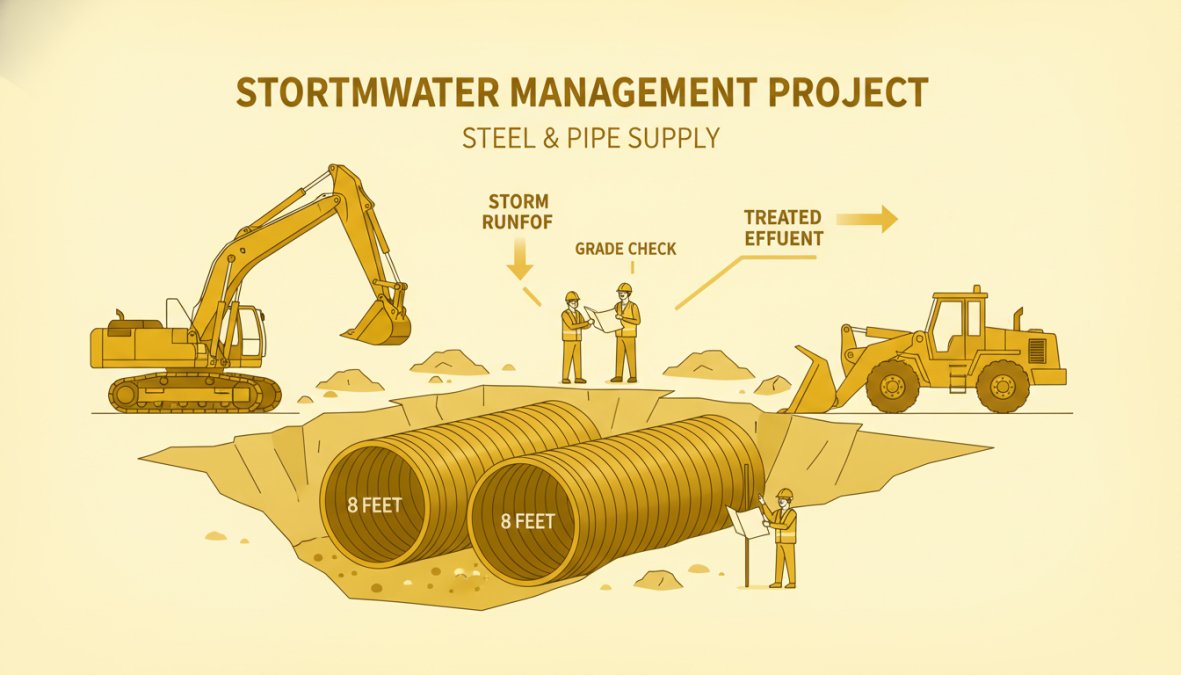
Stormwater detention systems increasingly use CSP to create underground storage capacity in constrained urban environments. The pipe’s strength allows installation at depths where concrete or plastic alternatives would fail.
Municipal and Industrial Wastewater Transport
Municipalities use steel pipe for gravity sewer systems, combined sewer overflows, and wastewater force mains. The material’s strength handles pressure demands of force mains where plastic pipes require thicker walls and concrete pipes become impractical. Industrial wastewater systems rely on polymer-coated steel pipes to resist aggressive chemicals that would degrade standard materials.
How to Get Started with Your Steel Pipe Supply
Start by documenting your project requirements: pipe diameter, length, material specification (galvanized vs. aluminized vs. polymer-coated), and delivery timeline. Share these specifications with 2-3 suppliers to compare pricing, lead times, and service capabilities.
Request samples or certifications confirming material quality. For large projects, specify third-party inspection during manufacturing. Confirm delivery logistics and unloading arrangements.
Steel & Pipe Supply offers free quotes on all steel pipe supply for drainage projects. Our team can review your engineer’s specifications, recommend cost-effective alternatives if appropriate, and lock in pricing for your project timeline. Call for a FREE quote and let us help you maximize value while ensuring your drainage infrastructure meets all performance requirements.
Choosing the right steel pipe supply for drainage projects determines whether your infrastructure performs reliably for decades or requires costly repairs within years. Steel pipes deliver the durability, hydraulic efficiency, and customization flexibility that modern drainage systems demand. Steel & Pipe Supply combines competitive pricing with deep expertise in regional soil conditions and project requirements, helping contractors and builders specify the right materials and lock in costs that protect project margins. Contact our team today for a free quote on your next drainage project.
Frequently Asked Questions
What types of steel pipes are most commonly used for drainage projects?
Corrugated steel pipe (CSP) is the industry standard for drainage, available in galvanized, aluminized, and polymer-coated variants. CSP comes in diameters from 6 inches to 144 inches and is manufactured to ASTM and AASHTO standards. Galvanized steel offers good corrosion resistance, while aluminized steel provides superior protection in aggressive environments. Polymer-coated options extend service life further. Your choice depends on soil conditions, water chemistry, and project budget.
How do I choose the right steel pipe supplier for drainage projects?
Evaluate suppliers on stock availability, lead times, quality certifications (ASTM, AASHTO compliance), and pricing transparency. Request references from past projects and confirm they can supply exact grades and wall thicknesses your engineers specify. Local suppliers often provide faster delivery and personalized service, while national suppliers offer broader inventory. Ask about pricing guarantees for large orders to avoid material cost spikes between bid and delivery.
What factors affect the cost of steel pipes for drainage?
Costs depend on pipe diameter, wall thickness, coating type, quantity, and delivery distance. Galvanized steel is typically less expensive than aluminized or polymer-coated options. Volume discounts apply to large orders. Market material costs fluctuate, so lock in pricing with your supplier before project commitment. Budget planning should account for fittings, accessories, and installation labor in addition to pipe material.
Are galvanized steel pipes suitable for all drainage applications?
Galvanized steel pipes work well for most standard drainage applications and offer reliable corrosion resistance. However, in highly acidic soils, saltwater environments, or aggressive chemical conditions, aluminized steel or polymer-coated options provide better long-term protection. Consult soil and water chemistry reports from your site, and work with your engineer and supplier to confirm the coating type meets your project's design service life requirements.
What's the typical lead time for steel pipe supply for drainage projects?
Standard inventory items typically ship within 1-2 weeks from local or regional suppliers. Custom fabrications, large diameter pipes, or specialized coatings may require 3-6 weeks or longer. Confirm lead times early in your project planning and negotiate delivery schedules with your supplier. Local suppliers often provide faster turnaround than national alternatives, reducing project delays and protecting your margin.