
Table of Contents
- Introduction to Steel Grades for Commercial Fabrication
- Steel Properties for Fabrication: What Every Fabricator Must Know
- Carbon Steel Grades for Fabrication: Strength, Cost, and Versatility
- Stainless Steel Grades for Fabrication: Corrosion Resistance and Aesthetics
- Alloy Steel Grades for Fabrication: High Performance and Durability
- Understanding ASTM Steel Grades and Classification Systems
- How to Choose the Right Steel Grade: Decision Framework
- Regulatory Compliance and Standards for Commercial Fabrication
- Post-Fabrication Finishing: Surface Preparation and Protection
- Sustainability and Recycled Steel Content in Commercial Fabrication
- Common Mistakes When Selecting Steel Grades for Fabrication
- Steel Grade Selection: Real-World Applications and Case Scenarios
- Comparison Table: Key Steel Grades for Commercial Fabrication
- Conclusion: Selecting the Best Steel Grades for Your Project
Last Updated: July 22, 2026
Introduction to Steel Grades for Commercial Fabrication
Selecting the right steel grade determines whether a project runs smoothly or fails under stress or corrosion. At Steel & Pipe Supply, we help fabricators and contractors across the Tampa Bay area navigate the complexity of choosing steel grades that match engineering requirements and budgets. Whether building structural frameworks, fabricating equipment for corrosive environments, or creating wear-resistant components, understanding steel properties and classifications is essential. This guide breaks down the most important steel grades used in commercial fabrication, explains how to evaluate them for specific projects, and shows how to make selection decisions that protect margins and deliver results.
The best steel grades depend on three factors: mechanical demands, environmental conditions, and fabrication methods. A structural beam in a dry warehouse requires completely different steel than a tank holding saltwater in a coastal facility. Understanding these distinctions separates experienced fabricators from those who encounter costly surprises mid-project.
Most fabricators spend more time managing material delays than optimizing material selection. Locking in your steel grade early and ordering from a supplier with consistent inventory turns a potential bottleneck into a competitive advantage.
Steel Properties for Fabrication: What Every Fabricator Must Know
Every steel grade exists because of its specific combination of properties. Before diving into individual grades, understand the properties that matter most in commercial fabrication and how they influence material choice.
Mechanical Properties and How They Impact Your Project
Mechanical properties define how steel behaves under stress, temperature, and deformation. The four most critical properties are tensile strength, yield strength, ductility, and hardness.
Tensile strength is the maximum stress a steel can withstand before breaking, measured in PSI or MPa. A steel with 50,000 PSI tensile strength will snap under less load than a steel with 100,000 PSI. For load-bearing applications like columns and beams, tensile strength is your baseline requirement.
Yield strength is the stress at which steel begins to permanently deform. This is often more important than tensile strength because engineers want steel to stay rigid under normal loads. A36 steel with 36,000 PSI yield strength suits most general structural work, but applications requiring minimal deflection need higher yield strength grades.
Ductility measures how much a steel can bend or stretch before breaking. High ductility allows welding without cracking, permits forming operations, and prevents brittle failure from impact or vibration.
Hardness is resistance to scratching, indentation, and wear. This matters most in applications where steel surfaces are abraded repeatedly, like bucket liners in mining equipment. Hard steels resist wear but sacrifice ductility.
The best steel for your application balances strength, ductility, and cost. Too much strength adds unnecessary expense; too little creates risk. The right grade is the minimum that meets your engineering requirements.
Chemical Composition and Alloying Elements
Steel is iron plus carbon, but the magic happens when you add other elements. Chemical composition determines mechanical properties, weldability, corrosion resistance, and machinability.
Carbon is the primary hardening element. More carbon means more hardness and strength, but less ductility and weldability. Low-carbon steels (under 0.30% carbon) are easy to weld and form but have modest strength. Medium-carbon steels (0.30-0.60% carbon) offer better strength with acceptable weldability.
Chromium is added for corrosion resistance. Stainless steels contain at least 10.5% chromium, which forms a passive oxide layer that prevents rust. More chromium improves corrosion resistance but increases cost.
Molybdenum and vanadium increase strength and toughness without sacrificing ductility. These elements are found in alloy steels for high-performance applications like automotive crankshafts and industrial machinery.
Manganese improves strength and hardenability while maintaining formability. It’s especially important in high-strength low-alloy (HSLA) steels.
Nickel increases toughness and corrosion resistance, especially at low temperatures. It’s a key component in many stainless steel grades.
Understanding these elements helps you predict how a steel will behave. A steel high in carbon and chromium will be hard and corrosion-resistant but difficult to weld. A steel with moderate carbon and added molybdenum will offer good strength and toughness with reasonable weldability.
Carbon Steel Grades for Fabrication: Strength, Cost, and Versatility
Carbon steels dominate commercial fabrication because they offer excellent value. They’re affordable, widely available, and suitable for most structural and mechanical applications. The trade-off is corrosion resistance; carbon steels rust in outdoor or wet environments unless protected with coatings or galvanizing.
ASTM A36: The Industry Standard for Structural Work
ASTM A36 is the workhorse of structural fabrication. It’s a low-carbon steel with 36,000 PSI yield strength and 58,000-80,000 PSI tensile strength. For warehouse frames, bridge components, and machinery support structures, ASTM A36 is almost certainly the right choice.
A36 dominates because it balances strength, cost, and fabricability perfectly for most applications. It welds easily without special procedures or post-weld heat treatment. It can be cut, drilled, punched, and shaped with standard equipment. It’s available in every conceivable shape from suppliers like Steel & Pipe Supply who stock it in multiple thicknesses and sizes.
The limitation of A36 is its modest strength. Applications demanding higher strength-to-weight ratio or longer spans need higher-strength grades. A36 also offers no corrosion protection, so outdoor applications require galvanizing or paint systems.
[Galvanizing A36 after fabrication](/pipe-tube/) adds cost and schedule time. If your project requires galvanizing, factor in the 2-4 week turnaround. Communicate with your steel supplier early about coating requirements.
A500 Structural Tubing: High-Strength Shapes
ASTM A500 is cold-formed welded and seamless carbon steel tubing available in round, square, and rectangular shapes. It comes in multiple grades (A, B, C, D) with increasing yield strength, from 39,000 PSI (Grade A) to 70,000 PSI (Grade D). Most commercial fabrication uses Grade B (50,000 PSI) or Grade C (65,000 PSI).
The advantage of A500 over A36 plate and beam shapes is structural efficiency. Tubing distributes material around a perimeter, creating higher moment of inertia with less total weight. For columns, frames, and truss members, A500 tubing delivers superior strength-to-weight ratio. This translates to lighter structures, smaller foundations, and reduced material cost.
A500 Grade B is particularly popular for general structural fabrication, offering 50% higher yield strength than A36 while remaining highly weldable. Grade C (65,000 PSI) pushes strength further but requires more careful welding procedures.
The trade-off is that you’re locked into standard sizes and wall thicknesses. If your design requires a specific cross-sectional area that doesn’t align with available tube dimensions, you may need to compromise on design or special-order custom tubing at significant cost and schedule delay.
HSLA Steel: Lightweight Strength Solutions
High-strength low-alloy (HSLA) steel achieves yield strengths ranging from 50,000 to 100,000 PSI through careful alloying and heat treatment, without the high carbon content that makes steel brittle and hard to weld.
The appeal of HSLA is the strength-to-weight advantage. A structure built from HSLA Grade 70 can use smaller cross-sections than A36, reducing total steel tonnage by 20-30%. For applications where weight matters, cranes, trailers, bridges with tight span requirements, this savings compounds into significant cost reductions in material, fabrication labor, and foundation design.
HSLA steels are also more formable than higher-carbon steels. They can be bent, shaped, and formed with less springback and lower risk of cracking.
The downside is availability and cost. HSLA grades are less commonly stocked than A36 or A500, so lead times can stretch beyond standard inventory. Pricing is higher per pound because of alloy content and controlled heat treatment. For most general structural work, A36 or A500 will deliver better value; HSLA makes sense only when weight savings justify the higher material cost.
Stainless Steel Grades for Fabrication: Corrosion Resistance and Aesthetics
When your project faces moisture, chemicals, or salt spray, carbon steel fails. Stainless steel, iron alloyed with chromium and nickel, resists corrosion because chromium forms a self-healing passive oxide layer on the surface. This layer protects the underlying steel even if scratched, as long as oxygen is present to regenerate it.
Stainless steel costs 3-5 times more than carbon steel, so you use it only when corrosion resistance is essential. The payoff is dramatically extended service life, reduced maintenance, and often superior aesthetics.
304 Stainless: Versatile and Food-Safe
304 stainless is the most widely used stainless grade in commercial fabrication. It contains 18% chromium and 8% nickel, creating an austenitic structure that is non-magnetic, highly ductile, and exceptionally corrosion-resistant in most environments.
304 stainless is the default choice for food processing equipment, kitchenware, chemical containers, architectural trim, and coastal applications where salt spray is a threat. It resists corrosion from food acids, mild chemicals, and atmospheric moisture. It’s easy to clean and maintain, critical in food service and pharmaceutical applications.
The weldability of 304 is excellent. It can be welded using standard MIG, TIG, or stick processes without special procedures. Post-weld annealing is not required, which simplifies fabrication and reduces cost.
The limitation of 304 is its performance in chloride-rich environments. Saltwater, de-icing salts, and high-chloride chemicals can cause pitting corrosion in 304, especially if the surface is scratched. For truly harsh marine environments or chemical plants handling aggressive chlorides, 316 stainless is the better choice.
304 stainless is the right choice for 90% of corrosion-resistance applications. It’s cost-effective, readily available, and performs reliably in typical atmospheric and food-service environments. Upgrade to 316 only if your specific environment demands it.
316 Stainless: Marine and Corrosive Environments
316 stainless adds 2-3% molybdenum to the 304 base chemistry, creating superior resistance to pitting and crevice corrosion. This makes 316 the standard choice for marine applications, chemical processing, and any environment where chlorides or other aggressive chemicals are present.
316 stainless is commonly specified for offshore platforms, desalination equipment, chemical storage tanks, and coastal architectural applications. The molybdenum addition provides protection that 304 cannot match in harsh environments.
The cost premium for 316 over 304 is significant, typically 20-30% higher material cost. For most inland applications, this premium is not justified. But in marine environments or chemical plants, the extended service life and reduced maintenance of 316 quickly justify the higher initial material cost.
316 welding characteristics are similar to 304, with good ductility and straightforward welding procedures. Machinability is slightly lower than 304 due to molybdenum content, but this is rarely a limiting factor in fabrication.
Alloy Steel Grades for Fabrication: High Performance and Durability
When carbon and stainless steels don’t deliver required performance, alloy steels step in. These materials have carefully controlled additions of chromium, molybdenum, vanadium, and sometimes nickel to achieve specific mechanical properties. Alloy steels are more expensive than carbon steels but deliver superior strength, toughness, and fatigue resistance for demanding applications.
4140 Alloy Steel: Toughness and Fatigue Resistance
4140 is a medium-carbon alloy steel (0.38-0.43% carbon) with chromium (0.80-1.10%) and molybdenum (0.15-0.25%). This combination creates a steel that is exceptionally tough, resists fatigue, and maintains strength at elevated temperatures. 4140 is the workhorse alloy steel for automotive and industrial applications.
In its annealed condition, 4140 is highly ductile and can be welded, formed, and machined with standard equipment. After heat treatment (quenching and tempering), 4140 achieves yield strengths of 100,000-200,000 PSI depending on the tempering temperature. This combination of toughness and strength is why 4140 dominates applications like crankshafts, axle shafts, gears, spindles, and tool holders.
The challenge with 4140 is that welding after heat treatment requires post-weld heat treatment to restore mechanical properties. If you weld a hardened 4140 component without re-heat-treating, the weld area will be soft and weak compared to the base material.
4140 is also tougher to machine than carbon steels. Feeds and speeds must be conservative, and tool life is shorter.
If your 4140 fabrication involves welding, plan for post-weld heat treatment. Skipping this step creates a stress concentration at the weld that can fail under fatigue loading. Communicate heat treatment requirements to your steel supplier and fabricator before work begins.
AR400 Abrasion-Resistant Steel: Extreme Wear Protection
AR400 (abrasion-resistant 400) is a specialized high-carbon alloy steel with surface hardness of 360-440 BHN (Brinell hardness number). It’s designed specifically for applications involving severe abrasion and impact, such as bucket liners in mining equipment, dump truck liners, and cutting edges on earthmoving machinery.
The appeal of AR400 is straightforward: it resists wear far better than carbon or standard alloy steels. Equipment lined with AR400 maintains sharp edges and smooth surfaces much longer than equipment made from softer materials. In mining or aggregate processing, this translates to extended service life and reduced downtime for replacement.
AR400 combines surface hardness with through-body ductility, resisting impact and sudden loading better than some other wear-resistant steels.
The limitations are significant. AR400 is difficult to machine and form. It requires specialized equipment and experienced fabricators. Welding AR400 is challenging because heat softens the hardened steel in the heat-affected zone, creating a weak area at the weld. Post-weld heat treatment is often necessary to restore hardness.
AR400 is also expensive, typically 2-3 times the cost of A36 carbon steel. You use it only when wear resistance justifies the cost premium, which is true for high-wear mining and earthmoving applications but not for general structural work.
Understanding ASTM Steel Grades and Classification Systems
Steel grades are standardized through classification systems that specify chemical composition, mechanical properties, and testing requirements. Understanding these systems helps you communicate precisely with suppliers and ensures you’re getting the material your design requires.
ASTM vs. SAE vs. AISI: Decoding Steel Standards
ASTM (American Society for Testing and Materials) standards define steel grades by mechanical properties and chemical composition limits. ASTM standards are the most commonly used in commercial fabrication in North America. Examples include ASTM A36 (structural carbon steel), ASTM A500 (structural tubing), and ASTM A992 (high-strength structural steel). When you specify "ASTM A36," you’re defining a material that meets specific mechanical and chemical requirements regardless of the mill that produces it.
SAE (Society of Automotive Engineers) grades are primarily used for alloy steels and tool steels. SAE grades use a four-digit numbering system where the first two digits indicate the alloy type and the last two digits indicate carbon content. For example, SAE 4140 is a chromium-molybdenum alloy steel with approximately 0.40% carbon. SAE grades are less commonly specified in general fabrication but dominate automotive and precision machining applications.
AISI (American Iron and Steel Institute) grades are similar to SAE grades and are often used interchangeably. AISI 304 stainless and AISI 316 stainless are common examples.
For commercial fabrication, ASTM standards are your primary reference. Always include the ASTM designation (e.g., "ASTM A36" not just "A36") to avoid ambiguity. Steel & Pipe Supply stocks materials to ASTM specifications and can provide mill certificates verifying that delivered material meets specification.
How to Read a Steel Grade Designation
A steel grade designation contains specific information. Breaking it down:
- ASTM A36: ASTM is the standards organization, A indicates a carbon steel, and 36 refers to the minimum yield strength (36,000 PSI).
- ASTM A500 Grade B: A500 is structural tubing, and Grade B specifies a yield strength of 50,000 PSI.
- SAE 4140: The "41" indicates chromium-molybdenum alloy steel, and "40" indicates approximately 0.40% carbon content.
- AISI 304: 304 is the stainless steel grade designation; the 3 series indicates austenitic stainless steel.
When reading a grade designation, pay attention to the grade modifier (like "Grade B" in A500 Grade B). The same base specification can have multiple grades with different mechanical properties. Specifying the wrong grade can result in material that doesn’t meet your strength requirements.
How to Choose the Right Steel Grade: Decision Framework
Selecting the best steel grade for commercial fabrication requires evaluating your application against four key criteria.
Step 1: Define Your Load Requirements and Stress Profile
Start by quantifying the loads and stresses your structure will experience. Will it carry static loads (like a beam supporting a fixed weight) or dynamic loads (like a crane hook that cycles repeatedly)? Will it experience impact loads or vibration?
Static loads require sufficient yield strength to prevent permanent deformation. If your design analysis shows maximum stress of 20,000 PSI, a steel with 36,000 PSI yield strength (A36) provides a safety factor of 1.8, which is acceptable for most applications. If maximum stress reaches 30,000 PSI, you’re cutting it close with A36; moving to A500 Grade B (50,000 PSI yield) gives you more safety margin.
Dynamic loads and fatigue are more demanding. A steel with adequate static strength may still fail under cyclic loading if the stress range is high and the number of cycles is large. For applications involving vibration, impact, or repeated loading, higher-strength steels with superior toughness (like 4140 alloy steel) are often justified.
Ductility becomes critical in high-stress applications. A ductile steel will deform visibly before failure, giving you advance warning. For structural applications where safety is paramount, ductility is as important as strength.
Calculate your maximum design stress and select a steel with yield strength at least 1.5 times higher. This provides safety margin for uncertainties in loading and material properties. For dynamic or fatigue-critical applications, increase this margin to 2.0 or higher.
Step 2: Assess Environmental Conditions and Corrosion Risk
Will your steel be exposed to moisture, chemicals, salt spray, or temperature extremes? Environmental conditions often dictate material selection more strongly than load requirements.
Carbon steels (A36, A500) rust rapidly in outdoor environments unless protected with paint or galvanizing. If your project is indoors and stays dry, carbon steel is fine. If it’s outdoors or exposed to moisture, corrosion protection is essential. Galvanizing provides 20-50 years of protection depending on environment. Paint systems require maintenance and touch-up over time.
Stainless steel (304 or 316) eliminates corrosion concerns. 304 is suitable for most atmospheric environments and food service applications. 316 is necessary for marine environments, chemical plants, or high-chloride exposures. The cost premium for stainless is justified when maintenance costs and replacement frequency are factored in.
Temperature extremes also influence material selection. Carbon steels become brittle at very low temperatures, while some stainless steels maintain ductility. For most commercial applications, temperature is not a limiting factor, but always verify if your application involves extreme hot or cold.
Step 3: Evaluate Fabrication Methods and Weldability
How will you fabricate your component? Will it be welded, bolted, riveted, or fastened? Weldability is critical because welding introduces heat that can affect material properties.
Carbon steels like A36 and A500 Grade B are highly weldable. They can be welded using standard MIG, TIG, or stick processes without special procedures or post-weld heat treatment.
Stainless steels (304, 316) are also highly weldable, though they require slightly different procedures than carbon steels. Stainless welding is well-established and not significantly more difficult than carbon steel welding.
Alloy steels like 4140 are where weldability becomes challenging. In the annealed condition, 4140 welds reasonably well, but if the steel has been hardened (heat-treated), welding softens the heat-affected zone and requires post-weld heat treatment to restore properties. This adds cost and complexity.
If your fabrication involves extensive welding and you don’t have post-weld heat treatment capability, stick with carbon or stainless steels. If your design requires alloy steel properties but involves welding, plan for post-weld heat treatment and budget accordingly.
Step 4: Factor in Cost and Supply Chain Availability
Material cost is real, but it’s only one component of total project cost. A slightly more expensive material that’s readily available and easy to fabricate can cost less overall than a cheaper material with long lead times and fabrication challenges.
ASTM A36 is the cheapest structural steel. A500 tubing costs slightly more per pound but delivers higher strength, potentially reducing overall tonnage. HSLA steels cost more but enable weight savings. Stainless steels cost 3-5 times more than carbon steels. Alloy steels like 4140 are expensive and require specialized handling.
Beyond material cost, consider availability. A36 and A500 are stocked by most suppliers, including Steel & Pipe Supply. If you order today, you can typically receive material within days. HSLA grades may require 1-2 weeks lead time. Specialized alloy steels or stainless grades in non-standard sizes can take 3-4 weeks or longer.
Supply chain disruptions can destroy project margins. A 4-week delay in material delivery can force you to pay overtime labor to catch up on schedule, or worse, miss a customer deadline. For critical projects, always verify material availability and lead time before committing to a design. Steel & Pipe Supply maintains broad inventory of A36, A500, and common stainless grades to minimize lead time risk.
| Decision Factor | Carbon Steel (A36) | Stainless Steel (304) | Alloy Steel (4140) |
|---|---|---|---|
| Yield Strength | 36,000 PSI | 30,000 PSI | 100,000+ PSI (heat-treated) |
| Corrosion Resistance | Poor (requires coating) | Excellent | Moderate (requires coating) |
| Weldability | Excellent | Excellent | Good (annealed); requires post-weld heat treatment if hardened |
| Machinability | Excellent | Good | Fair to poor |
| Cost | $ | $$$-$$$$ | $$-$$$ |
| Availability | Immediate | 1-2 weeks | 2-4 weeks |
| Best For | General structural, indoor use | Food service, marine, corrosive environments | High-performance automotive, machinery |
Regulatory Compliance and Standards for Commercial Fabrication
Commercial fabrication projects are often subject to regulatory requirements that mandate specific steel grades and testing. Building codes, pressure vessel codes, and industry-specific standards all influence material selection.
Building codes (like the International Building Code) specify minimum structural steel grades for different applications. Most codes accept ASTM A36 or higher-strength grades like ASTM A992. Pressure vessel fabrication is governed by ASME (American Society of Mechanical Engineers) codes that specify allowable stresses and material grades for different pressure ratings and temperatures.
When your project is subject to regulatory requirements, verify the applicable standard before finalizing material selection. Specifying the wrong grade can result in design rejection, costly rework, or inspection failure. Steel & Pipe Supply can provide mill certificates for all materials, documenting compliance with specified standards.
Post-Fabrication Finishing: Surface Preparation and Protection
Raw steel, even stainless steel, requires finishing to achieve desired appearance and corrosion protection. Post-fabrication finishing is often overlooked during material selection but has major implications for project cost and longevity.
Galvanizing and Coating Options
Galvanizing is the most common protective coating for carbon steel. Hot-dip galvanizing immerses fabricated steel in molten zinc, creating a metallurgical bond between zinc and steel. The zinc coating protects steel through two mechanisms: it physically blocks moisture and oxygen from reaching the steel surface, and it corrodes preferentially to steel (sacrificial protection), so even if the zinc coating is scratched, the exposed steel is protected.
Hot-dip galvanizing provides 20-50 years of protection in most environments. In harsh marine environments, protection lasts 10-20 years. The cost is moderate, typically $0.50-$1.50 per pound of steel, depending on thickness and complexity. The schedule impact is significant: galvanizing requires 2-4 weeks turnaround after fabrication.
Paint systems are an alternative to galvanizing. A properly applied paint system (typically 3-4 coats) provides 5-15 years of protection. Paint is cheaper upfront than galvanizing but requires maintenance touch-up over time. For indoor applications or short-term projects, paint may be more cost-effective than galvanizing.
Stainless steel requires minimal finishing. The passive oxide layer provides inherent corrosion protection. For aesthetic applications, stainless can be polished or brushed to achieve specific finishes.
Quality Verification and Inspection
Before accepting delivered material, verify that it meets specification. Request mill test reports documenting chemical composition and mechanical properties. Inspect material for obvious defects, cracks, severe corrosion, dimensional errors.
For critical applications, consider third-party material testing. Tensile testing, hardness testing, or chemical analysis can verify that delivered material matches specification. This is especially important for alloy steels and stainless grades where material properties are less familiar.
Steel & Pipe Supply provides material certification for all delivered products, documenting compliance with ASTM or other specified standards. For projects requiring certified material, communicate this requirement upfront so appropriate documentation is prepared.
Sustainability and Recycled Steel Content in Commercial Fabrication
Modern steel production incorporates significant recycled content. Electric arc furnace (EAF) steel, which uses scrap steel as the primary feedstock, now represents roughly half of U.S. steel production. Many commercial fabrication projects specify recycled content requirements as part of sustainability initiatives.
Recycled steel is mechanically identical to virgin steel of the same grade. ASTM A36 made from scrap performs identically to ASTM A36 made from iron ore. The primary advantage is reduced environmental impact: EAF production uses roughly 75% less energy than blast furnace production and generates lower CO2 emissions.
If your project has sustainability requirements, specify recycled content in your material purchase order. Steel & Pipe Supply can source materials with documented recycled content and provide certification. The cost premium for recycled content is minimal or nonexistent, making it an easy sustainability win for most projects.
Common Mistakes When Selecting Steel Grades for Fabrication
Fabricators and engineers make predictable mistakes when selecting steel grades. Avoiding these errors will improve project outcomes and protect margins.
Mistake 1: Selecting material based on price alone. The cheapest material upfront is rarely the cheapest overall. A36 costs less per pound than A500, but if A500 enables you to use smaller cross-sections and reduce total tonnage, A500 may be cheaper in total cost. Stainless steel costs more initially but eliminates coating and maintenance costs over the structure’s lifetime.
Mistake 2: Assuming all suppliers have identical lead times. Some suppliers stock A36 and A500 extensively; others special-order most grades. A 4-week delay in material delivery can destroy project margins. Verify supplier inventory and lead times before committing to a design. Steel & Pipe Supply maintains broad inventory specifically to minimize lead time risk.
Mistake 3: Overlooking weldability requirements. Specifying 4140 alloy steel for a heavily welded structure without planning for post-weld heat treatment creates risk of weld failure. If your fabrication involves extensive welding, verify that the selected grade can be welded with your available equipment and processes.
Mistake 4: Forgetting coating and finishing in the budget. Galvanizing, painting, or other finishing adds 15-30% to total project cost and 2-4 weeks to schedule. If your design includes carbon steel in an outdoor environment, budget for galvanizing or paint from the start.
Mistake 5: Selecting stainless steel without considering the specific grade. 304 stainless is fine for most applications, but marine environments demand 316. Specifying the wrong grade results in corrosion failure and costly replacement.
The most expensive mistake is material selection that forces expensive rework or replacement after fabrication. Invest time upfront in material selection and supplier verification. Communicate with your supplier about lead times, availability, and finishing requirements before work begins.
Steel Grade Selection: Real-World Applications and Case Scenarios
Understanding best steel grades for commercial fabrication is abstract until you apply it to real projects. Here are three scenarios showing how the decision framework works in practice.
Scenario 1: Warehouse Structural Frame
A contractor is designing a 50,000-square-foot warehouse in inland Florida. The structure will carry roof loads and occasional storage loads. The building will be indoors or covered, with no significant moisture exposure.
Decision analysis: Static loads and moderate stress mean ASTM A36 (36,000 PSI yield) provides adequate safety margin. The dry indoor environment means corrosion is not a concern and no coating is required. A36 is highly weldable with standard equipment. A36 is the cheapest option and immediately available from Steel & Pipe Supply.
Selection: ASTM A36 is the right choice. It meets all requirements at lowest cost with minimal lead time.
Scenario 2: Coastal Chemical Storage Tank
A chemical processor needs a storage tank for mild acidic chemicals in a coastal environment. The tank must resist corrosion from both the chemical contents and salt spray from the ocean.
Decision analysis: Tank walls experience hydrostatic pressure requiring 30,000+ PSI yield strength. Carbon steel will rust rapidly and fail. Stainless steel is essential. Tank fabrication involves extensive welding, and 304 stainless welds easily. 304 stainless costs 3-4 times more than carbon steel but eliminates coating and maintenance costs. Lead time is 1-2 weeks.
Selection: AISI 304 Stainless Steel is required. The corrosion resistance justifies the cost premium, and the excellent weldability makes fabrication straightforward.
Scenario 3: High-Performance Automotive Suspension Component
An automotive supplier is fabricating a suspension component that experiences cyclic loading (vibration and impact) and must achieve 100,000+ PSI yield strength in the final hardened condition.
Decision analysis: Dynamic cyclic loading with high stress requires fatigue resistance and 100,000+ PSI yield strength. A36 or A500 are inadequate. Alloy steel is expensive and requires 2-4 week lead time. If welding is required, post-weld heat treatment is necessary.
Selection: SAE 4140 Alloy Steel in annealed condition for fabrication, followed by heat treatment (quenching and tempering) to achieve final properties. The superior fatigue resistance and toughness of 4140 justify the cost and complexity.
Comparison Table: Key Steel Grades for Commercial Fabrication
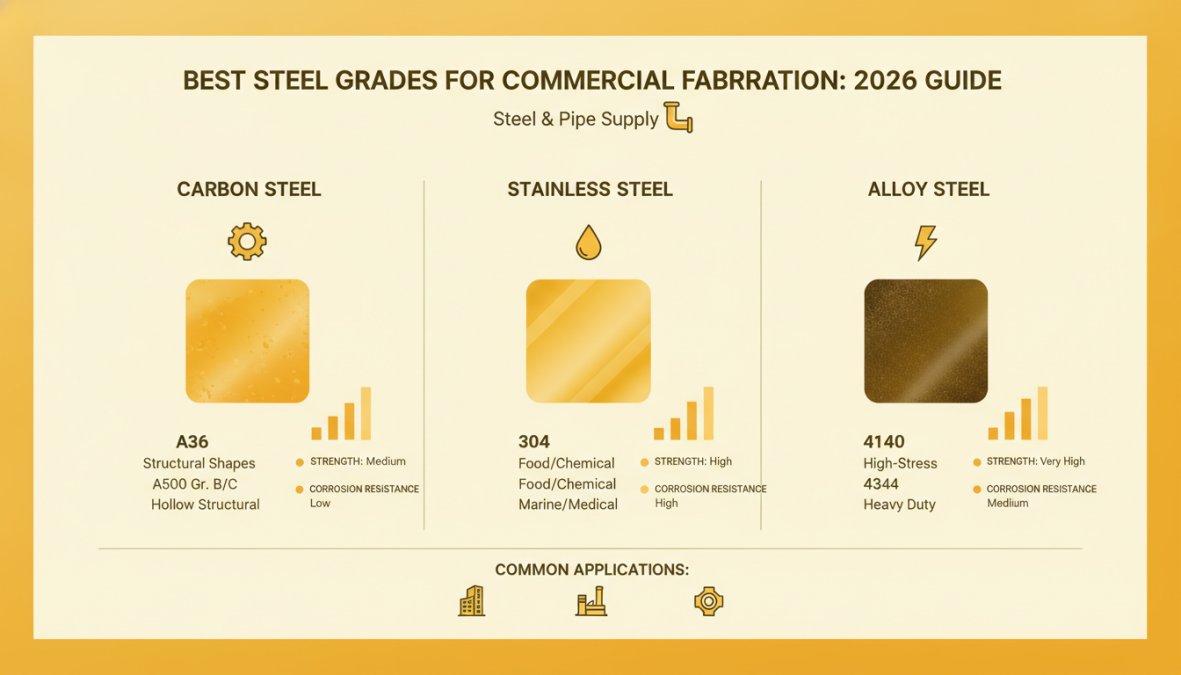
| Grade | Type | Yield Strength | Tensile Strength | Corrosion Resistance | Weldability | Best For | Relative Cost |
|---|---|---|---|---|---|---|---|
| ASTM A36 | Carbon | 36,000 PSI | 58,000-80,000 PSI | Poor (requires coating) | Excellent | General structural, beams, frames | $ |
| ASTM A500 Grade B | Carbon Tubing | 50,000 PSI | 65,000 PSI | Poor (requires coating) | Excellent | Structural tubing, columns, trusses | $ |
| HSLA Grade 70 | Low-Alloy | 70,000 PSI | 85,000 PSI | Poor (requires coating) | Good | Weight-critical structures, cranes | $$ |
| AISI 304 | Stainless | 30,000 PSI | 70,000 PSI | Excellent | Excellent | Food service, marine, architectural | $$$$ |
| AISI 316 | Stainless | 30,000 PSI | 70,000 PSI | Excellent (superior to 304) | Excellent | Harsh marine, chemical plants | $$$$ |
| SAE 4140 | Alloy | 100,000+ PSI (heat-treated) | 150,000+ PSI (heat-treated) | Moderate (requires coating) | Good (annealed); requires post-weld HT if hardened | Automotive, machinery, high-performance | $$$ |
| AR400 | Abrasion-Resistant | 50,000 PSI (yield); 360-440 BHN (hardness) | 100,000+ PSI | Poor (requires coating) | Difficult | Mining equipment, wear-resistant liners | $$$ |
Conclusion: Selecting the Best Steel Grades for Your Project
Choosing the best steel grades for commercial fabrication requires balancing strength, corrosion resistance, fabrication capability, cost, and supply chain availability. The material you select determines whether your project succeeds on schedule and budget, or encounters costly delays and failures.
The framework in this guide, defining load requirements, assessing environment, evaluating fabrication methods, and factoring in cost, will guide you through the decision process systematically. For most commercial fabrication work, ASTM A36 or A500 will be the right choice, offering excellent value and immediate availability. When corrosion resistance is essential, stainless steel (304 for typical applications, 316 for marine) delivers reliable long-term performance. For high-performance applications requiring superior strength or wear resistance, alloy steels justify their higher cost and complexity.
Steel & Pipe Supply specializes in supporting commercial fabrication projects across the Tampa Bay area with competitive pricing on A36, A500, stainless grades, and specialty alloys. Our team understands the material selection challenges fabricators face, supply chain disruptions, lead time pressure, and the need to balance cost with performance. We maintain broad inventory of the most commonly specified grades to ensure you get material when you need it, and we provide material certification and mill test reports for projects requiring regulatory compliance.
Get started with Steel & Pipe Supply today. Call for a FREE Quote and let our team help you select the right steel grade and secure competitive pricing on your next commercial fabrication project.
Key Takeaways for Steel Grade Selection:
- ASTM A36 is the industry standard for general structural work, affordable, widely available, and highly weldable
- ASTM A500 tubing delivers superior strength-to-weight ratio for columns and frames
- Stainless steel (304 or 316) is essential for corrosion-resistant applications, despite higher cost
- Alloy steels like 4140 are justified for high-performance, fatigue-critical applications
- Always verify material availability and lead time before finalizing your design
- Plan for post-fabrication finishing (galvanizing, paint, or coating) in your budget and schedule
- Communicate with your supplier about regulatory requirements and material certification needs
Frequently Asked Questions
What are the most common steel grades used in commercial fabrication?
The most widely used steel grades for commercial fabrication include ASTM A36 (carbon steel for general structural work), A500 tubing (for columns and frames), 304 stainless steel (for corrosion-resistant applications), and 4140 alloy steel (for high-strength, wear-resistant components). Selection depends on your project's load requirements, environmental exposure, and budget. Each grade offers distinct mechanical properties, A36 excels in weldability and cost, while 304 stainless provides superior corrosion resistance.
How do I choose the right steel grade for my specific fabrication project?
Start by identifying your project's key demands: tensile strength requirements, corrosion exposure, fabrication methods (welding, forming, machining), and budget constraints. Consult your engineering specifications and ASTM standards. Consider weldability and formability, carbon steels like A36 are easier to work with than harder alloys. For outdoor or corrosive environments, stainless steel or galvanized options provide better longevity. Request a free quote from your supplier to compare pricing and availability for your top grade choices.
What's the difference between carbon steel, stainless steel, and alloy steel for fabrication?
Carbon steel (like A36) contains primarily iron and carbon, offering good weldability and affordability but limited corrosion resistance. Stainless steel (304, 316) includes chromium and nickel, providing excellent corrosion resistance and aesthetic appeal, ideal for food processing and marine environments. Alloy steel (4140, AR400) contains added elements like molybdenum and chromium, delivering high strength, toughness, and wear resistance for demanding applications. Choose based on your environment and performance needs.
Are there steel grades specifically recommended for welding in commercial fabrication?
Yes. ASTM A36 carbon steel and 304 stainless steel are among the most weldable grades for commercial work. A36 requires minimal pre-heating and post-weld heat treatment. 304 austenitic stainless offers excellent weldability without brittleness. Avoid welding 4140 alloy steel in the hardened state, it requires post-weld heat treatment to restore toughness. Always verify weldability in your grade's ASTM specification, and consider the thermal conductivity and yield strength to prevent distortion and cracking.
How do ASTM steel grades relate to SAE and AISI classification systems?
ASTM, SAE, and AISI are different standardization systems. ASTM (American Society for Testing and Materials) defines steel by mechanical properties and intended use, common in structural and fabrication work. SAE (Society of Automotive Engineers) and AISI (American Iron and Steel Institute) focus on chemical composition, often used for automotive and tool steels. For commercial fabrication, ASTM grades (A36, A500, 304) are most relevant. Always reference the appropriate standard in your engineering specifications to ensure correct material selection.
What role does supply chain availability play in selecting steel grades for fabrication?
Supply chain availability directly impacts project timelines and costs. Common grades like A36 and 304 stainless are widely stocked and have predictable lead times. Specialty grades or unusual sizes may require custom orders with longer delays. Before finalizing your steel grade selection, confirm availability with your supplier, unexpected delays can derail project schedules and margins. Local suppliers often maintain broader inventory of standard grades, reducing lead times and enabling faster project starts.
What finishing options are available after fabrication, and how do they affect steel grade selection?
Common post-fabrication finishes include galvanizing (hot-dipped or electro for corrosion protection), painting, powder coating, and passivation (for stainless steel). Galvanizing works well on carbon steel for outdoor use but requires careful handling during welding. Stainless steel benefits from passivation to enhance corrosion resistance. Your chosen finish should complement your steel grade's properties. For example, galvanized A36 extends lifespan in non-marine environments, while passivated 304 stainless maximizes corrosion resistance in food-processing applications.
[EXTERNAL_LINK: ASTM International Standards for Steel Specifications | astm.org]
[EXTERNAL_LINK: American Iron and Steel Institute Guide to Steel Grades | steel.org]
[EXTERNAL_LINK: ASME Boiler and Pressure Vessel Code Requirements | asme.org]