
Table of Contents
- Why Steel Pipe Bollards Fail Prematurely: The Root Causes
- Corrosion and Environmental Factors: The Silent Threat
- Premature Failure Due to Improper Anchoring
- Bollard Installation Best Practices to Prevent Failure
- Impact Resistance and Mechanical Failure
- Bollard Corrosion Prevention Strategies
- Bollard Maintenance Tips and Inspection Protocols
- Common Mistakes That Accelerate Bollard Failure
- Protecting Your Investment: A Practical Action Plan
- Conclusion
Last Updated: July 23, 2026
Understanding why steel pipe bollards fail prematurely is essential for anyone responsible for protective infrastructure. Premature bollard failures usually trace back to material selection, foundation design, drainage, corrosion protection, installation quality or impact conditions. Most failures aren’t random, they result from specific, preventable mistakes during installation, maintenance, or design. A failed bollard loses its ability to stop vehicle collisions and forklift impacts, creating serious liability risks.
The failure mechanisms differ dramatically depending on whether you’re dealing with corrosion, improper anchoring, mechanical stress, or environmental exposure. This guide covers the seven critical causes that account for the vast majority of premature bollard degradation.
Understanding Structural Integrity and Failure Mechanisms
Structural failure in steel pipe bollards occurs when the material can no longer withstand applied stresses. A bollard’s structural integrity depends on three interconnected factors: the steel’s tensile strength, the quality of the anchoring system, and the bollard’s resistance to corrosion.
Most premature failures involve a combination of these factors. A bollard might have adequate initial tensile strength but fail early due to corrosion that eats through the pipe wall. Another might have excellent surface protection but collapse after a single heavy impact because the concrete footing was installed at insufficient depth.
A common misconception is that a bollard “just fails” without warning. In reality, degradation is measurable and predictable. Surface gaps between the bollard and concrete, rust staining below the ground line, and deformation after minor impacts are all early warning signs that structural failure is imminent.
Corrosion and Environmental Factors: The Silent Threat
Corrosion is the single largest cause of premature bollard failure. Steel naturally oxidizes when exposed to moisture and oxygen. Without proper protection, this process accelerates dramatically, consuming the pipe wall from the outside in. A bollard that loses 30% of its wall thickness due to rust loses far more than 30% of its load-bearing capacity, the relationship is exponential.
Environmental factors amplify corrosion rates. Temperature cycling causes the steel to expand and contract, opening microscopic gaps where moisture penetrates. Road salt in winter climates, coastal saltwater spray, and industrial chemical exposure all accelerate oxidation. The most dangerous corrosion occurs at the sub-surface level, where the bollard meets the concrete footing, this zone is often wet, poorly drained, and invisible during routine inspections.
Saltwater Corrosion in Coastal Regions
Coastal environments present an extreme corrosion challenge. Saltwater spray contains chloride ions that penetrate protective coatings and accelerate the electrochemical corrosion process. A bollard in a coastal parking lot experiences corrosion rates three to five times faster than an identical bollard inland.
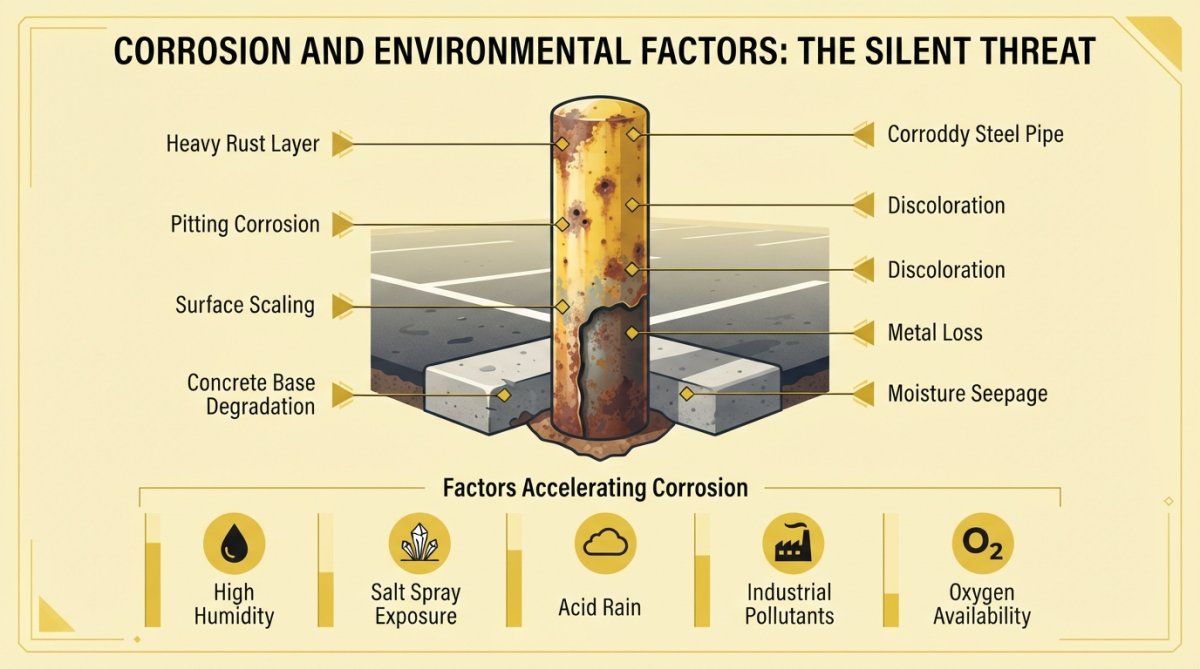
During freeze-thaw cycles, water trapped in surface cracks freezes and expands, further compromising protective coatings. Salt deposits accumulate in these cracks, creating localized corrosion cells that eat through the steel rapidly. A bollard installed in a coastal region without premium protection can lose structural integrity within 3-5 years.
Proper protection in coastal areas requires more than standard galvanization. Hot-dip galvanizing provides a zinc barrier, but powder coating adds an extra layer of defense by sealing the zinc surface and preventing moisture penetration. The combination of galvanization plus powder coating extends coastal bollard life significantly compared to either protection method alone.
Galvanization and Powder Coating Failures
Galvanization works by creating a zinc barrier between the steel and the environment. When applied correctly, hot-dip galvanization provides decades of protection. However, galvanization fails when the coating is damaged, improperly applied, or exposed to corrosive environments that exceed its capacity.
Powder coating adds aesthetic appeal and additional protection, but it only works if applied over a properly prepared surface. If the underlying galvanization is compromised, or if the powder coat is applied too thin, moisture will penetrate to the steel underneath. A critical mistake is relying on powder coating alone without galvanization underneath, this creates a single point of failure.
When specifying bollard protection, always require hot-dip galvanizing as the base layer, with powder coating as an additional protective layer in coastal or high-corrosion environments. Inspect the surface for coating damage during installation and after any impact event. Small breaches can be sealed with touch-up paint, preventing rust from spreading.
Premature Failure Due to Improper Anchoring
Installation quality determines whether a bollard will survive its first impact or fail prematurely under normal loads. Improper anchoring is the second-leading cause of bollard failure, and it’s entirely preventable.
A bollard’s anchoring system must transfer impact loads safely into the ground and prevent lateral movement or rotation that could compromise its protective function. When anchoring is inadequate, the bollard can shift, tilt, or pull free from its foundation under stress.
Concrete Footing vs. Steel Pipe: Where Failure Begins
The failure of the concrete footing often precedes the failure of the steel pipe itself. Many installers focus entirely on the bollard’s material while treating the concrete footing as an afterthought. This is backwards, the footing is often the weak link.
A properly designed bollard footing must extend deep enough to resist overturning forces. Shallow footings, those less than 24 inches deep, are vulnerable to failure because they don’t provide sufficient lateral resistance. When a vehicle strikes the bollard, the impact force tries to rotate the entire assembly. A shallow footing lacks the mechanical advantage to resist this rotation.
The concrete itself must be of adequate strength (3,000+ PSI) and properly reinforced. Low-strength concrete cannot safely anchor a bollard designed to resist vehicle impacts. The interface between the steel pipe and the concrete footing is where corrosion often begins. If this joint is not sealed properly, water collects at the sub-surface level, creating a corrosion cell that progressively weakens the anchor connection.
Bollard Installation Best Practices to Prevent Failure
Installation is where most bollard failures originate. A bollard installed correctly will outlast one made from superior materials but installed poorly.
Installation Depth and Sub-Surface Anchoring
Installation depth is non-negotiable. For a standard 4-inch diameter bollard designed to resist vehicle impacts, the minimum installation depth is 24 inches. For bollards in high-impact zones or those designed for heavier loads, 30-36 inches is more appropriate.
Shallow installations are tempting because they cost less and finish faster, but they fail predictably. A bollard installed 12 inches deep will resist a gentle push but will rotate or pull free under actual impact stress.
Sub-surface preparation is equally critical. The hole must be excavated to solid bearing soil, not filled with loose backfill or debris. If the soil is poor (sandy, wet, or unstable), the hole must be enlarged and backfilled with compacted gravel or engineered fill. The concrete footing must be poured directly into the excavated hole, not into a temporary form that’s removed afterward.
ASTM Standards and Load-Bearing Capacity
ASTM F24 standards define the testing and performance requirements for bollards. A bollard that meets ASTM standards has been tested to resist vehicle collisions and maintain structural integrity under defined load conditions. However, ASTM compliance doesn’t guarantee performance if installation deviates from the standard.
Understanding your bollard’s rated load-bearing capacity is essential. A bollard rated for 50 mph vehicle impacts at 5,000 pounds will not perform the same as one rated for 20 mph impacts at 2,000 pounds. Specifying the correct bollard for your application prevents premature failure due to overloading.
| Installation Factor | Minimum Specification | Impact on Longevity |
|---|---|---|
| Installation depth | 24-36 inches | Shallow depth = rotation/pull-out failure |
| Concrete strength | 3,000+ PSI | Weak concrete = cracking and collapse |
| Sub-surface bearing | Compacted soil or gravel | Loose backfill = settling and misalignment |
| Anchor bolt quality | Grade 8 or higher | Poor bolts = corrosion and loosening |
| Footing diameter | 18-24 inches minimum | Small footing = insufficient lateral resistance |
Impact Resistance and Mechanical Failure
Mechanical failure occurs when a bollard experiences an impact or load that exceeds its design capacity. A bollard can be perfectly protected from rust but still fail mechanically if struck with sufficient force or if the impact occurs at an angle that the design didn’t anticipate.
Vehicle Collision and Forklift Impact Testing
Vehicle collision testing is standardized under ASTM F24. A bollard is struck with a 4,000-pound vehicle traveling at specified speeds (typically 20, 30, or 50 mph depending on the rating level). The bollard must remain in place and maintain structural integrity without cracking or permanent deformation.
Forklift impact testing is more specialized. Forklifts can strike bollards from multiple angles and heights. A forklift tine hitting a bollard 3 feet above ground creates very different stress patterns than a bumper impact at ground level. Many premature failures occur because the bollard was not rated for the actual impact scenarios it encounters.
Tensile Strength and Fatigue Life Degradation
Tensile strength is the maximum stress the steel can withstand before permanently deforming or breaking. However, tensile strength alone doesn’t predict performance under repeated impacts. Each impact stresses the steel, and over time, microscopic cracks form at stress concentration points. After dozens or hundreds of impacts, these cracks propagate and the bollard fails suddenly.
A bollard’s mechanical failure risk increases dramatically after the first impact. Even if the bollard appears undamaged, internal stress has been applied. Post-impact inspection is essential to identify cracks and stress concentrations before the next impact causes catastrophic failure.
Bollard Corrosion Prevention Strategies
Preventing corrosion extends bollard life more effectively than any other intervention.
Concrete-Filled vs. Hollow Pipe Bollards
Concrete-filled bollards have the interior cavity filled with concrete or grout, increasing rigidity and impact resistance. However, water can enter from the top or from gaps in the surface. Once inside, the water has nowhere to drain, corroding the steel from the inside out. This interior corrosion is invisible until the outer surface fails.
Hollow pipe bollards avoid this problem if they have proper drainage holes at the base to allow water to escape. If drainage holes are blocked or missing, the same interior corrosion problem develops. The choice between concrete-filled and hollow depends on your application and drainage conditions.
Moisture Accumulation and Debris Trap Prevention
Surface gaps between the bollard and the concrete footing are debris traps and moisture collectors. Over time, accumulated moisture and debris create a localized corrosion cell that eats through the steel.
Preventing moisture accumulation requires proper sealing at the bollard-footing interface. A flexible sealant that accommodates the bollard’s slight movement prevents water from entering the gap. Drainage around the bollard is equally important. Proper grading should slope water away from the bollard. In areas with poor drainage, installing a drain ring or perforated pipe around the bollard’s base can prevent water accumulation.
Bollard Maintenance Tips and Inspection Protocols
Regular maintenance and inspection catch problems before they become critical failures.
Post-Impact Inspection and Maintenance Schedules
After any impact event, the bollard must be inspected immediately. Even minor impacts can cause internal cracking or stress concentration that leads to failure under the next impact. A post-impact inspection should check for visible deformation, cracks, loose bolts, corrosion, and tilting or lateral movement.
Beyond post-impact inspections, establish a regular maintenance schedule. Quarterly inspections in normal environments, monthly in harsh environments (coastal, industrial, high-traffic), are appropriate for most applications. During these inspections, check for surface corrosion, coating damage, moisture accumulation, loose fasteners, and changes in bollard alignment.
Surface Gap Inspection and Rust Prevention
Surface gaps at the bollard-footing interface should be inspected closely. If gaps are widening, it indicates movement or settling that requires attention. Small gaps can be sealed with flexible caulk.
Rust staining on the concrete below the bollard indicates corrosion at the sub-surface level. This is a warning sign that water is penetrating the bollard-footing interface. The area should be excavated, the corrosion assessed, and the interface re-sealed or repaired.
Touch-up painting is a simple but effective maintenance task. Any area where the protective coating is damaged should be cleaned and repainted immediately. Allowing bare steel to remain exposed allows rust to establish itself. Prompt touch-up prevents small coating breaches from becoming significant corrosion problems.
Common Mistakes That Accelerate Bollard Failure
Most premature bollard failures result from preventable mistakes made during installation, maintenance, or operation.
The first mistake is underestimating installation depth. Shallow installations fail predictably under impact stress. The second mistake is neglecting drainage and moisture management. A bollard installed in a puddle will corrode rapidly. The third mistake is skipping post-impact inspections. A damaged bollard that appears functional is more dangerous than no bollard at all.
The fourth mistake is delaying maintenance. Small corrosion problems are easy to fix when caught early. The fifth mistake is specifying the wrong bollard for the application. A bollard rated for 30 mph impacts in a 50 mph impact zone will fail prematurely. The sixth mistake is installing concrete-filled bollards without proper drainage. The seventh mistake is treating the concrete footing as secondary, the footing is as important as the steel pipe.
Protecting Your Investment: A Practical Action Plan
Extending bollard life requires a coordinated approach to installation, protection, and maintenance.
Phase 1: Specification and Installation (Before Installation)
- Specify bollards rated for your actual impact scenarios
- Require hot-dip galvanizing plus powder coating in coastal or high-corrosion environments
- Specify concrete strength of 3,500+ PSI and installation depth of 24-36 inches
- Include drainage requirements in installation specifications
- Require ASTM F24 compliance and third-party testing documentation
Phase 2: Installation Verification (During Installation)
- Verify that the hole is excavated to proper depth in stable bearing soil
- Confirm that concrete is properly mixed and cured before loading
- Inspect all welds and fasteners for quality
- Verify that drainage holes are open and functional
- Photograph the installation for future reference
Phase 3: Initial Inspection (Within 30 Days of Installation)
- Inspect for coating damage or surface defects
- Check that the bollard is properly aligned and not tilted
- Verify that the concrete footing has cured properly
- Confirm that drainage is functioning
- Document baseline conditions with photographs
Phase 4: Regular Maintenance (Ongoing)
- Quarterly inspections in normal environments
- Monthly inspections in coastal, industrial, or high-traffic areas
- Touch-up painting of any coating damage immediately
- Clearing debris and ensuring drainage around the base
- Post-impact inspection and assessment within 24 hours of any collision
Phase 5: Long-Term Monitoring (Years 3-10)
- Annual professional inspections by qualified personnel
- Thickness testing of the steel pipe to detect corrosion
- Assessment of coating integrity
- Evaluation of footing condition
- Planning for repair or replacement if degradation is detected
Premature bollard failure is avoidable through proper specification, installation, and maintenance. The root causes, corrosion, improper anchoring, mechanical damage, and neglected maintenance, are all preventable. By understanding why steel pipe bollards fail prematurely and implementing the strategies outlined above, you can ensure that your protective barriers perform reliably for their full design life.
When you’re ready to source high-quality bollards and materials that meet rigorous specifications, Steel & Pipe Supply offers the durable pipe products and expert guidance your project requires. We specialize in supplying bollards and structural materials to construction and commercial fabrication projects across the Tampa Bay area. With competitive pricing and a commitment to material quality, we help contractors protect their projects and maximize their bottom lines. Call for a FREE Quote!
Frequently Asked Questions
What are the most common causes of steel pipe bollard failure?
Steel pipe bollards fail prematurely due to seven primary causes: corrosion from moisture and saltwater exposure, improper anchoring and sub-surface installation, concrete footing degradation, vehicle or forklift impact damage, inadequate galvanization or powder coating, moisture accumulation inside hollow pipes, and fatigue from repeated stress cycles. Coastal regions face accelerated corrosion, while inland installations often fail due to anchoring errors or neglected maintenance schedules.
How can bollard corrosion prevention extend the lifespan of steel bollards?
Corrosion prevention directly extends bollard lifespan through protective coatings (galvanization and powder coating), proper drainage to eliminate moisture accumulation, concrete-filled designs that prevent internal rust, and regular maintenance inspections. Coastal installations require enhanced rust prevention measures due to saltwater exposure. Sealing surface gaps and addressing moisture at the bollard footing foundation prevents premature degradation and maintains structural integrity for years longer.
What role does proper installation play in preventing why steel pipe bollards fail?
Installation depth, anchoring method, and foundation quality are critical. Bollards must be installed to adequate sub-surface depth with proper concrete footing to ensure load-bearing capacity and resist vehicle collision forces. ASTM standards specify minimum installation requirements. Improper anchoring causes the concrete footing to fail before the steel pipe, leading to premature structural failure. Professional installation following best practices significantly reduces failure risk and extends bollard longevity.
How often should bollards be inspected, and what should a maintenance schedule include?
Inspect bollards quarterly or after any impact event. Maintenance schedules should include visual checks for rust, surface gaps, and coating damage; post-impact structural assessments; concrete footing inspection for cracks; and debris removal. Coastal installations need more frequent inspections due to saltwater corrosion risk. Regular maintenance prevents small issues from escalating to mechanical failure, catches fatigue life degradation early, and ensures bollards maintain safety asset status and premises liability protection.