
Table of Contents
- Understanding Steel Corrosion and Oxidation Outdoors
- Step 1: Prepare the Steel Surface Properly
- Step 2: Apply Galvanization and Zinc Coating Protection
- Step 3: Choose the Best Rust Proof Coating for Steel
- Galvanized Steel vs Stainless Steel Outdoor: Which Protects Better
- How to Protect Mild Steel Outdoors with Oil and Dry Film Coatings
- Environmental Factors That Accelerate Steel Corrosion Outdoors
- Step 4: Establish a Maintenance Schedule to Prevent Steel Corrosion
- DIY vs Professional Application: Cost-Benefit Analysis
- Common Mistakes to Avoid When Protecting Outdoor Steel
How to Prevent Steel Corrosion Outdoors: 8 Proven Methods
Last Updated: July 27, 2026
Steel structures exposed to outdoor environments face constant threats from moisture, salt, humidity, and temperature fluctuations. Learning how to prevent steel corrosion outdoors is essential for protecting your investment and extending the lifespan of pipes, beams, bollards, and structural components. At Steel & Pipe Supply, we help contractors and builders across the Tampa Bay area implement corrosion prevention strategies that save thousands in replacement costs and maintenance downtime.
Unprotected steel will corrode through a chemical reaction between iron, oxygen, and moisture. This process accelerates dramatically in outdoor environments, especially near coastal areas where salt spray accelerates oxidation. The key insight: corrosion prevention isn’t about choosing one strategy, it’s about layering multiple approaches to create redundancy. A single coating fails; multiple barriers work together.
Understanding Steel Corrosion and Oxidation Outdoors
Steel corrosion is an electrochemical process where iron atoms lose electrons to oxygen and water, forming iron oxide (rust). This weakens structural integrity and creates a rough surface that accelerates further deterioration. The process happens faster outdoors because steel is constantly exposed to moisture, salt spray, and temperature cycling.
Mild steel, the most common type used in construction, is particularly vulnerable. Unlike stainless steel or aluminum, which form protective oxide layers naturally, mild steel requires external protection through coatings, galvanization, or cathodic protection systems.
How Moisture and Environmental Exposure Trigger Corrosion
Moisture is the primary catalyst for steel corrosion outdoors. Water creates an electrolyte that allows electrons to flow between the steel surface and dissolved oxygen. Even a thin, invisible water film can trigger oxidation if the steel isn’t properly protected.
Salt spray accelerates corrosion significantly. In coastal environments, airborne salt particles deposit on steel surfaces and lower the electrical resistance of moisture layers, making corrosion easier to proceed. Coastal structures corrode 5-10 times faster than inland ones without proper protection.
Temperature cycling also matters. When steel heats and cools, coatings expand and contract at different rates than the substrate, creating micro-cracks where moisture penetrates and starts corrosion beneath the coating. Humidity levels above 50% create optimal conditions for rust formation, a threshold that outdoor steel exceeds regularly in most U.S. climates.
Step 1: Prepare the Steel Surface Properly
Surface preparation is the foundation of any corrosion prevention system. No coating will perform well over contaminated, corroded, or improperly prepared steel. This step determines whether your protection system lasts 5 years or 20 years.
Remove all loose rust, mill scale (the gray oxide layer from manufacturing), dirt, oil, and other contaminants. Mill scale looks protective but is actually porous and traps moisture underneath, accelerating corrosion. Steel that appears clean often has invisible surface contaminants that prevent coatings from adhering properly.
Degreasing and Sandblasting for Maximum Adhesion
Degreasing removes oils, grease, and organic contaminants using solvent or alkaline cleaning solutions. This must happen first because oils repel water-based primers and reduce coating adhesion.
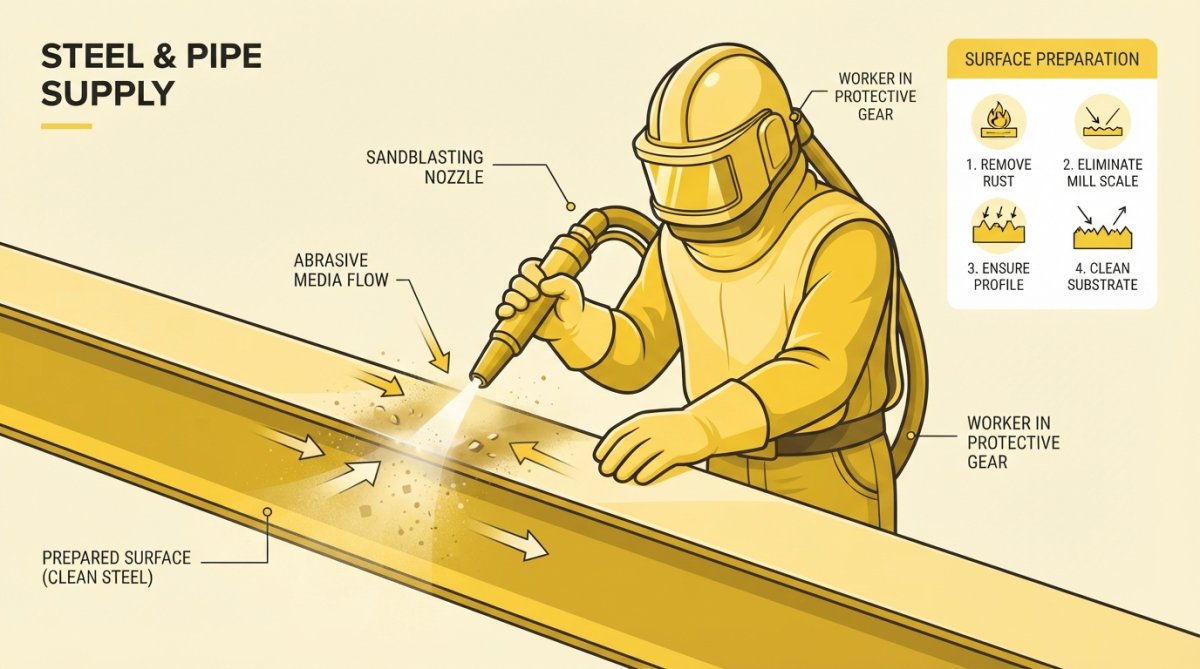
Sandblasting removes rust, mill scale, and embedded contaminants by propelling abrasive particles at high velocity against the steel surface. The process creates a rough, clean substrate that maximizes primer adhesion. The surface profile, microscopic peaks and valleys created by blasting, provides mechanical "keys" that help coatings grip the steel.
The standard specification for sandblasting is SSPC-SP10 (near-white blast clean), which removes nearly all mill scale and corrosion. For outdoor environments with high moisture or salt exposure, SP10 is the better choice despite higher cost. The additional surface cleanliness extends coating life by 5-10 years.
After blasting, steel must be coated within hours. Bare steel re-oxidizes quickly; a thin rust layer can form within 24 hours in humid conditions. Many contractors use "self-healing" primers that tolerate minor flash rusting, or they apply primers immediately after blasting while the surface is still warm and dry.
Step 2: Apply Galvanization and Zinc Coating Protection
Galvanization is one of the most effective methods to prevent steel corrosion outdoors. The process involves immersing steel in molten zinc (around 840°F) to create a metallurgical bond. The resulting coating is typically 45-100 microns thick, depending on steel thickness and immersion time.
Galvanized coatings work through two mechanisms: barrier protection (zinc physically blocks moisture and oxygen) and sacrificial protection (zinc corrodes preferentially to steel, protecting the substrate even if scratched). When the zinc coating is damaged, zinc ions migrate to exposed steel, preventing corrosion from spreading.
Hot-dip galvanizing is the most durable zinc coating method for outdoor steel, lasting 50+ years in inland environments and 20-30 years in coastal areas. For mild steel structures in high-corrosion environments, specify a minimum coating thickness of 85 microns. Steel & Pipe Supply stocks galvanized pipe and structural products that meet ASTM A123 specifications, ensuring consistent coating quality and long-term protection.
One limitation: galvanized coatings are susceptible to white rust (zinc oxide) in damp storage conditions before installation. This white corrosion is superficial and doesn’t affect performance, but applying a thin clear coat or primer prevents it.
Step 3: Choose the Best Rust Proof Coating for Steel
After surface preparation and galvanization, select a topcoat system appropriate for your outdoor environment. The best rust proof coating depends on exposure severity, budget, and aesthetic requirements.
Epoxy primers bond strongly to prepared surfaces, resist moisture penetration, and provide good chemical resistance. A two-part epoxy primer typically offers 1-2 years of protection on bare steel before topcoating. Polyurethane topcoats over epoxy primers provide superior UV resistance and gloss retention, creating a durable system that lasts 10-15 years in outdoor environments.
Primer Selection and Topcoat Application
Primer selection is critical because it determines topcoat adhesion and moisture barrier protection. Use primers specifically designed for outdoor steel. Outdoor primers contain additives that improve adhesion to mill scale, resist moisture penetration, and inhibit corrosion at the coating-steel interface.
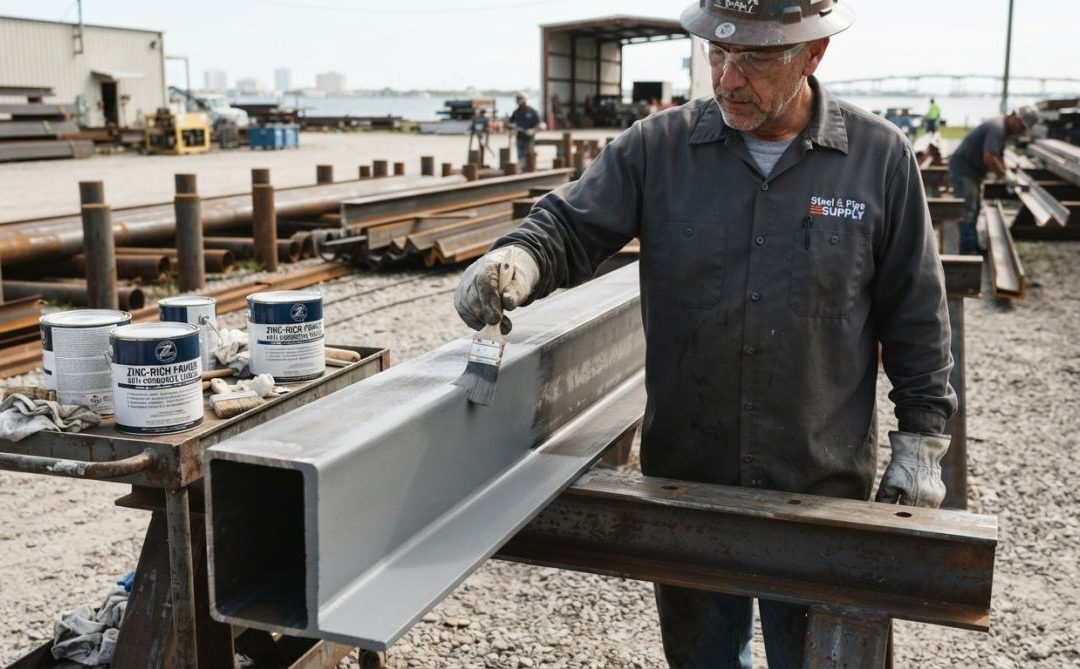
Zinc-rich primers contain zinc dust (75-85% by weight) suspended in an epoxy binder. The zinc dust provides sacrificial protection similar to galvanizing; if the coating is scratched, zinc particles corrode preferentially to steel. Zinc-rich primers are particularly effective in high-corrosion coastal environments.
Apply primers in two coats: the first coat (50-75 microns dry film thickness) seals the surface and provides adhesion; the second coat (50-75 microns) fills pores and ensures complete coverage. Topcoats should be applied at 75-100 microns dry film thickness. Total system thickness for outdoor steel should be 200-300 microns for standard environments and 300-400 microns for high-corrosion coastal areas.
Temperature and humidity during application matter. Apply coatings when the surface is dry, ambient temperature is between 50-85°F, and relative humidity is below 85%. Cold, damp conditions slow curing and reduce adhesion.
| Coating Type | Dry Film Thickness | Outdoor Lifespan | Best For | Application Notes |
|---|---|---|---|---|
| Epoxy Primer | 50-75 microns | 1-2 years (primer only) | Base coat under topcoats | Requires topcoat for UV protection |
| Polyurethane Topcoat | 75-100 microns | 10-15 years | Over epoxy primer | Excellent UV and gloss retention |
| Zinc-Rich Primer | 75-100 microns | 5-10 years | High-corrosion coastal areas | Provides sacrificial protection |
| Powder Coating | 75-150 microns | 15-20 years | Structural beams, pipes | Factory application, no solvent |
Galvanized Steel vs Stainless Steel Outdoor: Which Protects Better
Choosing between galvanized steel and stainless steel requires understanding the trade-offs in cost, maintenance, and performance.
Galvanized steel costs significantly less than stainless steel, typically 30-50% cheaper for comparable components. Galvanized steel is ideal for budget-conscious projects where the structure will be repainted or maintained regularly.
Stainless steel (300-series austenitic stainless, particularly 304 and 316 grades) offers superior corrosion resistance without maintenance. The chromium content (minimum 10.5%) forms a self-healing passive oxide layer that prevents rust. Stainless steel requires no coating, no painting, and minimal maintenance.
The trade-off is cost. Stainless steel costs 2-4 times more than galvanized steel. For outdoor structures in harsh environments (coastal areas, chemical plants), stainless steel’s durability justifies the premium. For inland structures with moderate corrosion exposure, galvanized steel with periodic recoating is more economical.
Stainless steel grade selection matters. Grade 304 works well in inland and mild coastal environments. Grade 316, which includes molybdenum for enhanced salt spray resistance, is necessary for heavy coastal exposure. A hybrid approach works well: use galvanized steel for primary structural components and stainless steel fasteners and trim to protect vulnerable areas.
How to Protect Mild Steel Outdoors with Oil and Dry Film Coatings
Mild steel outdoors can be protected using oil-based and dry film coatings, which are lighter-weight alternatives to epoxy and polyurethane systems.
Rust-inhibiting oils create a thin moisture barrier on the steel surface using corrosion inhibitors that slow oxidation. They’re commonly used for protecting stored equipment and components during shipping. The protection lasts weeks to months, making them best for short-term applications.
Dry film lubricants (typically molybdenum disulfide or PTFE-based) provide corrosion protection while reducing friction. These thin coatings (5-25 microns) dry to the touch and don’t attract dust like oils. They work well for outdoor machinery, fasteners, and components needing both corrosion protection and low friction.
For longer-term protection, apply a rust-inhibiting oil first, then a dry film lubricant topcoat. This two-layer approach provides months of protection with a clean surface.
[For equipment stored outdoors temporarily](https://steelandpipesupply.com/blogs/news/store-steel-outdoors-tips), spray a thin coat of rust-inhibiting oil and allow it to dry. The oil migrates into micro-cracks and pores, displacing moisture and slowing corrosion. This is cheaper than full coating systems and works well for seasonal storage.
Environmental Factors That Accelerate Steel Corrosion Outdoors
Understanding environmental factors that accelerate steel corrosion helps you choose the right prevention strategy for your location.
Salt Spray, Humidity, and Climate-Specific Strategies
Salt spray is the most aggressive environmental factor for steel corrosion. Airborne salt particles deposit on the steel surface, lower the electrical resistance of moisture films, and dramatically accelerate the corrosion reaction. Coastal areas within 1-2 miles of saltwater experience salt spray exposure.
In salt spray environments, use ASTM B117 salt spray testing to evaluate coating durability. Coatings surviving 1,000+ hours of salt spray testing will perform well in coastal areas. Galvanized steel typically survives 500-1,000 hours; high-quality epoxy-polyurethane systems survive 1,000+ hours.
Humidity above 50% creates conditions where corrosion accelerates. Most U.S. outdoor environments exceed 50% humidity regularly. Coastal areas and regions near large bodies of water experience persistently high humidity. In these environments, coatings must provide excellent moisture barrier protection.
Temperature cycling accelerates corrosion through coating stress (expansion and contraction) and increased chemical reaction rates. Steel in northern climates experiences freeze-thaw cycles that damage coatings. In southern climates, daily temperature swings of 30-40°F create constant stress on coating systems.
Climate-specific strategies adjust corrosion prevention based on your region:
- Coastal areas: Use hot-dip galvanizing + epoxy-polyurethane coating system, or stainless steel. Inspect and maintain coatings annually.
- High-humidity inland areas: Galvanized steel with polyurethane topcoat, or stainless steel. Ensure drainage and ventilation to minimize standing water.
- Freeze-thaw regions: Use flexible coating systems that tolerate expansion and contraction. Epoxy-polyurethane with proper surface preparation works well.
- Arid regions: Corrosion is slower due to low humidity. Galvanized steel or painted mild steel works well.
Step 4: Establish a Maintenance Schedule to Prevent Steel Corrosion
Preventing steel corrosion outdoors is not a one-time effort. Even the best coating systems degrade over time through UV exposure, mechanical damage, and moisture infiltration. A maintenance schedule ensures your protection system remains effective for its full design life.
Regular Cleaning, Inspection, and Recoating Intervals
Inspect outdoor steel structures quarterly in the first year after installation, then semi-annually thereafter. Look for coating damage (peeling, chalking, blistering), rust stains indicating corrosion beneath the coating, and areas where water pools. Early detection prevents small problems from becoming expensive repairs.
Clean the steel surface annually using low-pressure water spray and a soft brush. Remove dirt, salt deposits, bird droppings, and organic growth. Salt deposits accelerate corrosion, so regular cleaning extends coating life significantly. In coastal areas, clean every 6 months.
Recoating intervals depend on the coating system and environment:
- Galvanized steel in inland areas: Recoat every 10-15 years
- Galvanized steel in coastal areas: Recoat every 5-8 years
- Epoxy-polyurethane system in inland areas: Recoat every 8-12 years
- Epoxy-polyurethane system in coastal areas: Recoat every 5-7 years
- Stainless steel: No recoating required; clean as needed
When recoating, follow the same surface preparation rules as the original coating. If the existing coating is in good condition, you may apply a new topcoat directly. If the coating is damaged or failing, remove it completely and start over.
Painting over a failing coating is the most common maintenance mistake. The new paint will peel off within 1-2 years, wasting money and leaving the steel unprotected. Always remove failed coatings completely before recoating.
DIY vs Professional Application: Cost-Benefit Analysis
Deciding whether to handle corrosion prevention yourself or hire professionals depends on project scale, complexity, and your tolerance for risk.
DIY application works well for small projects: fence posts, gate frames, small pipes, or components you can handle safely. The advantage is cost savings; the disadvantage is quality risk. Poor surface preparation, incorrect coating thickness, or application in unsuitable weather will result in premature failure.
For DIY projects, invest in proper equipment: pressure washer, sandblasting or wire-wheel attachment, spray gun or brush applicators, and safety gear. Budget 2-3 days per 100 square feet for surface preparation, the most time-consuming step.
Professional application is necessary for large structures, high-visibility projects, or critical applications where failure is costly. Professional contractors have industrial-grade equipment, trained applicators, quality control processes, and insurance.
The cost difference is significant: DIY costs run $2-5 per square foot (material only), while professional application costs $8-15 per square foot (material + labor). For a 1,000 square foot structure, DIY saves $3,000-10,000. A hybrid approach works for many projects: handle surface preparation yourself and hire professionals for coating application.
| Approach | Best For | Cost per sq ft | Time Required | Risk Level |
|---|---|---|---|---|
| DIY | Small projects, fence posts, gates | $2-5 | 2-3 days per 100 sq ft | High |
| DIY + Professional Coating | Medium projects, structural repair | $4-8 | 1-2 days prep + 1 day coating | Medium |
| Full Professional | Large structures, critical applications | $8-15 | 5-10 days (contractor scheduled) | Low |
Common Mistakes to Avoid When Protecting Outdoor Steel
Learning what NOT to do prevents costly failures and wasted resources.
Skipping surface preparation. This is the most common and most expensive mistake. Applying coatings over mill scale, rust, or contamination results in coating failure within 1-2 years. Invest the time and money in proper surface preparation, it determines whether your coating system lasts 5 years or 20 years.
Using interior primers and paints outdoors. Interior coatings lack UV stabilizers and moisture resistance needed for outdoor exposure. They chalk, peel, and fail within 1-2 years. Always specify coatings formulated for outdoor steel.
Applying coatings in poor weather. Painting in high humidity, rain, or cold temperatures causes adhesion problems and coating failure. Wait for dry conditions with temperatures between 50-85°F.
Ignoring maintenance schedules. Coatings degrade over time. Skipping inspections and recoating allows small damage to become major corrosion. Regular maintenance costs far less than structural repair.
Mixing incompatible coating systems. Applying polyurethane topcoat over a primer not designed for polyurethane causes adhesion failure. Always confirm that primer and topcoat are compatible.
Underestimating coating thickness. Thin coatings fail faster than properly applied coatings. Measure dry film thickness with a gauge and ensure it meets specifications.
Choosing the wrong material for the environment. Using galvanized steel in a heavy salt spray environment without additional topcoat protection results in corrosion within 5-10 years. Assess your environment and choose materials accordingly.
Outdoor steel corrosion is preventable. By combining proper surface preparation, galvanization or stainless steel selection, quality coating systems, and regular maintenance, you can protect your steel structures for 20-50 years. Steel & Pipe Supply provides galvanized pipe, structural steel, and technical guidance for corrosion prevention projects across the Tampa Bay area. Our team helps contractors specify the right materials for their specific environment and budget. ASTM International standards for steel coatings and galvanization provide the specifications that ensure quality and durability. Call Steel & Pipe Supply today for a free quote on galvanized materials and corrosion prevention solutions tailored to your outdoor steel project.
Frequently Asked Questions
What is the best way to prevent steel corrosion outdoors?
The most effective approach combines multiple layers: proper surface preparation through degreasing and sandblasting, application of a rust inhibitor primer, protective coating (galvanization or paint), and regular maintenance. For mild steel, galvanization provides the longest-lasting barrier. For ferrous metals in high-salt environments, stainless steel or aluminum alternatives may offer superior corrosion resistance. Establish a maintenance schedule to inspect coatings annually and reapply as needed.
How does galvanizing prevent rust on steel?
Galvanization creates a zinc coating layer that acts as a moisture barrier between the steel substrate and the environment. The zinc coating sacrifices itself through oxidation, protecting the underlying steel through cathodic protection. This dual mechanism, physical barrier plus electrochemical protection, makes galvanization one of the most durable corrosion prevention methods. Coating thickness directly affects longevity, with thicker applications lasting 20+ years outdoors.
What environmental factors accelerate steel corrosion outdoors?
Salt spray, high humidity, temperature fluctuations, and proximity to coastal areas dramatically accelerate the chemical reaction that causes oxidation. Ferrous metals corrode faster in humid climates and near saltwater. Abrasion from weather exposure can damage protective coatings, exposing the substrate. Acidic rain and industrial pollutants also increase corrosion rates. Climate-specific strategies should account for your region's moisture levels and salt exposure to determine appropriate coating thickness and maintenance intervals.
How often should outdoor steel be maintained to prevent corrosion?
Inspection frequency depends on environmental exposure and coating type. Establish a maintenance schedule: inspect annually in moderate climates, semi-annually in high-humidity or coastal areas. Clean debris and check for coating damage or abrasion. Touch up damaged areas immediately with compatible primers and topcoats to prevent corrosion at breach points. Reapply full protective coatings every 5-10 years depending on coating type and environmental severity. Galvanized steel requires less frequent maintenance than painted surfaces.
This article was written using GrandRanker