
Table of Contents
- Why Steel Pipe Matters for Well Casing
- Steel Well Casing vs PVC: Material Comparison
- API 5CT Casing Grades: Understanding Your Options
- Wall Thickness, Schedule Ratings, and Pipe Diameter Selection
- Corrosion Resistance and Well Longevity
- Well Casing Installation: Professional vs DIY Approaches
- Cost of Well Casing: Pricing and Budget Considerations
- Best Steel Pipe for Well Casing: Our Recommendations
- Sustainability and Recyclability in Well Casing Materials
- Conclusion
Last Updated: July 15, 2026
Finding the best steel pipe for well casing requires understanding material properties, pressure ratings, and soil conditions specific to your location. Selecting well casing requires attention to material properties, pressure ratings, groundwater chemistry, soil conditions and the requirements of the drilling professional or engineer. This comprehensive guide covers the steel casing options that actually perform in the field, from budget-friendly carbon steel to corrosion-resistant stainless alternatives.
The stakes matter here. A poorly selected casing fails prematurely, compromises water quality, and creates expensive remediation costs. Conversely, the right pipe selection ensures decades of reliable service while protecting your groundwater investment. Below, we’ll walk you through material comparisons, API grade specifications, installation realities, and cost trade-offs so you can make an informed decision backed by engineering standards and real-world performance data.
Why Steel Pipe Matters for Well Casing
Your well casing does three critical jobs: it prevents borehole collapse, isolates different aquifer layers, and protects groundwater from surface contamination. Steel accomplishes all three better than many alternatives, but only when you choose the right grade and wall thickness for your specific geological conditions.
Steel’s tensile strength and rigidity outperform PVC and HDPE in deep wells and high-pressure formations. Where PVC casings can fail under formation stress or collapse from external pressure, properly specified steel holds its integrity. The trade-off is weight and installation complexity, steel requires heavier equipment and professional crews, whereas PVC can sometimes be installed with lighter rigs.
The material you select determines longevity, maintenance costs, and water quality outcomes. Corrosion resistance varies dramatically between carbon steel, galvanized pipe, and stainless steel options. In acidic groundwater or regions with sulfide-bearing soils, the difference between a 20-year casing life and a 50-year one comes down to material selection.
Regional geology matters more than national averages. Before selecting a pipe grade, pull your local well logs and soil survey data. Acidic soils, high sulfate content, and hydrogen sulfide presence all demand upgraded material specifications that generic recommendations miss.
Steel Well Casing vs PVC: Material Comparison
The choice between steel and PVC isn’t simply about cost. Each material excels in different scenarios, and the wrong pick creates problems that cost far more than the initial savings.
Carbon Steel Casing delivers superior collapse resistance and tensile strength. It handles the formation stresses of deep wells (500+ feet) where PVC becomes risky. Steel also resists drilling fluid additives and chemical exposure better than plastic. The downside: corrosion risk in acidic or saline groundwater, higher installation costs, and heavier equipment requirements.
PVC Casing costs significantly less upfront and requires no corrosion protection. It’s lightweight, which reduces drilling rig requirements and labor costs. PVC works well for shallow to moderate-depth wells (under 300 feet) in non-corrosive groundwater. However, PVC cannot handle high-pressure formations, brittle fractures in cold climates, and certain drilling chemicals degrade PVC faster than steel.
HDPE (High-Density Polyethylene) offers flexibility and corrosion immunity, making it suitable for some agricultural wells. Its pressure rating is lower than steel, and it’s less common in commercial well drilling, so fewer contractors have experience with installation standards.
The practical reality: many well professionals consider steel for deeper wells, high external loads or conditions where rigidity is critical; the final selection should follow local code and professional design. PVC dominates shallow domestic wells where cost is the primary constraint. Steel & Pipe Supply stocks both materials in the sizes and schedules that drilling contractors actually use, which means you’re not waiting for special orders when your project timeline is tight.
| Material | Best Depth | Corrosion Resistance | Installation Cost | Lifespan |
|---|---|---|---|---|
| Carbon Steel | 300-1000+ ft | Moderate (requires protection) | High | 30-50 years |
| Stainless Steel | Any depth | Excellent | Very high | 50+ years |
| Galvanized Steel | 200-600 ft | Good (zinc coating) | Moderate | 25-40 years |
| PVC | Under 300 ft | Excellent | Low | 25-50 years |
| HDPE | 100-400 ft | Excellent | Moderate | 30-50 years |
API 5CT Casing Grades: Understanding Your Options
API 5CT is the industry standard for casing and tubing specifications. The grade designation tells you the minimum yield strength, which determines how much downhole pressure and formation stress the pipe can withstand. Selecting the right grade prevents casing collapse, burst failures, and premature replacement.
K55 Grade: Budget-Friendly for Shallow Wells
K55 is the entry-level API 5CT grade with a minimum yield strength of 379 MPa (55,000 psi). It’s the most cost-effective option and works well for shallow to moderate-depth wells where formation pressure remains manageable. K55 pipe is readily available in standard sizes and wall thicknesses, which keeps lead times short and pricing competitive.
The limitation: K55 cannot handle deep wells or high-pressure formations. If your well exceeds 500 feet in depth or penetrates high-pressure zones, K55 may not provide adequate collapse resistance. Additionally, K55 offers no special corrosion protection, in acidic or sulfide-rich groundwater, you’ll need external coating or galvanizing for extended life.
K55 works best for agricultural wells, domestic wells in non-corrosive formations, and situations where budget constraints are absolute. Pair it with galvanizing or external epoxy coating if water quality testing shows corrosive conditions.
N80 Grade: Balanced Performance for Medium Depths
N80 grade provides a middle ground with 552 MPa (80,000 psi) yield strength. It handles deeper wells (400-800 feet) and higher formation pressures while remaining more affordable than premium grades. N80 comes in two variants: N80 Type 1 (normalized heat treatment) and N80-Q (quenched and tempered), with N80-Q offering superior collapse resistance.
N80 is the workhorse of commercial well drilling. It delivers the strength needed for challenging formations without the premium cost of L80 or P110. Most drilling contractors stock N80 in multiple sizes because it covers the widest range of practical applications.
The trade-off: N80 still lacks specialized corrosion protection. In sour service (hydrogen sulfide present) or highly corrosive groundwater, N80 requires coating or material upgrades. For standard non-corrosive applications, N80 provides years of reliable service at a reasonable cost.
L80 and P110 Grades: High-Strength Solutions
L80 grade (552 MPa yield strength) and P110 grade (758 MPa yield strength) are engineered for extreme conditions. L80 excels in sour service environments where hydrogen sulfide is present, the alloy composition resists sulfide stress cracking that would compromise lower grades. P110 is the premium choice for the deepest, highest-pressure wells where maximum collapse and burst resistance is non-negotiable.
L80 typically includes chromium and nickel alloying elements that enhance corrosion resistance in challenging environments. P110 is produced exclusively by quench and temper heat treatment, which creates superior mechanical properties. Both grades cost considerably more than K55 or N80, but they’re essential when formation conditions demand them.
Use L80 and P110 when geological surveys or water quality testing indicate sour service conditions, extreme depth, or highly corrosive groundwater. Specifying lower grades in these situations guarantees premature failure.
Never downgrade from L80 to N80 to save money in sour service wells. Hydrogen sulfide accelerates cracking in lower-strength steel. The cost of replacing a failed casing in a deep sour well exceeds the initial savings by orders of magnitude.
Wall Thickness, Schedule Ratings, and Pipe Diameter Selection
Wall thickness and pipe diameter determine the structural capacity of your casing string. These parameters must match your well depth, formation pressure, and expected loads during drilling and operation.
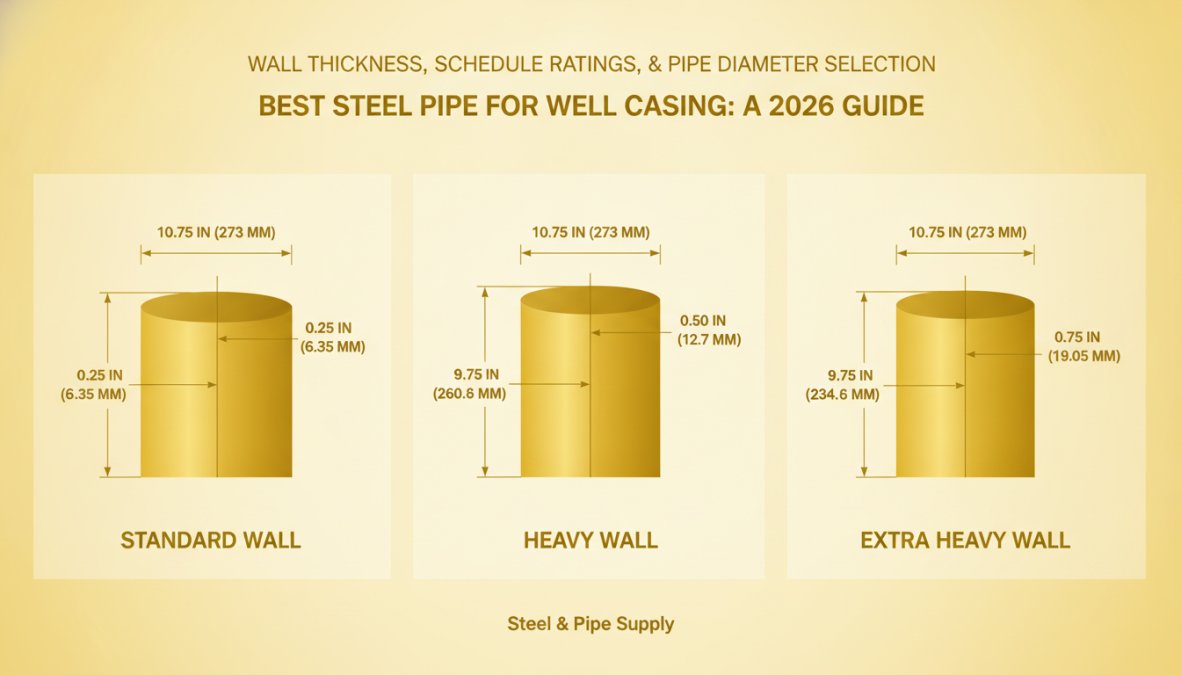
Pipe Diameter ranges from 4.5 inches to 20 inches OD for standard well casing. Smaller diameters (4.5-7 inches) suit domestic and agricultural wells where pump size is modest. Larger diameters (10-20 inches) are specified for high-capacity municipal or industrial wells. Your pump size and expected flow rate drive diameter selection, undersizing restricts flow and reduces well productivity.
Schedule Ratings (Schedule 40, Schedule 80, Schedule 160) indicate wall thickness. Schedule 40 is standard for moderate-depth wells; Schedule 80 provides thicker walls for deeper applications or high-pressure formations. Schedule 160 is rarely used in well casing but appears in some industrial applications.
Wall Thickness directly affects collapse resistance. Thicker walls resist external formation pressure better, which matters in unstable formations or deep wells. However, thicker walls increase material cost and weight, complicating installation. The engineering design balances structural need against practical constraints.
Most well drilling uses Schedule 40 or Schedule 80 pipe in the 4.5-inch to 10-inch diameter range. Steel & Pipe Supply stocks these standard sizes in K55, N80, and L80 grades, which covers 95% of typical well casing projects. Custom sizes and premium schedules are available but require longer lead times.
Corrosion Resistance and Well Longevity
Corrosion is the silent killer of well casings. Even high-strength steel fails prematurely if corrosion eats through the wall, and many drillers underestimate the corrosive potential of their local groundwater. Understanding how specific water chemistry attacks different steel alloys is essential to selecting a casing that will last decades rather than fail within 15 years.
How Groundwater Chemistry Attacks Steel: Specific Mechanisms
Acidic Water and General Corrosion
Groundwater with pH below 6.5 is considered acidic and accelerates corrosion of carbon steel through a straightforward electrochemical process. Acidic water increases hydrogen ion concentration, which lowers the pH and destabilizes the protective iron oxide layer (magnetite) that naturally forms on steel surfaces. Once this layer breaks down, the underlying steel oxidizes directly, forming iron oxide (rust) that flakes away, exposing fresh steel to further attack.
In acidic groundwater (pH 5.0-6.5), bare carbon steel corrodes at rates of 0.5-2.0 mils per year (a mil is 0.001 inch). A 7-inch Schedule 40 casing has a wall thickness of 0.280 inches (280 mils). At a corrosion rate of 1 mil per year, the casing loses 50% of its wall thickness in 140 years, which sounds acceptable until you account for localized corrosion (see below). In practice, acidic groundwater causes visible pitting and wall perforation within 15-25 years in unprotected carbon steel.
Stainless steel (13% chromium or higher) resists acidic corrosion because chromium forms a passive oxide layer (chromium oxide) that is far more stable than iron oxide. Even in pH 4.0 groundwater, stainless steel corrodes at rates below 0.1 mils per year, making it effectively immune to general acidic corrosion.
Galvanized steel (carbon steel coated with 0.7-1.0 mils of zinc) provides intermediate protection. Zinc is more reactive than iron, so it corrodes preferentially, sacrificing itself to protect the underlying steel (cathodic protection). In acidic groundwater, the zinc layer depletes within 10-20 years, after which corrosion of the underlying steel accelerates rapidly. Galvanizing extends casing life in mildly acidic water (pH 6.0-6.5) but is insufficient for strongly acidic conditions.
Sulfide Corrosion and Hydrogen Sulfide Stress Cracking
Groundwater containing dissolved hydrogen sulfide (H₂S), common in sulfide-bearing formations and anaerobic aquifers, creates two distinct corrosion problems: sulfide corrosion and hydrogen sulfide stress cracking.
Sulfide corrosion occurs when H₂S reacts with iron to form iron sulfide (FeS), a black, porous corrosion product that provides no protection. Iron sulfide is less stable than iron oxide, so corrosion rates in sulfide-bearing water are 2-4 times higher than in neutral water. A well in sulfide-rich groundwater can perforate within 10-15 years if cased with unprotected carbon steel.
Hydrogen sulfide stress cracking (HSSC) is more insidious. In the presence of H₂S, hydrogen atoms diffuse into the steel lattice, making it brittle. Under the tensile stress created by formation pressure or casing weight, the embrittled steel cracks suddenly without warning. This failure mode is catastrophic because it occurs without visible corrosion; the casing appears intact until it fractures.
Lower-strength steels (K55, N80) are more susceptible to HSSC than higher-strength grades. API 5CT specifies that L80 and P110 grades can be used in sour service (H₂S present) because their alloy composition (typically 1-3% chromium, 0.5-1.5% molybdenum) and heat treatment make them resistant to hydrogen embrittlement. Stainless steel is also immune to HSSC because chromium passivation prevents hydrogen absorption.
If water quality testing reveals hydrogen sulfide above 0.3 ppm (parts per million), you must upgrade from K55 or N80 to L80 or stainless steel. Specifying lower grades in sour service guarantees premature failure, often within 5-10 years.
Chloride Pitting and Localized Corrosion
Chloride ions (Cl⁻), common in coastal groundwater and some inland saline aquifers, cause pitting corrosion, deep, narrow holes that penetrate the casing wall while the surrounding surface remains relatively intact. Pitting is particularly dangerous because it is difficult to detect visually and can perforate a casing wall in localized spots while general corrosion rates appear acceptable.
Carbon steel and galvanized steel are vulnerable to chloride pitting. In groundwater with chloride concentrations above 500 ppm, pitting rates can exceed 2-5 mils per year in localized areas. A pit can penetrate a 280-mil wall thickness in 50-140 years, but pits often form in clusters, and once one pit initiates, it grows preferentially because the pit bottom becomes anodic (more reactive).
Stainless steel resists chloride pitting up to certain thresholds. Standard 13% chromium stainless steel can tolerate chloride levels up to 1,000-2,000 ppm without significant pitting. Higher-grade stainless steels (duplex stainless with 22% chromium, or super-austenitic grades) tolerate even higher chloride levels. In coastal areas or known saline aquifers, stainless steel is the appropriate choice.
Galvanized steel provides no protection against chloride pitting; once the zinc layer is breached, pitting of the underlying steel proceeds rapidly.
Regional Soil Compatibility: Matching Steel Type to Groundwater Conditions
Your casing material must match your regional geology and groundwater chemistry. Acidic soils in the eastern United States, sulfide-bearing formations in the Great Plains, and saline groundwater in coastal regions all demand different material responses.
Eastern U.S. (Acidic Soils and Groundwater)
Much of the eastern United States, particularly New England, the Mid-Atlantic, and the Southeast, has naturally acidic soils and groundwater (pH 5.0-6.5). Granite and metamorphic bedrock produce acidic leachate. In these regions, bare carbon steel casings fail within 15-25 years. Galvanized pipe extends life to 25-35 years. Stainless steel is recommended for wells expected to serve 50+ years or for high-value installations (municipal supplies, food processing).
Great Plains (Sulfide-Bearing Formations)
The Great Plains, particularly Kansas, Oklahoma, and Texas, contain sulfide-bearing shales and evaporite formations. Groundwater in these regions often contains dissolved hydrogen sulfide, especially in deeper aquifers. If water quality testing reveals H₂S above 0.3 ppm, you must use L80 or stainless steel. K55 or N80 will fail within 5-10 years in sour service.
Coastal Regions (Saline Groundwater)
Coastal areas and some inland basins have saline groundwater with chloride concentrations of 500-5,000+ ppm. In these environments, carbon steel and galvanized steel are unsuitable; stainless steel is the only practical choice for long-term durability.
Neutral to Alkaline Regions (Midwest, Southwest)
Much of the Midwest and Southwest has neutral to slightly alkaline groundwater (pH 7.0-8.5) with low sulfide and chloride content. In these regions, bare carbon steel Schedule 40 in K55 or N80 grade performs reliably for 30-50 years. Galvanizing is optional but recommended if water quality testing shows mild corrosive tendencies.
Water Quality Testing: The Foundation of Material Selection
Water quality testing is not optional for wells deeper than 200 feet or in regions with known groundwater challenges. Test results should include:
- pH: Determines acidic corrosion risk. pH below 6.5 requires upgraded materials.
- Dissolved Oxygen: Higher oxygen accelerates corrosion; anaerobic water (low oxygen) may contain H₂S.
- Hydrogen Sulfide (H₂S): Above 0.3 ppm requires L80 or stainless steel.
- Sulfates (SO₄²⁻): Above 500 ppm indicates potential for sulfide formation and corrosion.
- Chlorides (Cl⁻): Above 500 ppm creates pitting risk; above 1,000 ppm requires stainless steel.
- Iron and Manganese: High levels indicate reducing conditions and potential H₂S formation.
- Alkalinity and Hardness: Indicate buffering capacity and scale-forming potential.
Most state geological surveys and university extension services offer water quality testing at reasonable cost ($50-$200 for a basic panel). Many drilling contractors include water testing as part of the design process. Test results justify material upgrades and protect your investment by ensuring the casing material matches actual groundwater conditions rather than regional assumptions.
Never assume your groundwater is non-corrosive based on regional reputation. Localized pockets of acidic or saline water exist in regions that are generally neutral. Water quality testing is the only reliable way to determine appropriate casing material.
Material Selection Based on Water Chemistry
| Water Condition | pH | H₂S (ppm) | Chloride (ppm) | Recommended Material | Expected Life |
|---|---|---|---|---|---|
| Neutral, non-corrosive | 6.5-8.5 | <0.1 | <200 | Carbon Steel K55/N80 | 30-50 years |
| Mildly acidic | 6.0-6.5 | <0.1 | <200 | Galvanized K55/N80 | 25-40 years |
| Acidic | 5.0-6.0 | <0.1 | <200 | Stainless Steel 13Cr | 50+ years |
| Sour service (H₂S present) | Any | >0.3 | <500 | L80 or Stainless Steel | 30-50 years |
| Saline/Coastal | 6.5-8.5 | <0.1 | >500 | Stainless Steel 13Cr+ | 50+ years |
| Acidic + Sour | <6.5 | >0.3 | Any | Stainless Steel 13Cr+ | 50+ years |
Most well failures trace back to material selection based on generic regional assumptions rather than site-specific testing. Steel & Pipe Supply recommends pulling water samples and soil borings before designing your casing string. That upfront investment prevents costly failures and ensures your casing performs as designed for the full expected service life.
Well Casing Installation: Professional vs DIY Approaches
Installation quality determines whether your casing performs as designed. Improper installation, misaligned joints, inadequate cementing, incorrect torque specifications, or mechanical damage, compromises the entire system and creates water quality risks that persist for decades.
Installation Challenges and Rigidity Requirements
Steel casing is heavy and rigid, which creates installation challenges that PVC avoids. A 500-foot string of 7-inch Schedule 40 steel casing weighs over 8,000 pounds and requires a drilling rig with adequate derrick capacity and hoisting power. Mishandling during installation causes dents, thread damage, and stress concentrations that weaken the casing and reduce its collapse resistance by 10-30% depending on dent severity.
Proper installation demands threaded connections with correct torque specifications (typically 3,000-5,000 foot-pounds for 7-inch casing, depending on grade and thread type), centralizers to keep the casing centered in the borehole, and careful handling to prevent mechanical damage. Cementing around the casing is equally critical: poor cement bond allows formation fluids to migrate along the outside of the casing, which defeats the isolation purpose and can contaminate the well within years.
The rigidity of steel is an advantage for structural integrity but a challenge for installation. Steel cannot be bent or flexed like PVC, so the borehole must be reasonably straight and free of ledges. Crooked boreholes, boulders in the formation, or unstable shale layers complicate steel casing installation and may require specialized equipment like casing scrapers or underreamers to enlarge the hole.
DIY vs Professional Installation Risks: Legal, Safety, and Financial Consequences
Installing well casing without professional expertise creates cascading risks that extend far beyond the well itself.
Regulatory and Legal Exposure
Most U.S. states require licensed well drillers for wells deeper than 25-50 feet. These regulations exist because improper installation contaminates aquifers and creates public health hazards. If you install a well without proper licensing and it later contaminates a neighbor’s well or public water supply, you face liability for remediation costs, which can reach $50,000-$500,000+ depending on contamination extent and affected population.
Many states impose criminal penalties for unlicensed well drilling. Fines range from $1,000-$10,000, and in cases of contamination, criminal negligence charges are possible. Additionally, if you sell property with an improperly installed well, you may be liable for disclosure violations and forced remediation at your expense.
Technical Failure Modes and Their Costs
Improper thread torque is the most common DIY failure. Under-torqued connections leak formation fluids into the annulus (the space between casing and borehole wall), allowing contaminants to migrate into the well. Over-torqued connections strip threads or crack the pipe, causing joint failure under pressure. Either scenario requires pulling the casing, removing the entire string from the borehole, and reinstalling it, a process that costs $10,000-$50,000+ depending on depth.
Inadequate cementing is the second major failure mode. Cement must fill the annulus completely to isolate aquifer layers and prevent cross-contamination. If cement is poured too quickly, it channels (flows unevenly), leaving voids where fluids can migrate. Professional drillers use cement calculators, proper mixing ratios, and wait times (typically 24-48 hours) before drilling out the cement plug. DIY installations often skip these steps, resulting in weak cement bonds that fail within 5-10 years.
Mechanical damage during handling, dents, thread galling, or stress concentrations from dropped pipe, reduces casing strength by 10-30%. These defects are invisible until the casing fails under formation pressure, often years after installation. At that point, the well is compromised, and remediation requires pulling and replacing the entire casing string.
Equipment and Expertise Gaps
Professional drilling rigs include torque wrenches, pipe elevators, slips, and centralizers specifically designed for casing installation. DIY installations using improvised equipment (chain hoists, manual wrenches, or hand-tightening) cannot achieve the precision required. Professional drillers also understand how to interpret borehole conditions in real time, recognizing unstable formations, adjusting casing design on the fly, and knowing when to use specialized equipment like casing shoes or guide shoes.
Water quality testing and casing material selection also require expertise. A professional driller pulls water samples, interprets pH and sulfide levels, and recommends appropriate material upgrades (galvanizing, stainless steel, or coating). DIY installations often skip this step, selecting casing based on cost alone, which leads to premature corrosion in aggressive groundwater.
Financial Reality Check
A professional well installation costs $3,000-$15,000 depending on depth, formation difficulty, and casing material. Of this, casing material represents 15-25%, and professional drilling labor represents 40-50%. Attempting to save money by installing casing yourself may reduce labor costs by $1,000-$3,000, but if installation fails, remediation costs $10,000-$50,000+. The financial risk-reward calculation strongly favors professional installation.
Steel & Pipe Supply supplies materials to licensed drilling contractors who understand casing installation standards, local geology, and code requirements. We recommend working with licensed drillers rather than attempting DIY installation, even if you have construction experience. The stakes, water quality, legal liability, and long-term well performance, are too high for shortcuts.
Cost of Well Casing: Pricing and Budget Considerations
Material cost is one component of total well cost, but it’s often overestimated. A well’s total cost includes drilling labor, casing material, cementing, pump installation, and testing. Casing material typically represents 15-25% of total well cost.
Pricing varies by casing grade, size, and market conditions. K55 carbon steel is the least expensive option. Galvanized K55 costs more but extends life in mildly corrosive conditions. Stainless steel costs 3-5 times more than carbon steel but lasts indefinitely in aggressive environments.
The economic calculation should compare total cost of ownership, not just material price. A cheap casing that fails in 15 years costs more than a premium casing that lasts 50 years. If your well must serve for decades, the upfront material investment in corrosion-resistant options pays dividends.
For current pricing on specific sizes and grades, contact Steel & Pipe Supply for a quote. Pricing depends on quantity, delivery location, and market conditions, so online price calculators are unreliable. Our team can provide accurate quotes based on your project specifications.
The cheapest casing upfront often becomes the most expensive choice over the well’s lifetime. Corrosion-resistant materials cost more initially but eliminate replacement costs and water quality risks that plague cheaper alternatives.
Best Steel Pipe for Well Casing: Our Recommendations
After evaluating material properties, cost, and real-world performance, certain configurations emerge as the best choices for specific applications. These recommendations balance engineering requirements, practical installation, and long-term value.
Top Choice: Carbon Steel Schedule 40 for Most Applications
For typical well drilling projects, carbon steel Schedule 40 in K55 or N80 grade delivers the best balance of strength, cost, and availability. Schedule 40 provides adequate wall thickness for wells up to 600 feet in non-corrosive groundwater. K55 grade handles shallow wells (under 300 feet) economically, while N80 grade covers deeper applications (300-600 feet) with improved collapse resistance.
Carbon steel Schedule 40 is the industry standard because drilling contractors stock it, it’s readily available, and installation procedures are well-established. For wells in neutral to slightly alkaline groundwater without sulfide presence, carbon steel performs reliably for 30-40 years.
Pair carbon steel with galvanizing if water quality testing indicates mild corrosive conditions. Galvanized Schedule 40 costs 15-20% more than bare steel but extends life significantly in acidic or sulfide-bearing water.
Premium Option: Stainless Steel for Corrosive Environments
Stainless steel (typically 13% chromium or higher) is the right choice when water quality testing reveals aggressive chemistry, low pH, high sulfides, high chlorides, or coastal locations. Stainless steel resists corrosion in virtually all groundwater conditions and eliminates the need for protective coatings.
The cost is higher: stainless steel Schedule 40 costs 3-5 times more than carbon steel. However, in corrosive environments, stainless steel’s longevity (50+ years) justifies the premium. You avoid the risk of premature failure and the expense of casing replacement.
Stainless steel is also the choice for high-profile installations where water quality is critical, municipal water supplies, food processing facilities, or situations where casing failure would create public health consequences.
Budget-Conscious Pick: Galvanized Pipe for Moderate Protection
Galvanized carbon steel Schedule 40 bridges the cost gap between bare carbon steel and stainless steel. The zinc coating provides moderate corrosion protection, extending life by 10-20 years compared to bare steel. Galvanized pipe costs 20-40% more than bare carbon steel but 70-80% less than stainless steel.
Galvanized pipe works well for agricultural wells, domestic wells in slightly acidic groundwater, and situations where budget constraints are real but corrosion risk is present. It’s a practical compromise between cost and durability.
The limitation: galvanizing doesn’t protect against severe corrosion. In highly acidic (pH < 5.5) or high-sulfide groundwater, galvanizing depletes within 15-20 years, and corrosion accelerates. For aggressive environments, upgrade to stainless steel.
Sustainability and Recyclability in Well Casing Materials
Steel is infinitely recyclable, which matters if environmental impact is a consideration. At end-of-life, steel casing can be recovered and recycled into new products without degradation of properties. This contrasts with PVC and HDPE, which are more difficult to recycle and persist in landfills.
Stainless steel is particularly valuable in recycling markets because of its alloy content. Galvanized steel requires careful handling to separate the zinc coating, but the underlying steel is fully recyclable.
If your project prioritizes sustainability, steel casing, especially galvanized or stainless options, aligns with circular economy principles. The material’s durability also reduces the environmental cost of replacement, since a 50-year casing has lower lifecycle impact than a 20-year casing that requires replacement.
Selecting the best steel pipe for well casing requires matching material properties to your specific geological conditions, water chemistry, and depth requirements. Carbon steel Schedule 40 in K55 or N80 grade covers most applications economically. For corrosive environments or long-term municipal installations, stainless steel justifies its premium cost. Galvanized pipe offers a practical middle ground when budget and moderate corrosion risk intersect.
At Steel & Pipe Supply, we stock the standard sizes and grades that drilling contractors rely on, and our team can help you specify the right material for your project. Whether you need K55 carbon steel for a shallow domestic well or stainless steel for a high-profile municipal application, we deliver competitive pricing and the reliable materials your project requires. Call for a FREE Quote and let our team help you get the right casing material on schedule.
Frequently Asked Questions
What is the best material for well casing?
Carbon steel pipe is the best choice for most well casing applications, offering an excellent balance of strength, corrosion resistance, and cost-effectiveness. For corrosive environments or longer-term installations, stainless steel provides superior durability. PVC is a lightweight alternative for shallow, non-pressurized wells. The best material depends on your well depth, water chemistry, soil conditions, and budget.
How long does steel well casing last?
Carbon steel well casing typically lasts 20-50 years depending on water quality, soil pH, and maintenance. Galvanized steel extends longevity to 40-75 years by adding protective zinc coating. Stainless steel casings can exceed 100 years in most conditions. Regular inspection and proper installation significantly impact lifespan. Regional soil compatibility and groundwater chemistry are critical factors affecting how long your casing will perform.
What are the different grades of steel well casing?
API 5CT casing grades include K55 (55,000 psi yield strength) for shallow, low-pressure wells; N80 (80,000 psi) for medium-depth applications; L80 for corrosive environments with superior H2S resistance; and P110 (110,000 psi) for deep, high-pressure wells. Each grade offers different tensile strength and collapse resistance. K55 is most cost-effective, while P110 provides maximum strength for extreme conditions. Grade selection depends on well depth, pressure requirements, and environmental factors.
When should you use steel casing instead of PVC?
Use steel casing for wells deeper than 50 feet, high-pressure applications, areas with corrosive groundwater, or where structural rigidity is critical. Steel outperforms PVC in tensile strength, collapse resistance, and durability in aggressive soil conditions. PVC works only for shallow, low-pressure wells in neutral soil. Steel is essential for commercial wells, areas with acidic water, or installations requiring long-term reliability beyond 30 years.
What size steel pipe is best for well casing?
Common well casing sizes range from 4.5 inches to 10 inches outer diameter, with 6-inch and 8-inch being standard for residential wells. Larger diameters (10-20 inches) suit commercial or high-capacity wells. Pipe diameter selection depends on well depth, expected flow rate, and submersible pump size. Schedule 40 wall thickness works for most applications, while Schedule 80 provides extra strength for deeper or high-pressure wells. Consult your drilling engineer for specific sizing recommendations.