
Table of Contents
- Understanding Cost of Steel Culverts Per Foot
- Corrugated Steel Pipe Cost Per Foot by Diameter
- Galvanized Steel Culvert Specifications and Wall Thickness
- Culvert Installation Cost Breakdown
- Steel Culvert Diameter Pricing Comparison Table
- Types of Steel Culverts and Cost Variations
- Regulatory Requirements and Permitting for Culvert Installation
- Maintenance and Longevity: Hidden Cost Factors
- How to Get Competitive Pricing on Your Culvert Order
- Conclusion
Cost of Steel Culverts Per Foot: 2026 Pricing Guide
Last Updated: July 28, 2026
When contractors and builders plan drainage infrastructure projects, understanding the cost of steel culverts per foot becomes critical to accurate budgeting. Steel & Pipe Supply has tracked pricing trends across the industry, revealing significant variation based on diameter, gauge, material coating, and order volume. This guide breaks down what drives culvert pricing in 2026 and how to secure competitive quotes.
The cost of steel culverts per foot typically ranges based on specifications, but the real challenge is knowing whether you’re comparing apples to apples. A 12-inch galvanized culvert costs substantially less per foot than a 36-inch corrugated steel pipe with aluminized coating. Add in cutting fees, shipping, and installation labor, and the total project cost can swing by 40% or more depending on supplier selection and order timing.
Most contractors miss one critical detail: the cheapest per-foot price often comes from suppliers with long lead times or minimum order requirements that force larger purchases than needed. Steel & Pipe Supply focuses on flexible ordering and transparent pricing to help you hit your project budget without overbuying inventory.
Understanding Cost of Steel Culverts Per Foot
The price you pay for steel culverts per foot depends on five primary factors: material diameter, wall thickness (gauge), protective coating type, order quantity, and delivery distance. A 12-inch corrugated steel pipe with 16-gauge galvanized coating costs significantly less per foot than the same diameter in heavier 14-gauge with aluminized protection.
According to industry standards, the relationship between diameter and cost is non-linear. Doubling the diameter doesn’t double the price, it increases material volume and manufacturing complexity, pushing costs up by 150-200%. A 15-inch culvert costs roughly 40% more per foot than a 12-inch. A 36-inch culvert costs 3-4 times more per foot than a 12-inch.
The protective coating makes a measurable difference in both upfront cost and long-term durability. Galvanized steel provides baseline corrosion resistance for 20-30 years in most soil conditions. Aluminized steel extends service life to 40-50 years. Polyethylene-coated options add 10-15% to the base price but deliver superior performance in acidic soils or high-moisture environments.
Quantity discounts apply at predictable thresholds. Single sections carry the highest per-foot cost. Orders of 5-10 sections see 5-10% reductions. Orders exceeding 20 sections often qualify for 15-25% discounts, particularly when the supplier can batch-cut to your exact lengths.
What Affects Culvert Pricing
Lead time significantly impacts pricing. Standard inventory items (8-inch through 24-inch galvanized in 16-gauge) ship within 5-7 business days. Custom gauges, larger diameters, or specialized coatings require 2-4 weeks, and suppliers sometimes add rush fees if you need material faster.
Seasonal demand also impacts availability and pricing. Spring and fall construction seasons see higher demand, and some suppliers implement temporary surcharges during peak months. Winter orders often qualify for better pricing simply because fewer contractors are actively bidding projects.
The end condition of the pipe affects cost slightly. Standard corrugated ends cost less than annular corrugated ends. Riveted seams are standard; welded seams cost 10-15% more but eliminate the small leak risk at seam connections.
Minimum order requirements vary widely. Some suppliers require a full truckload (typically 8-12 sections depending on diameter). Others allow single-section orders but charge premium per-foot pricing. Steel & Pipe Supply maintains flexible minimums because smaller contractors shouldn’t be forced into oversized purchases just to access competitive pricing.
Corrugated Steel Pipe Cost Per Foot by Diameter
Corrugated steel pipe pricing follows predictable patterns by diameter, but the absolute cost depends on gauge and coating. The most common option, 16-gauge galvanized corrugated steel pipe, serves as the baseline for most highway and culvert applications.
Small Diameter Options (8-15 inches)
Eight-inch and 12-inch culverts dominate residential and light commercial drainage applications. A 12-inch galvanized corrugated culvert in 16-gauge represents the sweet spot for cost-to-capacity ratio, handling most residential and agricultural drainage needs without oversizing.
Fifteen-inch culverts bridge the gap between small residential applications and medium-scale projects. They’re less common than 12-inch, so per-foot pricing runs 35-45% higher than 12-inch. If your project can function with a 12-inch, the cost savings often justify the slightly reduced capacity.
The relationship between diameter and cost becomes visible here: moving from 8-inch to 12-inch increases the per-foot cost by roughly 60-70%. Moving from 12-inch to 15-inch adds another 40%.
Medium Diameter Options (18-36 inches)
Eighteen-inch and 24-inch culverts handle moderate stream crossings, highway drainage, and larger commercial applications. An 18-inch culvert costs roughly 90-110% more per foot than a 12-inch. A 24-inch culvert typically runs 2-2.5 times the per-foot cost of a 12-inch.
Thirty-inch and 36-inch culverts enter the heavy-duty category, serving major highway crossings and significant stream channels. A 36-inch galvanized culvert in 16-gauge typically costs 3.5-4.5 times the per-foot cost of a 12-inch.
At these larger diameters, gauge selection becomes more critical. A 36-inch pipe in 14-gauge costs 20-30% more than 16-gauge but provides superior load-bearing capacity and longer service life in high-traffic applications. Coating selection also shifts at these sizes, larger diameter installations often specify aluminized steel or polyethylene coating to extend service life beyond 30 years, adding 15-25% to the base material cost.
Large Diameter Options (42+ inches)
Forty-two-inch, 48-inch, and larger culverts serve major infrastructure: interstate highway crossings, significant river channels, and critical drainage systems. A 48-inch culvert in standard 16-gauge galvanized costs 5-7 times more per foot than a 12-inch. Larger diameters require custom quotes because most suppliers don’t stock them.
At these scales, gauge selection directly impacts installation feasibility. Heavier gauges provide structural rigidity but increase weight, requiring specialized equipment. Corrugated vs. smooth interior becomes a specification decision, smooth interior options improve hydraulic capacity and reduce maintenance but cost 20-40% more per foot.
Galvanized Steel Culvert Specifications and Wall Thickness
Galvanized culverts dominate the market because they balance cost, durability, and ease of installation. The galvanizing process creates a protective coating that prevents rust for 20-30 years in typical soil conditions.
16-Gauge vs. Heavier Gauges
Sixteen-gauge is the standard for most culvert applications and represents the baseline for per-foot pricing. It provides adequate structural strength for typical drainage loads and soil conditions.
Fourteen-gauge adds roughly 25-30% to the per-foot cost and is specified when the culvert bears concentrated loads, beneath highway pavements, or in unstable soil conditions. Twelve-gauge costs 50-70% more per foot but delivers superior performance in demanding applications where long service life without deformation is critical.
Eighteen-gauge is rarely used because it provides minimal cost savings (8-12% reduction) while reducing structural capacity and corrosion protection thickness.
Material Thickness Impact on Durability
Wall thickness directly determines how long a culvert survives before corrosion penetrates the coating. A 16-gauge galvanized culvert in neutral soil typically lasts 25-30 years. In acidic soil, service life drops to 15-20 years. In alkaline soil, it extends to 35-40 years.
Fourteen-gauge adds roughly 10-15 years to service life. Twelve-gauge extends it another 10 years. This matters for critical infrastructure where replacement isn’t an option for decades.
Aluminized steel coating extends service life by 50-80% in aggressive soil conditions. For culverts in acidic or high-moisture environments, aluminized coating justifies its 15-25% price premium by delivering 40-50 year service life instead of 25-30.
Culvert Installation Cost Breakdown
The cost of steel culverts per foot covers only the material. Total project cost includes installation labor, site preparation, equipment rental, and disposal of old pipe if you’re replacing existing infrastructure.
Labor and Equipment Expenses
Installation labor varies dramatically based on site conditions, culvert size, and depth of burial. A simple 12-inch culvert installation on a well-prepared site might require 4-6 hours of labor. A 36-inch culvert in difficult terrain can require 20-30 hours.
Equipment rental adds significant cost. A small excavator for a residential driveway culvert runs $150-250 per day. A larger excavator for highway-scale work costs $300-500 per day. Trenching depth affects labor time exponentially, a 2-foot-deep installation is straightforward, while a 10-foot-deep highway crossing requires specialized equipment and multiple workers, pushing labor costs to $3,000-8,000.
Compaction of bedding material beneath the culvert is mandatory for proper installation. Poor compaction leads to settlement and premature failure. Proper compaction requires specialized equipment and adds 15-25% to installation labor time.
Bedding, Trenching, and Site Preparation
Bedding material costs roughly $40-80 per ton. A 24-inch culvert installation typically requires 2-4 tons of sand or gravel for proper bedding.
Trench excavation cost depends on soil type and depth. Soft soil excavates easily at roughly $15-25 per cubic yard. Rocky soil requires blasting or specialized equipment, running $40-80 per cubic yard. A 12-inch culvert trench 200 feet long and 3 feet deep might require 200-250 cubic yards of excavation, $3,000-6,000 depending on soil.
Backfilling and compaction after installation requires controlled placement in layers with compaction at each layer. This adds $30-60 per linear foot for medium-sized culverts. Site restoration (grading, seeding, surface repair) adds another layer of cost, with paved surfaces requiring patching at $50-150 per square yard.
Cutting Fees and Custom Fabrication
Most culverts ship in 20-foot standard lengths. Custom cutting typically costs $50-150 per cut. Ordering multiple lengths to minimize waste is usually smarter than cutting. Custom end conditions add $25-75 per section.
Helical corrugation or smooth interior options require custom ordering and add 4-8 weeks to lead time. The per-foot material cost increases 20-40%, but for high-flow applications, the improved hydraulic capacity justifies the premium.
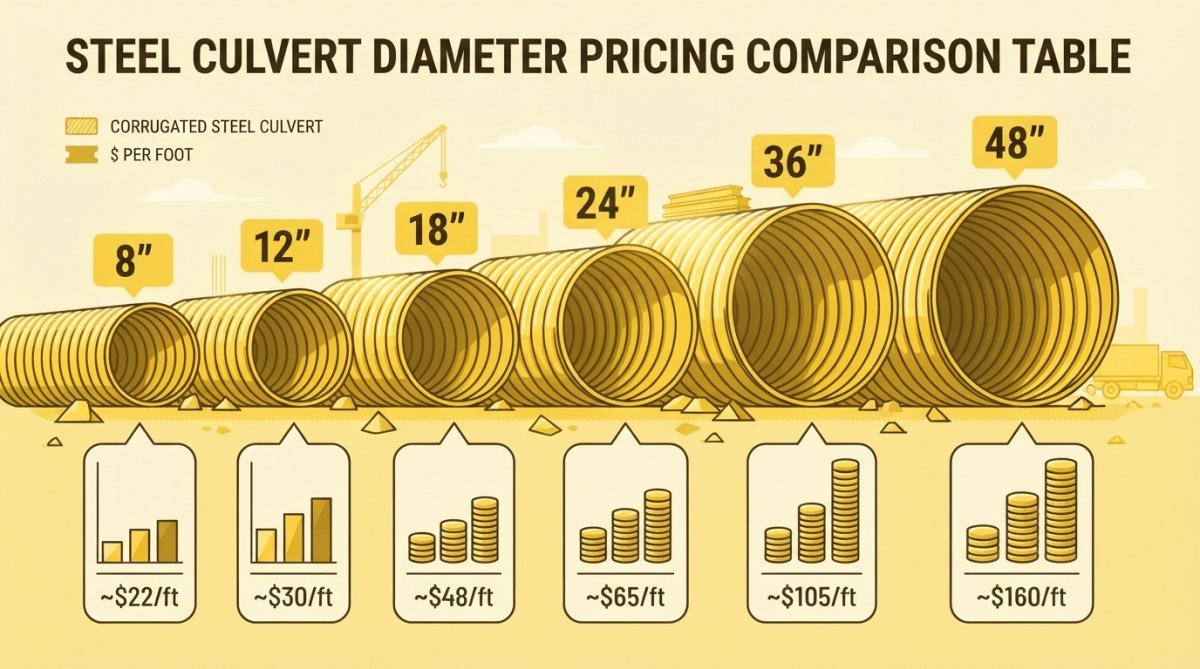
Steel Culvert Diameter Pricing Comparison Table
| Diameter | 16-Gauge Galvanized (per foot) | 14-Gauge Galvanized (per foot) | Typical Application | Load Capacity |
|---|---|---|---|---|
| 8 inch | Baseline | +25-30% | Residential drainage, small streams | Light residential |
| 12 inch | +60-70% vs. 8" | +25-30% | Standard driveway, parking lots | Residential to light commercial |
| 15 inch | +40% vs. 12" | +25-30% | Moderate stream crossing | Light commercial |
| 18 inch | +90-110% vs. 12" | +25-30% | Highway drainage, larger streams | Commercial |
| 24 inch | +200-250% vs. 12" | +25-30% | Major drainage, significant streams | Heavy commercial |
| 36 inch | +350-450% vs. 12" | +25-30% | Highway crossing, river channels | Heavy infrastructure |
| 48 inch | +500-700% vs. 12" | +25-30% | Major infrastructure, interstate | Critical infrastructure |
Types of Steel Culverts and Cost Variations
The steel culvert market offers several material and coating options beyond basic galvanized 16-gauge. Understanding these variations helps you select the right specification for your project’s soil conditions and budget.
Corrugated Metal Pipe (CMP) vs. Smooth Interior Options
Corrugated metal pipe (CMP) is the standard. The 2⅔-inch by ½-inch corrugation pattern provides structural strength, allowing thinner gauges to handle heavy loads. CMP is the lowest-cost option and works well for most applications.
Smooth interior pipe maintains structural strength through a different corrugation pattern but offers a smoother interior surface, reducing sediment accumulation and maintaining hydraulic capacity longer. Smooth interior costs 20-40% more per foot than standard CMP. For drainage applications where maintenance access is difficult or where flow capacity degrades over time, smooth interior justifies the premium.
Structural plate culverts (assembled from curved steel plates bolted together) are used for very large diameters (60+ inches) where single-piece pipe becomes impractical. These cost significantly more per foot than corrugated pipe but are necessary for mega-scale infrastructure.
Aluminized Steel vs. Galvanized Coatings
Galvanized coating (pure zinc) is the standard and provides 25-30 year service life in neutral soil. Aluminized steel coating (aluminum-zinc alloy) extends service life to 40-50 years in typical conditions and 50-70 years in alkaline soil. Aluminized costs 15-25% more per foot than galvanized but delivers dramatically longer service life, making it economical for infrastructure meant to last 50+ years.
Polyethylene-coated steel combines a steel base with a plastic coating for superior corrosion resistance in extremely aggressive environments. It costs 30-50% more than galvanized but provides 60+ year service life even in harsh conditions.
For standard highway and residential applications, galvanized is adequate and most economical. For critical infrastructure or installations in aggressive soil, aluminized justifies its premium.
Used vs. New Steel Pipe Pricing
Used culvert pipe is available from demolition and salvage projects. Pricing typically runs 40-60% below new material cost, making it attractive for budget-conscious projects.
However, used pipe carries risks. Corrosion damage may be hidden inside, reducing structural capacity. A used 24-inch culvert that appears sound might have pinhole corrosion that causes failure under load. Used pipe is reasonable for temporary installations or low-pressure applications. For permanent installations bearing vehicle loads or critical drainage infrastructure, new pipe is the safer choice despite higher cost.
Regulatory Requirements and Permitting for Culvert Installation
Most jurisdictions require permits for culvert installation, particularly if the culvert crosses public drainage systems, streams, or wetlands. Stream crossing culverts typically require environmental review under state water quality standards. The permit process usually takes 4-8 weeks and costs $200-1,000 in application and review fees.
Culverts installed beneath roadways must meet Department of Transportation specifications. These often mandate specific gauges, coatings, and end conditions. Verify specifications before ordering to avoid purchasing material that doesn’t meet regulatory requirements.
Sizing requirements are based on hydraulic modeling. The culvert must handle the 100-year storm flow without backing up and flooding upstream property. Professional hydraulic analysis costs $500-2,000 but ensures you specify the right size.
Local building codes may require specific corrosion protection based on soil pH and groundwater conditions. Acidic soil often requires aluminized or polyethylene coating rather than standard galvanized. Check local soil surveys and groundwater data before finalizing material specifications.
Maintenance and Longevity: Hidden Cost Factors
The lowest per-foot material cost isn’t always the most economical choice when you factor in maintenance and replacement frequency. A culvert that lasts 25 years costs more over 50 years than one that lasts 50 years, even if the initial material cost is higher.
Sediment and debris accumulation reduces culvert capacity over time. Standard CMP with corrugated interior traps sediment more readily than smooth interior. Periodic cleaning costs $500-2,000 depending on culvert size and access. Smooth interior culverts require less frequent cleaning, potentially saving $5,000-10,000 over a 50-year period.
Corrosion progression is predictable. A 16-gauge galvanized culvert in neutral soil loses roughly 1 mil of thickness per year to corrosion. After 25-30 years, the coating is consumed and base steel begins rusting. Planning for replacement at 40 years is realistic.
A heavier gauge or superior coating extends service life by 15-25 years, deferring replacement cost. For critical infrastructure or situations where replacement is expensive, the higher initial cost is justified by extended service life.
Inspection and assessment should occur every 10 years for critical culverts. Visual inspection costs $200-500. Regular inspection catches problems early, when partial repair is possible, rather than waiting for catastrophic failure.
How to Get Competitive Pricing on Your Culvert Order
Getting competitive pricing requires understanding what drives variation and asking the right questions. Request quotes from at least three suppliers using identical specifications: exact diameter, gauge, coating, length, quantity, and delivery address. This forces apples-to-apples comparison. If quotes vary by more than 10-15%, investigate why.
Ask about volume discounts explicitly. At what order quantity do prices drop? If your project is close to a discount threshold, ordering slightly more material might be economical.
Inquire about lead time. Standard inventory items ship faster and cost less. Custom specifications require longer lead times and sometimes carry premiums. If your timeline allows, ordering standard specifications saves money.
Bulk Order Discounts and Minimum Purchase Requirements
Bulk discounts typically kick in at 5-10 sections for small diameters (8-24 inch) and 3-5 sections for large diameters (36+ inch). Some suppliers offer tiered discounts (5% at 5 units, 10% at 10 units), while others have fixed breakpoints.
Minimum order requirements vary. Some suppliers require a full truckload. Others allow single-section orders at premium pricing. Steel & Pipe Supply maintains flexible minimums to accommodate smaller contractors and projects.
If your project requires only 2-3 sections, bundling with another project or future work can help you reach a discount threshold. Seasonal ordering can also yield better pricing, off-season (winter months) often brings 10-15% reductions simply because demand is lower.
Shipping and Delivery Cost Factors
Shipping cost depends on distance, culvert size, and weight. A single 20-foot section of 12-inch galvanized pipe weighs roughly 600-800 pounds. A single 36-inch section weighs 2,000-2,500 pounds.
Local delivery (within 50 miles) often costs $200-500. Regional delivery (100-300 miles) typically runs $500-1,500. Cross-country shipping can exceed $2,000-3,000 per shipment.
Consolidating multiple sections into a single shipment reduces per-unit shipping cost. Ask whether the quote includes delivery or if shipping is billed separately. Clarifying this prevents surprises when the invoice arrives.
For projects requiring custom cutting or fabrication, factor in additional lead time and potential expedite fees. A standard 20-foot section ships immediately; a custom-cut 17-foot section might require 2 weeks and cost 10-15% more.
Understanding the cost of steel culverts per foot requires balancing material specifications, installation requirements, and long-term durability. The cheapest per-foot price often becomes expensive when you factor in installation complexity, maintenance, and replacement frequency. Steel & Pipe Supply offers competitive pricing on galvanized and aluminized culverts in all standard diameters, flexible ordering minimums, and transparent cost breakdowns to help you make informed decisions. Whether you’re installing a simple residential driveway culvert or managing critical highway infrastructure, getting a detailed quote that accounts for your specific soil conditions, hydraulic requirements, and timeline ensures you’re comparing true project cost, not just material price. Contact our team for a free quote and let’s find the right culvert specification and pricing for your next project.
Frequently Asked Questions
What factors influence the cost of steel culverts per foot?
The cost of steel culverts per foot depends on diameter, wall thickness (gauge), material type (galvanized vs. aluminized), corrugation pattern, length, and order quantity. Larger diameters and heavier gauges cost more. Galvanized coatings add corrosion resistance and expense. Bulk orders typically reduce per-foot pricing. Custom cutting and fabrication fees also affect total project cost.
How does diameter affect steel culvert diameter pricing?
Diameter is one of the primary cost drivers for steel culvert diameter pricing. Small diameters (8-15 inches) are the most economical per foot, while medium sizes (18-36 inches) offer a balance of capacity and cost. Large diameters (42+ inches) command premium pricing per foot due to increased material volume and manufacturing complexity. Choosing the right diameter for your hydraulic capacity needs prevents oversizing and unnecessary expense.
Are there hidden costs beyond the per-foot culvert price?
Yes. Installation costs include labor, equipment rental, trenching, bedding material, and site preparation, often exceeding the material cost. Cutting fees apply for custom lengths. Shipping and delivery can be substantial for heavy culverts. Permitting and inspections may be required. Maintenance and eventual replacement should factor into long-term project budgeting. Always request a complete quote including all these components.
What's the difference between galvanized and aluminized steel culverts?
Galvanized steel culverts use a zinc coating for corrosion resistance and are the industry standard, offering good durability at moderate cost. Aluminized steel uses an aluminum-silicon coating and typically costs more but provides superior corrosion resistance in certain soil and water conditions. For most applications, galvanized steel offers excellent value. Consult your civil engineer on which coating suits your project's soil chemistry and expected service life.
Can I reduce culvert installation costs with proper planning?
Absolutely. Accurate site surveys and proper culvert sizing prevent oversizing and waste. Consolidating orders increases bulk discounts. Coordinating delivery with other materials reduces mobilization fees. Working with suppliers who stock standard sizes avoids custom fabrication delays and premiums. Choosing locally available gauges and diameters simplifies procurement. Contact Steel & Pipe Supply for a free quote to lock in competitive pricing before your project starts.
This article was written using GrandRanker