
Table of Contents
- What Are Custom Steel Pipe Cutting Services?
- Pipe Cutting Methods: Laser, Plasma & Saw Technologies
- Materials We Cut: Steel Grades & Specifications
- Pipe Beveling Services & End Preparation Options
- Industrial Pipe Cutting for OEM & Fabrication
- Precision Tolerances & Quality Control Standards
- Cost Savings & Efficiency Benefits of Custom Cutting
- Additional Fabrication Services Beyond Cutting
- Why Steel & Pipe Supply for Your Cutting Needs
- Conclusion: Get Your Custom Steel Pipe Cutting Quote
Last Updated: July 20, 2026
What Are Custom Steel Pipe Cutting Services?
Custom steel pipe cutting services transform raw steel tubing into precisely dimensioned components for construction, industrial, and engineering applications. Beyond simple length reduction, these services encompass precision tolerances, specialized end preparations, and integration with broader fabrication workflows that directly impact project margins and timelines.
When contractors and fabricators specify cut-to-length pipe with exact dimensions, bevels, or threaded ends, they outsource a critical manufacturing step that would otherwise consume labor hours and specialized equipment. Steel pipe cutting involves several distinct methodologies, laser, plasma, and saw technologies, each optimized for specific material grades, wall thicknesses, and production volumes. The right cutting method reduces material waste, improves consistency, and eliminates costly rework.
The real cost of poor cutting isn’t just material scrap, it’s the labor hours spent hand-finishing rough edges, managing inventory of oversized stock, and dealing with dimensional failures during assembly. Precision cutting eliminates that downstream waste.
Pipe Cutting Methods: Laser, Plasma & Saw Technologies
Different cutting technologies deliver fundamentally different results. The choice between laser, plasma, and saw cutting depends on material type, wall thickness, production volume, and precision requirements.
Laser Pipe Cutting for Precision Work
Laser cutting uses a focused beam of high-intensity light to melt or vaporize steel, creating extremely clean cuts with minimal heat distortion. Fiber laser systems cut carbon steel and stainless steel up to approximately 1/2-inch wall thickness with exceptional precision, producing a narrow kerf that reduces material waste compared to mechanical methods.
Laser-cut edges emerge with minimal burring, often requiring no secondary finishing. The real advantage appears in complex geometries, laser systems can cut angled bevels, internal holes, and custom profiles in a single pass, consolidating operations and reducing lead times for small-to-medium production runs.
However, laser cutting has practical limits. Very thick-wall pipe (6 inches and beyond) exceeds typical fiber laser capacity, and reflective materials like aluminum present challenges. For high-volume commodity cutting, the per-unit cost advantage diminishes compared to faster plasma or saw methods.
Plasma Cutting for Speed and Versatility
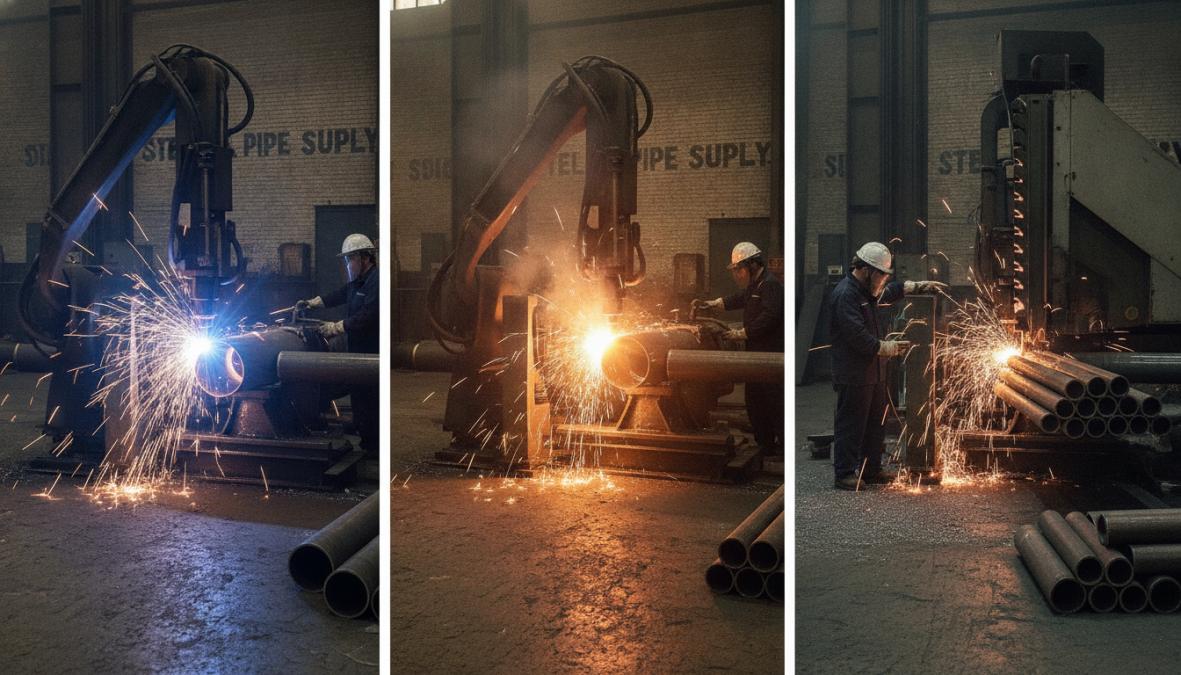
Plasma cutting ionizes a gas into a high-temperature arc that melts through steel at remarkable speed. A 6-axis CNC plasma cutter processes pipe diameters from 2 inches to 30 inches, handling both carbon and stainless steel across many wall thicknesses.
Plasma excels at throughput, where laser might process one complex part in 5 minutes, plasma handles the same cut in 1-2 minutes. For high-volume fabrication shops, this speed differential translates directly to lower per-unit cutting costs and faster job turnaround. The technology also handles thicker materials more efficiently than laser, making it the standard choice for heavy structural applications and infrastructure projects.
The tradeoff involves edge quality. Plasma-cut edges carry more heat distortion and require secondary finishing for applications demanding mirror-smooth surfaces. For applications where edge finish doesn’t drive downstream assembly costs, plasma represents the optimal speed-versus-cost balance.
Saw Cutting for Heavy-Duty Applications
Traditional saw cutting using carbide-tipped bandsaw blades remains the workhorse for commodity pipe cutting. It handles any material grade and wall thickness, producing burr-free edges without secondary finishing.
Saw cutting shines for high-volume, repetitive cuts where setup time amortizes across hundreds of identical pieces. The equipment cost is lower than laser or plasma systems, making it accessible to smaller fabrication shops. The limitation is speed per unit and geometric complexity, saw cutting produces straight cuts efficiently but requires multiple operations or manual hand-finishing for complex bevels or internal features.
Materials We Cut: Steel Grades & Specifications
Steel & Pipe Supply cuts carbon steel, stainless steel, and specialty alloys across a comprehensive range of wall thicknesses and diameters. The material specification determines both the cutting method and quality control protocols required.
Carbon Steel (ASTM A53 Grade B and API 5L Grade B) represents the largest volume of custom cutting work for pipelines, well drilling, and structural applications. These materials cut cleanly across all three technologies, with saw and plasma methods proving most cost-effective for high-volume runs.
Stainless Steel (304 and 316 grades) resists corrosion and handles high-temperature applications but work-hardens during cutting. Laser and plasma methods manage this better than saws, preventing edge hardening that can lead to cracking during assembly or service.
Alloy Steels (P91, chrome-moly, and specialty compositions) demand precision cutting and post-cut inspection for pressure vessels and critical infrastructure. Cutting methods must preserve material properties and prevent heat-affected zone degradation.
Wall thickness ranges from Schedule 10 (thin-wall) to Schedule 160 (extra-heavy). Thinner walls require gentler plasma settings or laser precision to avoid warping, while thicker walls demand strong equipment and longer processing times.
Mismatched cutting method to material grade causes expensive failures downstream. Stainless steel cut with a dull saw blade can develop micro-cracks that propagate under service pressure. Always verify that your cutting partner understands your material specification and has validated their process for that grade.
Pipe Beveling Services & End Preparation Options
End preparation transforms raw-cut pipe into assembly-ready components. Beveling, angling the pipe end to facilitate welding, is the most common end preparation, but threading, grooving, and facing offer additional capabilities.
Bevel Cutting prepares pipe ends for welding by creating a V-shaped or compound-angle groove along the circumference. CNC plasma and laser systems excel at variable-degree beveling, cutting precise angles in a single operation and eliminating hand-grinding. For critical infrastructure, precision beveling reduces weld defects and improves joint integrity.
Threading cuts internal or external threads directly into pipe ends, eliminating the need for separate coupling fittings. Grooving creates circumferential grooves for mechanical couplings, seals, or alignment features. Facing machines the pipe end perpendicular to the axis, ensuring square, burr-free surfaces for flanges or other components.
Industrial Pipe Cutting for OEM & Fabrication
Original equipment manufacturers and custom fabricators depend on reliable pipe cutting to maintain production schedules. OEM applications typically involve medium-to-large production runs where cutting represents a significant cost component.
A single fabrication project might require 500 pieces of 4-inch Schedule 40 carbon steel pipe cut to 12 feet 3 inches with a 37.5-degree single-V bevel. That’s 500 identical operations where consistency and speed directly impact the final product cost. Fabricators building structural components, pressure vessels, or mechanical assemblies require precision tolerances and repeatability, a 0.125-inch variance in cut length across 100 pieces compounds into assembly delays and rework.
The best cutting suppliers for OEM work maintain real-time production tracking, communicate proactively about schedule changes, and validate quality through statistical process control rather than 100% inspection.
OEM suppliers who invest in CNC automation and statistical quality systems deliver lower per-unit costs and faster lead times than job-shop cutters relying on manual setup and spot-checking. If your production volume exceeds 100 pieces per month, the difference in cutting cost and schedule reliability becomes substantial.
Precision Tolerances & Quality Control Standards
Precision cutting demands rigorous quality control. ASTM standards define acceptable tolerances for pipe dimensions, and ASME codes govern pressure-vessel applications.
Length Tolerance typically holds ±1/16 inch for standard cutting and ±1/32 inch for precision applications. Bevel Angle Tolerance for welding applications typically holds ±2 degrees. Surface Finish is measured in microinches (Ra): laser-cut edges emerge at approximately Ra 63 (smooth), plasma-cut edges typically measure Ra 125-250 (rougher), and saw-cut edges fall between these depending on blade condition.
Quality control procedures should include first-article inspection (FAI) validating that the cutting setup produces parts within specification, statistical process control (SPC) monitoring critical dimensions across production runs, traceability documentation linking each part to its cutting date and equipment, and periodic recalibration of cutting equipment.
Cost Savings & Efficiency Benefits of Custom Cutting
Custom cutting reduces waste and labor compared to manual cutting or purchasing oversized inventory. Understanding the actual cost structure enables accurate project budgeting.
Understanding Cutting Cost Drivers
Cutting cost depends on material grade, cutting method, production volume, complexity, and lead time. Transparent suppliers break down these factors so you can optimize your specifications for cost.
Material Cost represents your largest expense. A 4-inch Schedule 40 carbon steel pipe costs roughly $8-12 per linear foot. Stainless steel (304/316) runs 2-3× higher, typically $20-35 per linear foot. Specialty alloys can exceed $50 per linear foot.
Cutting Method Markup varies significantly. Laser cutting typically adds 15-25% to material cost for small-to-medium runs (50-500 pieces). Plasma cutting adds 8-15% for high-volume runs (500+ pieces). Saw cutting adds 5-10% for high-volume commodity work (1000+ identical pieces).
Complexity Surcharge applies when cuts require beveling, multiple angles, or custom end preparations. Threading or grooving adds 20-40% to the base cutting cost. Bundling multiple services typically reduces the per-service cost by 10-20% compared to separate vendors.
Volume Discount Structure is where transparent suppliers differentiate. Most cutting shops use tiered pricing: 1-50 pieces at full rate, 51-250 pieces at 10-15% discount, 251-1000 pieces at 20-30% discount, and 1000+ pieces at 35-50% discount.
Lead Time Pricing affects cost when schedules are tight. Standard lead times (2-3 weeks) carry baseline pricing. Rush orders (1 week or less) typically add 25-50% to cutting costs.
Real-World Cost Example: Structural Casing Project
Consider a contractor fabricating 200 pieces of 6-inch Schedule 40 carbon steel pipe, each cut to 8 feet with a 45-degree double-V bevel.
Material Cost: 6-inch Schedule 40 carbon steel at ~$18 per linear foot × 1,600 linear feet = $28,800
Cutting Cost (Plasma method, 200-piece volume): $35 per piece × 200 pieces = $7,000
Total Project Cost: $35,800 (Material: 80.4%, Cutting: 19.6%)
Cost Savings vs. In-House Cutting:
In-house cutting with a manual bandsaw would require ~60 hours of labor at $45/hour ($2,700), plus equipment wear ($800) and material scrap losses ($2,300), totaling $5,800 plus material waste. Outsourcing at $7,000 includes optimized nesting reducing scrap by 60% (saves ~$1,400 in material), precision bevels requiring zero hand-finishing (saves ~$1,500 in labor), and faster turnaround. Net savings: ~$2,400 plus schedule acceleration and quality improvement.
Material Yield Improvement
A project requiring 500 pieces of 12-foot-3-inch pipe cut from standard 20-foot stock illustrates yield improvement:
Manual/Inefficient Cutting: 7.75 feet scrap per piece × 500 pieces = 3,875 linear feet at $18/foot = $69,750 in wasted material
CNC Optimized Cutting: 2-3 feet scrap per piece × 500 pieces = 1,250 linear feet at $18/foot = $22,500 in scrap
Yield Improvement: $47,250 saved (40% reduction in material waste)
Labor Reduction and Schedule Impact
Manual cutting and hand-finishing of bevels consumes 15-20 labor hours per 100 pieces. Precision CNC cutting reduces that to 2-3 hours. At $45/hour fully loaded labor cost: manual approach costs $675 per 100 pieces in labor, while CNC outsourced costs $112 per 100 pieces. Labor savings: $563 per 100 pieces, or $5.63 per piece.
Precision cutting also eliminates dimensional surprises during assembly. Projects with ±1/8-inch variation see fit-up problems and rework consuming 5-10% of assembly time. Precision CNC cutting holding ±1/32-inch tolerance virtually eliminates this rework.
When evaluating cutting suppliers, request a transparent cost breakdown showing material, cutting method, complexity surcharge, volume discount tier, and lead time. Compare total project cost including material yield, labor, and rework. The cheapest cutting quote often masks hidden costs in material waste and assembly labor.
| Factor | Impact on Cost | Optimization Strategy |
|---|---|---|
| Material Grade | 2-3× variance (carbon vs. stainless) | Specify minimum grade meeting performance requirements |
| Cutting Method | 5-25% markup over material | Match method to volume: saw for 1000+, plasma for 100-1000, laser for precision |
| Complexity (bevels, threading) | +20-40% per feature | Bundle services with single vendor to reduce per-feature cost |
| Production Volume | 35-50% discount at 1000+ pieces | Batch orders into standard lead times to access volume tiers |
| Lead Time | +25-50% for rush orders | Plan 2-3 weeks ahead to avoid rush premiums |
| Material Yield | 40% waste reduction vs. manual | CNC nesting optimization saves 5-10% of material cost |
Additional Fabrication Services Beyond Cutting
Cutting often integrates with complementary fabrication services that prepare pipe for final assembly or installation. Threading converts bare pipe ends into assembly-ready components with internal or external threads. Grooving creates circumferential grooves for mechanical couplings and seals. Welding joins multiple cut pieces into subassemblies before final shipment. Shot Blasting removes mill scale and corrosion, preparing surfaces for painting or coating. Bending curves cut pipe to specific radii for non-straight runs. Drilling and Tapping create holes and threaded features for mechanical attachment.
Suppliers offering integrated fabrication services reduce your supply chain complexity. Instead of coordinating separate vendors, a single partner manages the entire workflow, reducing lead times and communication overhead.
Why Steel & Pipe Supply for Your Cutting Needs
Steel & Pipe Supply brings competitive pricing, responsive service, and a proven track record with contractors and fabricators across the Tampa Bay region. We differentiate through precision capability, integrated fabrication services, and a commitment to understanding your project constraints so we become a profit center rather than a cost center.
Proven Track Record: Case Studies & Measurable Outcomes
Case Study 1: Structural Fabricator – Schedule Acceleration
A Tampa-based structural steel fabricator needed 2,400 pieces of 4-inch Schedule 40 carbon steel pipe cut to 14 feet 6 inches with 37.5-degree single-V bevels. The fabricator’s in-house bandsaw could produce 40 pieces per day, creating a 60-day bottleneck. Steel & Pipe Supply set up a dedicated CNC plasma cutting line with 300-piece daily capacity and maintained a 3-day lead time for design changes, producing all 2,400 pieces within 8 days with precision bevels requiring zero hand-finishing.
Outcome: 52-day schedule acceleration, zero weld defects from bevel inconsistency (vs. 2-3% rework rate with hand-ground bevels), and $9,600 net savings plus schedule acceleration.
Case Study 2: Pressure Vessel Fabricator – Quality & Compliance
A fabricator producing ASME Section VIII pressure vessels was cutting P91 chrome-moly pipe using a manual saw, which introduced edge hardening creating micro-cracks during welding. Steel & Pipe Supply invested in laser cutting capability for specialty alloys, eliminating heat-affected zone hardening and implementing full traceability documentation.
Outcome: Weld defect rate reduced from 8-10% to <1%, rework labor reduced by 7-9 hours per 100 pieces, and full ASME traceability documentation provided with each shipment.
Case Study 3: Contractor – Material Yield Optimization
A general contractor building a municipal water infrastructure project needed 1,200 pieces of 6-inch Schedule 40 carbon steel pipe for culvert sections. In-house cutting generated 8-10 feet of scrap per piece. Steel & Pipe Supply optimized the cutting plan using CNC nesting software, reducing scrap to 2-3 feet per piece and providing all pieces cut to ±1/32-inch tolerance.
Outcome: 70% improvement in material waste reduction, $129,600 saved in material costs, 15-20 labor hours saved during installation, and $4,200 cutting cost.
Why These Outcomes Matter
These case studies illustrate a critical principle: the cheapest cutting quote often masks hidden costs in material waste, assembly labor, and schedule delays. When evaluating cutting suppliers, ask: Can they optimize nesting to reduce material waste? Do they have equipment and expertise to handle your material grade without introducing defects? Can they maintain responsive lead times for schedule-critical projects? Do they provide full traceability and quality documentation for compliance-critical applications?
Our Competitive Advantages
Multi-Technology Capability: We maintain laser, plasma, and saw cutting equipment, allowing us to match the right technology to your material, volume, and precision requirements.
Integrated Fabrication Services: Beyond cutting, we offer beveling, threading, grooving, facing, and shot blasting in-house. Bundling services reduces handling, improves consistency, and accelerates lead times.
Responsive Local Service: We’re based in Tampa Bay and maintain multiple production lines with spare capacity, enabling 2-3 day lead times for standard orders and the ability to accommodate schedule changes without premium rush charges.
Precision Quality Systems: We use statistical process control (SPC) to monitor critical dimensions across production runs, catching process drift before it produces scrap and reducing your incoming inspection burden.
Transparent Pricing: We provide detailed cost breakdowns showing material, cutting method, complexity surcharge, volume discount tier, and lead time impact, enabling accurate project budgeting and cost optimization.
Material Expertise: Our team understands the nuances of cutting different material grades. We validate our processes for your specific material specification, preventing costly failures from mismatched cutting methods.
Steel & Pipe Supply delivers more than cutting services, we deliver project outcomes. Whether your priority is schedule acceleration, material cost reduction, quality improvement, or compliance documentation, we have the equipment, expertise, and local responsiveness to solve your specific problem. Contact us today with your project specifications, and we’ll provide a detailed cost analysis showing how precision cutting impacts your total project cost and timeline.
Frequently Asked Questions
What types of steel pipes can custom steel pipe cutting services handle?
Custom steel pipe cutting services work with carbon steel, stainless steel, and various alloys in diameters ranging from small tubing to large industrial pipe. Services accommodate different wall thicknesses, from Schedule 10 to 6-inch walls, and handle both standard and exotic materials. Capabilities vary by cutting method; laser cutting typically handles thinner walls, while plasma and saw cutting excel with heavier-gauge pipe for structural and fabrication applications.
How do laser pipe cutting and plasma cutting differ in precision and cost?
Laser pipe cutting delivers tighter tolerances and cleaner edges, ideal for precision work and prototyping, but typically costs more per unit. Plasma cutting is faster, more cost-effective for high-volume runs, and handles thicker materials well, though edges require more finishing. Saw cutting suits heavy-duty applications where precision is less critical. Choice depends on your tolerance requirements, material thickness, volume, and budget, discuss your specific needs for accurate cost comparison.
What additional services complement custom steel pipe cutting?
Beyond cutting, fabricators offer pipe beveling services, threading, grooving, drilling, tapping, welding, and bending. Shot blasting and surface treatments prepare pipes for assembly or coating. These value-add services reduce your total fabrication time and labor costs by consolidating multiple operations in one shop, ensuring consistency and faster project timelines compared to managing separate vendors.
How do I ensure the cut pipes meet my engineering specifications?
Reputable custom steel pipe cutting providers follow ASTM and ASME standards, use CNC machines for consistency, and employ quality control inspections for dimensional accuracy and material grade verification. Request documentation of tolerances achieved, material certifications, and inspection reports before committing to large orders. Local suppliers like Steel & Pipe Supply offer direct communication and rapid inspection feedback, reducing the risk of spec failures that delay projects.
What lead times should I expect for custom steel pipe cutting orders?
Lead times depend on order size, material availability, and cutting method. Standard inventory cuts typically ship within days; custom or high-volume orders may take 1-3 weeks. Local suppliers often maintain wider stock and offer faster turnaround than national competitors. Confirm lead times upfront and discuss rush options if your project timeline is tight, this prevents costly project delays and margin erosion.