
Table of Contents
- Steel Beam vs Pipe for Structural Support: Key Differences
- Structural Steel Shapes: I-Beams, H-Beams, and Wide-Flange Options
- Hollow Structural Sections (HSS) and Round Pipe Comparison
- I-Beam Load Capacity: Engineering Tables and Real-World Applications
- Cost of Steel Beams Per Linear Foot and Material Pricing
- Welding, Fabrication, and Installation Difficulty
- Durability, Corrosion, and Maintenance Comparison
- Common Construction Applications: Garages, Rafter Systems, and Go-Kart Frames
- Which Should You Choose for Your Project?
- Conclusion
Steel Beam vs Pipe for Structural Support: A Complete Guide
Last Updated: July 24, 2026
When engineers and builders evaluate structural materials, the decision between steel beam vs pipe for structural support shapes cost, installation timeline, load capacity, and long-term durability. Choosing wrong can mean wasting materials or discovering mid-project that your selected profile can’t handle the required span.
At Steel & Pipe Supply, we work with contractors and builders across the Tampa Bay region who face this decision regularly. This guide breaks down the engineering differences, real-world applications, and decision framework you need to choose correctly the first time.
Steel Beam vs Pipe for Structural Support: Key Differences
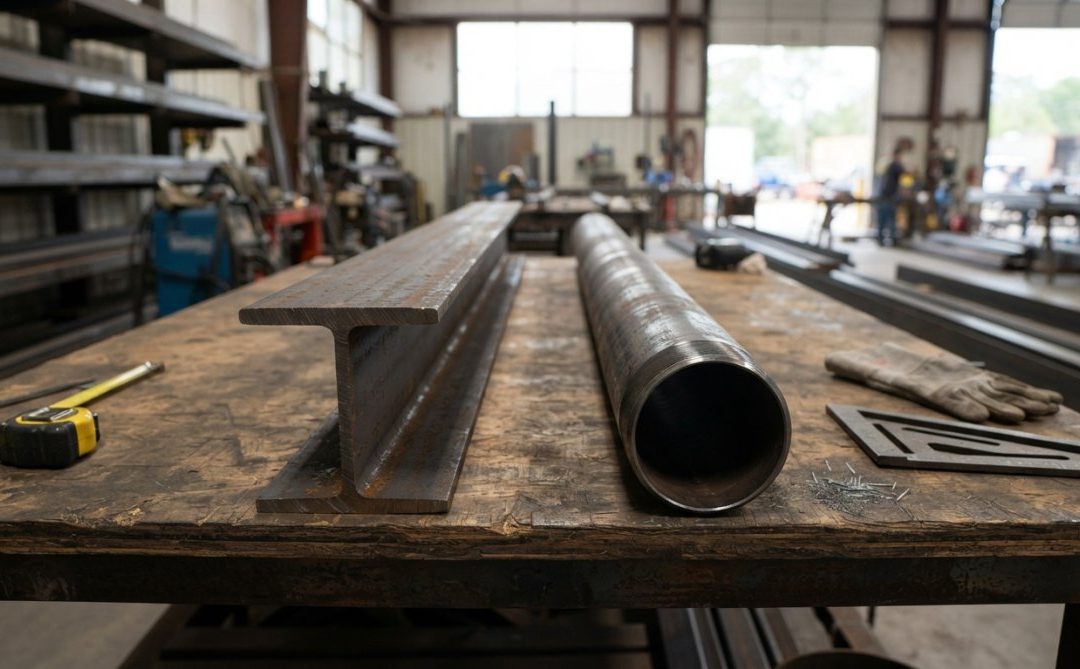
A steel beam, typically an I-beam, H-beam, or wide-flange shape, concentrates material in flanges (horizontal plates) and a web (vertical connector), creating high moment of inertia in one direction. A pipe, whether round or square, distributes material evenly around a hollow core, creating uniform torsional rigidity.
Beams excel when you need maximum bending strength in one primary direction. Pipes excel when you need equal strength in multiple directions or when torsional forces dominate your loading scenario.
Consider a garage rafter system: an I-beam spans horizontally and carries vertical loads, exactly what an I-beam’s geometry optimizes for. A go-kart frame experiences twisting forces from acceleration, braking, and cornering, round pipe handles those torsional stresses uniformly, while an I-beam can twist more easily because material isn’t distributed around the central axis.
The real cost advantage goes to whichever shape matches your loading pattern. Oversizing a pipe to handle bending loads you could handle efficiently with a beam wastes material. Undersizing a beam when torsion is present creates a dangerous weak point.
Structural Steel Shapes: I-Beams, H-Beams, and Wide-Flange Options
I-beams and H-beams differ in flange geometry. An I-beam has sloped flanges that taper toward the web. An H-beam has parallel flanges, creating a wider, more symmetrical cross-section. H-beams distribute loads more evenly and resist lateral forces better, making them preferable for heavy industrial applications. I-beams cost less and work well for standard commercial construction.
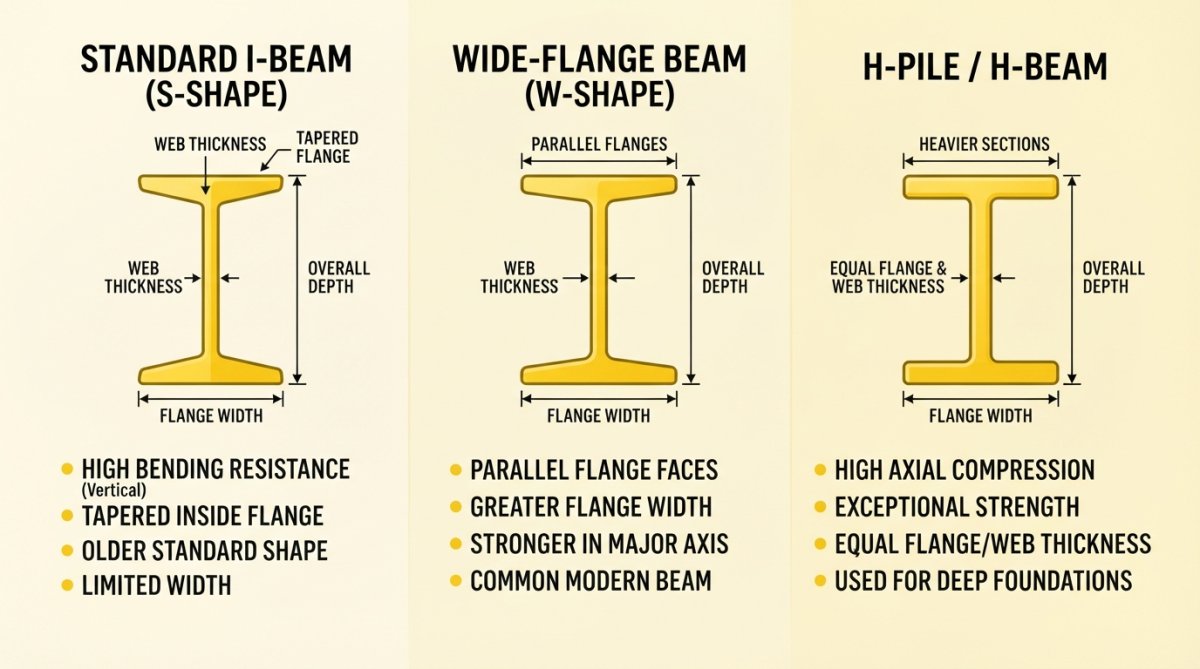
Wide-flange beams (W-beams) represent the modern standard for most construction. They combine the efficiency of an I-beam with thicker, wider flanges that increase moment of inertia without proportionally increasing weight. A W12×26 beam can span farther and carry more load than an older standard I-beam of similar depth.
According to American Institute of Steel Construction (AISC) Steel Construction Manual, wide-flange beams achieve 15-20% better load-to-weight ratios than traditional I-beams, which directly impacts project budgets and installation labor.
Wide-flange beams are the default choice for new construction. If you’re working with legacy I-beam specifications, verify whether they’re based on outdated standards before committing to material orders.
Hollow Structural Sections (HSS) and Round Pipe Comparison
Hollow Structural Sections, square tubing, rectangular tubing, and round pipe, offer advantages that solid beams cannot match in certain applications. The hollow core reduces weight while maintaining structural integrity.
Square tubing vs round pipe represents the most common HSS choice. Square tubing provides two equal axes of bending strength and handles torsion better than rectangular tubing. Round pipe offers the highest torsional rigidity because material is distributed uniformly around the central axis.
The wall thickness of HSS determines its load capacity. A 4-inch square tube with 1/4-inch walls carries significantly more load than the same profile with 3/16-inch walls. This flexibility allows engineers to fine-tune strength without changing external dimensions.
HSS connects differently than beams. Welding to the flat face of a beam flange is straightforward. Welding to round pipe requires careful joint design to ensure proper penetration. Square tubing offers a middle ground: larger flat surfaces than round pipe, but less material waste than rectangular tubing.
For water tanks and standpipes, pipe is the only practical choice. For structural frames where internal volume doesn’t matter, HSS costs less than pipe because it’s manufactured in higher volumes for construction applications.
Do not assume round pipe and square tubing are interchangeable. A round pipe 4 inches in diameter with 1/4-inch walls has different moment of inertia values in different directions than a 4-inch square tube with 1/4-inch walls. Always verify engineering calculations before substituting one for the other.
I-Beam Load Capacity: Engineering Tables and Real-World Applications
I-beam load capacity depends on three variables: the beam’s moment of inertia (determined by its size and shape), the material’s yield strength (typically 36 ksi for ASTM A36 or 50 ksi for ASTM A992 Grade 50), and the span distance. These factors interact non-linearly, meaning small changes in span produce dramatic changes in safe load capacity.
Simplified Load Capacity Reference
The table below shows approximate safe uniformly distributed loads (UDL) for common wide-flange beam sizes at typical residential and light commercial spans. These values assume ASTM A992 Grade 50 steel, standard deflection limits (L/240), and typical connection details. Always consult a structural engineer or detailed load tables for final design decisions.
| Beam Size | 15 ft Span | 20 ft Span | 25 ft Span | 30 ft Span |
|---|---|---|---|---|
| W8×24 | 8,400 lbs | 4,700 lbs | 2,800 lbs | 1,800 lbs |
| W10×30 | 12,500 lbs | 7,200 lbs | 4,400 lbs | 2,900 lbs |
| W12×26 | 14,800 lbs | 8,900 lbs | 5,400 lbs | 3,600 lbs |
| W12×40 | 22,000 lbs | 13,200 lbs | 8,100 lbs | 5,400 lbs |
| W14×38 | 26,500 lbs | 16,000 lbs | 9,800 lbs | 6,600 lbs |
Source: Simplified from AISC Steel Construction Manual load tables; values assume typical residential/commercial loading and standard deflection criteria.
How Span Distance Dominates Load Capacity
Span distance is the single most critical variable. When you double the span distance, safe load capacity drops to approximately one-quarter of its original value. A W12×26 beam spanning 15 feet can safely carry 14,800 pounds of uniformly distributed load. The same beam at 30 feet carries only 3,600 pounds, a 75% reduction for a 100% increase in span. This is why engineers often recommend larger beams or additional support posts rather than accepting longer spans with marginal safety margins.
Deflection vs. Strength: Two Separate Calculations
Deflection limits, how much a beam bends under load, are separate from strength calculations and often control the final beam size. Building codes typically limit deflection to span/240 for floors (a 20-foot span can deflect no more than 1 inch) and span/180 for roof systems. Excessive deflection can cause floor squeaking, cracking in drywall, doors that won’t close properly, and visible sag.
In many residential and light commercial applications, deflection limits, not strength, determine the required beam size. A W10×30 might have sufficient strength to carry a 20-foot residential floor span, but deflection calculations may require a W12×26 or larger to stay within code limits.
Material Grade and Yield Strength
ASTM A992 Grade 50 is the modern standard, offering 50 ksi yield strength and excellent weldability. Older structures may use ASTM A36 (36 ksi yield), which costs less but requires approximately 40% larger beams to achieve equivalent strength. Material cost savings from A36 are typically offset by the cost of larger beams and increased installation labor.
Point Loads vs. Uniformly Distributed Loads
The load tables above assume uniformly distributed loads. Point loads, concentrated weight at one location, require different calculations and typically require larger beams. Always specify whether loads are distributed or concentrated when requesting engineering calculations.
Lateral Bracing and Unbraced Length
Beam capacity also depends on lateral bracing, support that prevents the beam from twisting sideways. An unbraced beam can fail at lower loads than a fully braced beam of identical size. Residential floor systems are typically fully braced by floor decking and joists, allowing beams to carry their full rated capacity.
Always request engineering calculations from your fabricator or engineer, not just material specifications. A beam that meets strength requirements might exceed deflection limits or require lateral bracing you hadn’t planned for.
Building Code References
The International Building Code (IBC) references AISC standards for structural steel design. The AISC Steel Construction Manual provides detailed load tables for all standard beam sizes. Your local building department may have specific requirements or amendments that affect allowable loads.
Cost of Steel Beams Per Linear Foot and Material Pricing
Material cost for structural steel beams varies by size, grade, and market conditions. Smaller beams (W8 and W10 series) generally cost less per pound than larger beams. However, using multiple smaller beams instead of one larger beam often increases total project cost due to additional connections and labor.
The cost calculation extends beyond material. Fabrication costs, cutting, drilling, welding, and surface preparation, often exceed material costs by 50-100% depending on complexity.
Steel & Pipe Supply maintains competitive pricing on standard beam sizes and offers volume discounts for larger projects. We stock our Tampa location serving the Tampa Bay area to minimize delivery delays. Galvanized finishes (zinc coating for corrosion protection) add 15-25% to material cost but extend service life dramatically, especially in coastal or high-moisture environments.
Fabrication and Production Economics
Fabrication difficulty directly impacts project cost and timeline. I-beams and wide-flange beams connect via bolted or welded connections to gusset plates or end plates. These connections require accurate drilling, cutting, and positioning.
Hollow structural sections introduce different fabrication challenges. Square and round tubing connections require careful joint design to ensure welds penetrate properly and distribute stress evenly.
Production economics favor beams for large projects. A 50,000-pound order of W12 beams costs less per pound than the same weight in miscellaneous pipe and tubing because beam production runs are longer and more standardized. Small projects, under 5,000 pounds, may find pipe more economical because you’re not paying for setup costs on a beam production run.
Lead times matter. Standard beam sizes maintain consistent inventory, with delivery in 2-4 weeks. Specialty sizes can extend lead times to 8-12 weeks. Steel & Pipe Supply stocks common sizes locally, reducing wait times for standard projects.
Welding, Fabrication, and Installation Difficulty
Welding structural steel beams requires certified welders, but difficulty and cost vary dramatically by material profile and connection type.
Beam Flanges vs. Pipe: Welding Difficulty Comparison
Structural steel beams offer ideal welding geometry. The flat flange (typically 6-12 inches wide) and vertical web create large, accessible surfaces for welding. Most certified welders can produce full-penetration welds on beam flanges without specialized training.
Round pipe welding demands significantly higher skill. A welder must maintain consistent penetration as the torch moves around the pipe. Incomplete welds on round pipe can hide inside the hollow section, creating stress concentrations that fail under load without visible warning.
Square tubing occupies a middle ground. The flat faces provide larger welding surfaces than round pipe, but the corners create stress concentrations that require careful joint design.
Fabrication Operations: Cutting, Drilling, Threading
Cutting: Beams and pipe both cut cleanly with band saws, oxy-fuel torches, or plasma cutters. Pipe requires careful torch technique to avoid warping the hollow section.
Drilling: Beam flanges drill easily with standard equipment. Drilling round pipe requires a jig to hold the pipe steady; the curved surface makes hand-drilling difficult and inaccurate.
Threading: Beam flanges thread easily with standard taps and dies. Round pipe threading is difficult; most fabricators weld on lugs (small plates with pre-drilled holes) rather than threading the pipe itself.
Bolted vs. Welded Connections: Installation Trade-offs
Bolted connections offer several advantages: field assembly without welding equipment, easier inspection, reversibility, lower skill requirement, and faster field installation. Bolted connections require pre-drilled holes, typically done in the fabrication shop. Beam flanges are ideal for bolted connections.
Welded connections offer different advantages: rigid, permanent joints with no bolt relaxation, smaller connection footprint, better for dynamic loads, lower material cost, and better for corrosive environments. Welded connections require certified welders, inspection, and time for welds to cool.
When Professional Installation Is Required
Structural engineer stamp required:
- Any welded connections in load-bearing applications
- Spans exceeding standard residential tables
- Unusual loading conditions
- Any project subject to seismic or wind design requirements
- Commercial projects
Certified welder required:
- All structural welds in load-bearing applications
- Welds on pipe or tubing
- Welds subject to inspection or testing
DIY-feasible projects (with proper design and local approval):
- Simple bolted beam connections in residential applications
- Non-load-bearing pipe bracing or handrails
- Garage additions with standard beam sizes and bolted connections
Even for DIY-feasible projects, verify local building code requirements. Contact your local building department before starting design work.
Connection Design and Shop Drawings
Connection design determines installation speed, cost, and reliability. Detailed shop drawings catch design errors before fabrication starts and show exact connection geometry, bolt/weld locations, material specifications, weld symbols, bolt specifications, dimensional tolerances, and surface finish requirements.
Do not assume field modifications are simple. A welder in the field costs 2-3 times more than a welder in the shop. Design it right the first time.
Fabrication Cost Estimation
Total fabrication cost includes material, labor, and overhead. For a typical project: material cost is 30-40%, labor is 40-50%, and overhead and profit is 10-20%. Bolted connections typically cost 20-30% less in labor than equivalent welded connections. Small projects (under 2,000 pounds) have higher per-pound costs because setup time and overhead are fixed.
Durability, Corrosion, and Maintenance Comparison
Bare structural steel oxidizes when exposed to moisture and oxygen. The resulting rust is porous and doesn’t protect underlying material. Bare steel requires regular maintenance, typically repainting every 5-10 years depending on environment.
Galvanized steel (zinc-coated) provides superior corrosion protection. The zinc coating sacrifices itself to protect the underlying steel. Galvanized beams and pipe last 50+ years in most environments with minimal maintenance. Coastal areas with salt spray exposure may require additional paint coatings over galvanization.
Red iron (bare structural steel in its as-rolled condition) is common in industrial and agricultural applications where appearance matters less than cost. Red iron is cheaper than galvanized material but requires a maintenance program.
Environmental resistance varies by location. Inland, dry climates favor bare steel with periodic paint maintenance. Coastal areas, high-humidity regions, and areas with industrial pollution demand galvanization or other protective coatings. Steel & Pipe Supply can advise on appropriate finishes based on your project location and expected exposure.
Stainless steel offers maximum corrosion resistance but costs 3-5 times more than carbon steel. Stainless is rarely used for structural applications unless the environment is extremely corrosive or contamination is unacceptable.
Common Construction Applications: Garages, Rafter Systems, and Go-Kart Frames
Garage construction represents the most common application for structural steel beams. A typical two-car garage spans 24 feet (the width) and 20-24 feet (the depth). A pair of W12×26 beams, one at each side wall, carries the roof load and allows clear interior space.
Go-kart frames and small race cars demand torsional rigidity and light weight. Round pipe dominates this application because it handles the twisting forces from acceleration, braking, and cornering with minimal material. A typical frame uses 1.5-inch or 2-inch diameter pipe with 0.095-inch wall thickness, creating a structure weighing 40-60 pounds that withstands thousands of pounds of dynamic force.
Industrial applications, storage racks, mezzanines, and equipment supports use beams for vertical loads and pipe for bracing. The combination provides efficient strength in multiple directions. Water storage stands and elevated tanks use pipe almost exclusively because the hollow section creates usable volume and the uniform cross-section distributes pressure loads evenly.
Which Should You Choose for Your Project?
Choosing between steel beam vs pipe for structural support requires evaluating three primary factors: primary loading direction, required strength-to-weight ratio, and fabrication constraints.
If your primary loads are vertical and concentrated in one direction, beams win. Garage rafters, floor systems, and simple bridge designs all favor beams because the geometry optimizes for bending in one plane.
If loads come from multiple directions or torsion is significant, pipes or square tubing are superior. Go-kart frames, rotating equipment supports, and structures subject to wind loads from all sides benefit from the uniform strength properties of hollow sections.
If weight is critical, calculate the weight-to-strength ratio for both options. A beam profile might deliver the required strength at 70% of the weight compared to pipe, or vice versa depending on the specific loading scenario.
If fabrication is constrained by available equipment or budget, bolted connections favor beams because flat flanges are easier to drill and bolt.
Decision Framework: Load, Span, and Budget
Start with your span distance and maximum load. Use engineering load tables or consult a structural engineer to determine required beam size. Once you have a baseline beam profile, calculate the weight and cost.
Next, evaluate whether torsional forces or lateral loads are significant. If they are, investigate equivalent pipe or tubing options. Compare total material cost, fabrication cost, and installation labor for both approaches.
Building codes in your jurisdiction may influence the decision. Verify code requirements before finalizing your material selection. For projects under $10,000 in material cost, the cost difference between beams and pipe is often small relative to labor. Choose based on engineering fit and fabrication capability.
Building Code Compliance and Engineering Requirements
All structural steel must comply with applicable building codes. The International Building Code (IBC) governs most construction and references AISC standards for design and construction of structural steel.
ASTM standards specify material properties. ASTM A992 Grade 50 is the modern standard for structural beams and pipe. Professional engineers must stamp structural drawings for most jurisdictions. Welding inspection is mandatory for critical connections.
Steel & Pipe Supply can connect you with local structural engineers and certified fabricators who understand Tampa Bay building codes and inspection requirements. We’ve supported hundreds of projects that passed inspection on the first submission because materials and specifications were correct from the start.
Structural steel decisions shape your project’s timeline, budget, and safety. Whether you’re building a garage, fabricating equipment, or designing an industrial structure, matching the right material profile to your loading conditions prevents costly mistakes and ensures long-term reliability.
Steel & Pipe Supply stocks standard beam and pipe sizes across multiple Tampa Bay locations, eliminating weeks of lead time on common materials. Our team works with engineers, contractors, and fabricators daily to ensure materials meet specifications and arrive when you need them. Call for a free quote on your exact structural support needs and let us help you choose the right material for your project.
Frequently Asked Questions
What is the main difference between a steel beam and a steel pipe for structural support?
Steel beams, particularly I-beams and H-beams, feature a high moment of inertia with wide flanges and a vertical web, making them excellent for resisting bending loads in one plane. Steel pipes, including Hollow Structural Sections (HSS) and round pipes, offer uniform strength in all directions and superior torsional rigidity. Beams excel at spanning horizontal distances with heavy loads; pipes work better for columns, bracing, or applications requiring omnidirectional strength and resistance to twisting forces.
How do I-beam load capacity and Hollow Structural Sections (HSS) compare?
I-beams typically offer greater bending capacity per unit weight because of their optimized cross-section for vertical loads and horizontal spans. HSS and square tubing provide more balanced load distribution and higher torsional rigidity, making them superior for compression, lateral bracing, and frame applications where loads come from multiple directions. For pure horizontal span applications, I-beams often deliver more capacity; for complex three-dimensional loading, HSS generally performs better.
Are steel pipes cheaper than steel beams for construction projects?
Pricing depends on quantity, delivery location, grade, wall thickness, and current material costs. Generally, round pipes may have lower per-pound material costs, but I-beams often provide greater load-bearing efficiency, meaning you may need less total material. For accurate cost comparison on your project, contact Steel & Pipe Supply for a free quote reflecting current pricing and your specific structural requirements.
When should I use a steel pipe instead of a beam for structural support?
Use steel pipes when you need compression strength (columns), omnidirectional load resistance, torsional rigidity for braced frames, or when loads approach from multiple angles. Pipes work well for go-kart frames, machinery mounts, and water stand structures. Use beams when you have clear horizontal spans with vertical loads, such as garage roofs, rafter systems, or floor joists where bending resistance in one plane is the primary concern.
What building codes and ASTM standards apply to steel beams and pipes?
Steel beams and pipes must comply with the International Building Code (IBC) and local jurisdictional amendments. Structural steel typically follows ASTM standards such as A36 for general structural steel, A500 for hollow structural sections, and A53 for pipe. Engineers verify tensile strength, yield strength, and mechanical properties against these standards. Always consult your local building department and have a professional engineer design your structure to ensure code compliance and safety.
This article was written using GrandRanker