
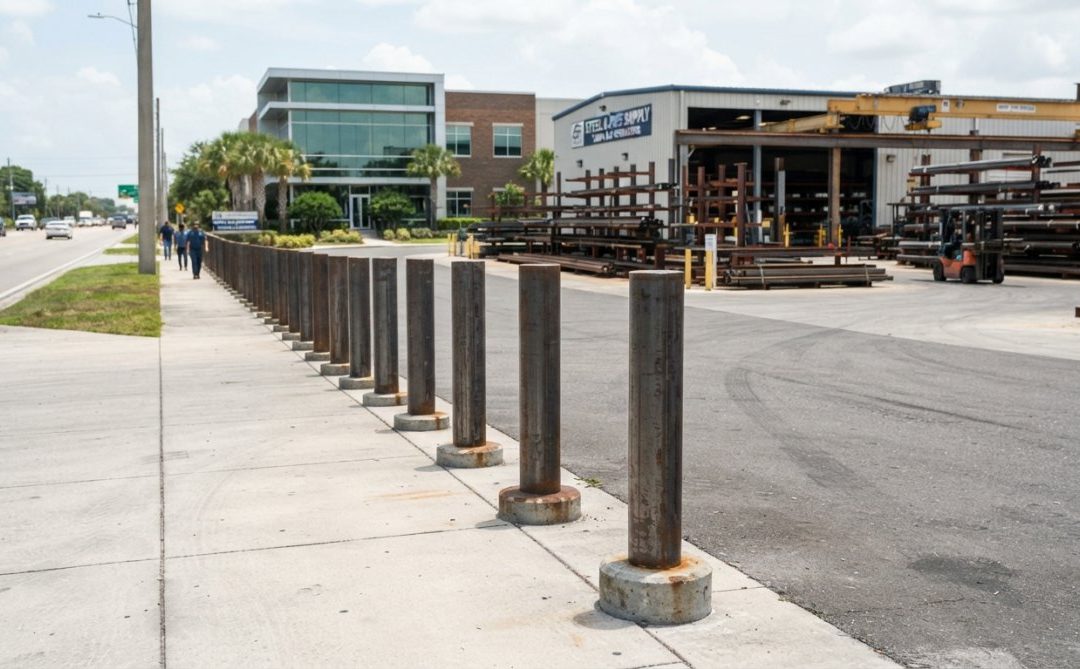
Table of Contents
- What Are Steel Bollards and Why Security Matters
- Security Bollard Types: Fixed, Rising, and Crash-Rated Options
- Crash-Rated Bollards: Anti-Ram Protection and Impact Resistance
- 7 Core Benefits of Steel Bollards for Security
- 1. Superior Impact Resistance and Vehicle Mitigation
- 2. Corrosion Resistance and Long-Term Durability
- 3. Controlled Access and Perimeter Security
- 4. Traffic Segregation and Pedestrian Safety
- 5. Vandalism Protection and Visual Deterrence
- 6. Cost-Benefit Analysis Over Lifecycle
- 7. Insurance Savings and Legal Liability Protection
- Bollard Installation Guidelines and Spacing Requirements
- Steel vs. Concrete Bollards: A Practical Comparison
- Environmental Impact and Sustainability Considerations
- Smart Bollard Integration for Modern Security Systems
- Choosing the Right Steel Bollards for Your Security Needs
- Conclusion: Why Steel Bollards Deliver Long-Term Security Value
Steel Bollards for Security: 7 Key Benefits Explained
Last Updated: July 25, 2026
What Are Steel Bollards and Why Security Matters
Steel bollards are sturdy, cylindrical metal posts installed at ground level to control vehicular access and protect pedestrians and property from impact. At Steel & Pipe Supply, we work with contractors and builders across the Tampa Bay area who rely on these barriers to harden their perimeters against both accidental and deliberate threats.
A properly installed steel bollard can stop a vehicle traveling at highway speeds, making it one of the most reliable deterrents available for site hardening. What makes steel the material of choice is its combination of strength, durability, and cost-effectiveness compared to alternatives. The security landscape has shifted dramatically over the past five years, businesses are no longer relying solely on cameras and access control systems. They’re adding physical infrastructure that makes unauthorized vehicle access nearly impossible, because electronic security alone cannot prevent a determined attacker from using a vehicle as a weapon.
Steel bollards provide multi-layered protection: they deter casual trespassing, stop accidental vehicle incursions, and can withstand deliberate ram-raid attempts depending on their crash rating and installation depth.
Security Bollard Types: Fixed, Rising, and Crash-Rated Options
Different security scenarios demand different bollard configurations. The choice between fixed, rising, and crash-rated options depends on your access control requirements, traffic patterns, and the level of threat you’re defending against.
Fixed Steel Bollards
Fixed bollards are permanently installed posts that never move. They’re the most affordable option and require minimal maintenance since there are no mechanical components to fail. Installation involves digging a hole, setting the bollard in a concrete foundation, and backfilling. The depth of the foundation directly correlates with impact resistance, a bollard set 36 inches deep can withstand significantly more force than one set 24 inches deep. Most commercial installations use 36-48 inch depths for maximum protection.
The trade-off with fixed bollards is inflexibility. Once installed, you cannot move them without excavation work, making them ideal for permanent security applications but unsuitable for locations where emergency vehicle access might be required.
Rising and Retractable Bollards
Rising bollards solve the access problem by sinking below ground level when activated, allowing authorized vehicles to pass, then rising again to block further traffic. They integrate with access control systems, card readers, or license plate recognition to trigger the mechanism. Response time varies by model, typically 3-5 seconds to fully raise or lower.
The complexity of rising bollards means higher upfront costs and ongoing maintenance requirements. Hydraulic systems need fluid checks, seals can wear, and mechanical failure is more likely than with fixed posts. However, for locations requiring both security and regular vehicle access, they’re the standard solution.
Rising bollards installed in high-traffic areas should have weatherproof seals and annual maintenance schedules. Debris accumulation around the base can prevent full retraction and cause mechanical strain over time.
Crash-Rated Bollards: Anti-Ram Protection and Impact Resistance
Crash-rated bollards represent the highest tier of vehicle mitigation technology. These are engineered and tested to withstand impacts from vehicles traveling at specific speeds, typically 30, 40, or 50 mph depending on the rating. A bollard rated to stop a 15,000-pound vehicle at 50 mph must meet rigorous ASTM (American Society for Testing and Materials) performance criteria through actual vehicle crash testing.
Installation depth becomes critical for crash-rated bollards. A bollard rated for 50 mph impact but installed only 24 inches deep will fail. The rating assumes proper foundation depth, typically 48-60 inches into the ground, with engineered concrete to handle force transfer from the bollard to surrounding soil.
Crash-rated bollards cost significantly more than standard fixed bollards, but they’re essential for high-security applications: government buildings, military installations, critical infrastructure, and facilities protecting large crowds. The investment in a crash-rated system is insurance against catastrophic vehicle-based attacks.
7 Core Benefits of Steel Bollards for Security
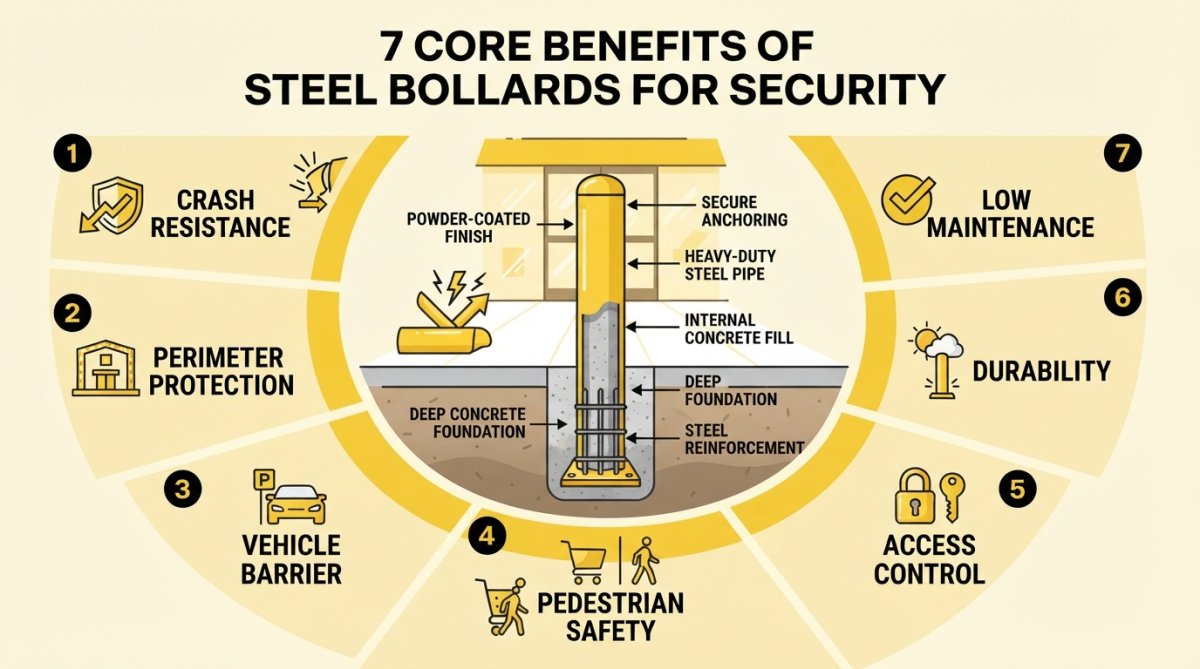
1. Superior Impact Resistance and Vehicle Mitigation
Steel bollards deliver impact resistance that concrete, plastic, or wooden alternatives cannot match. Steel’s density and tensile strength allow it to absorb and dissipate vehicle impact energy without deforming or breaking. When a vehicle strikes a properly installed steel bollard, the post remains standing while the vehicle sustains damage, a powerful psychological and physical deterrent.
Steel’s yield strength, its ability to bend slightly under stress without permanently deforming, allows the bollard to absorb impact without catastrophic failure. Concrete bollards, by contrast, are rigid and brittle; they crack and shatter under severe impact, losing their protective function. A 4-inch diameter steel bollard set 48 inches deep in reinforced concrete can stop a 15,000-pound vehicle traveling at 50 mph.
2. Corrosion Resistance and Long-Term Durability
Steel’s durability depends entirely on surface treatment. Most commercial bollards use powder-coat finishes, a dry coating process that creates a uniform, durable layer resistant to chipping and fading. Powder-coated bollards can last 15-20 years in typical outdoor conditions with minimal maintenance. In harsh environments, stainless steel bollards offer superior corrosion resistance, though at higher cost.
The maintenance burden of steel bollards is remarkably low. Unlike wood that requires regular treatment or concrete that can spall and crack, powder-coated steel bollards need only occasional inspection and cleaning. If the coating is damaged, localized touch-up paint prevents rust from spreading.
Bollards installed in coastal areas should use stainless steel or marine-grade coatings. Standard powder-coat finishes fail within 5-7 years in salt-spray environments, resulting in rust and structural weakening.
3. Controlled Access and Perimeter Security
Bollards create defined perimeters that control where vehicles can and cannot go. A row of bollards along a storefront or building entrance makes it physically impossible for vehicles to drive through, no electronic system failure, no human error, no workaround. This passive security approach is far more reliable than access control systems alone.
Perimeter security using bollards works in layers: fixed bollards around the outer edge prevent casual vehicle intrusion, while rising bollards at the main entrance allow authorized access while blocking unauthorized vehicles. Bollards can also segregate loading zones from pedestrian areas and direct traffic flow.
4. Traffic Segregation and Pedestrian Safety
By physically separating vehicle traffic from pedestrian zones, bollards dramatically reduce the risk of accidental vehicle-pedestrian collisions. Plazas, parks, and public gathering spaces benefit enormously from this separation. Traffic segregation also reduces accidents in commercial and industrial settings by creating clear awareness and compliance.
Bollard spacing directly affects pedestrian safety. Standard spacing for pedestrian protection is 4-6 feet on center, which prevents most vehicles from passing while allowing emergency responders to navigate around bollards if necessary.
5. Vandalism Protection and Visual Deterrence
Steel bollards are difficult to move, damage, or remove without specialized equipment, making them ideal for locations where property damage is a concern. The visual presence of bollards also serves as a deterrent, when potential intruders see a well-designed perimeter secured with steel bollards, they recognize that the site is protected and move on to easier targets.
Bollards can be customized with paint, logos, or artistic designs that integrate them into the landscape rather than making them look like fortress barriers, allowing you to maintain appearance while ensuring security.
6. Cost-Benefit Analysis Over Lifecycle
The initial cost of installing steel bollards is typically lower than alternatives like vehicle barriers, guard gates, or extensive surveillance systems. For a row of 20 bollards protecting a storefront, total project cost is often less than a year of security guard services.
Over a 15-20 year lifecycle, the cost advantage becomes even more pronounced. Bollards require minimal maintenance, occasional cleaning and inspection. There are no mechanical components to replace, no software licenses to renew, no monitoring fees. A properly installed, powder-coated steel bollard will still be protecting your site two decades after installation, making the per-year cost remarkably low.
7. Insurance Savings and Legal Liability Protection
Insurance companies recognize steel bollards as a legitimate risk mitigation strategy. Properties that implement physical security measures like bollards often qualify for reduced insurance premiums. Legal liability protection is equally important, if a vehicle crashes into your building, documentation of deliberate security measures like bollards demonstrates that you took vehicle mitigation seriously and implemented industry-standard protective measures.
Properties with documented physical security measures like bollards typically see insurance premium reductions of 5-15%, depending on the facility type and risk profile. Over 15-20 years, these savings often exceed the total installation cost.
Bollard Installation Guidelines and Spacing Requirements
Proper Bollard Spacing Requirements for Maximum Protection
Bollard spacing is determined by the threat you’re defending against and the size of vehicles you want to prevent from passing. Standard vehicle widths range from 6 feet (compact cars) to 8 feet (full-size SUVs). To prevent any vehicle from passing, bollards should be spaced 5 feet on center or closer.
The spacing calculation also accounts for bollard diameter. A 4-inch diameter bollard takes up more of the gap than a 3-inch bollard, so you might space 4-inch bollards slightly farther apart. However, most engineers recommend consistent spacing for aesthetic and maintenance reasons. Staggered spacing, where bollards alternate from left to right, forces vehicles to navigate a zigzag path that’s impossible at speed.
| Spacing Configuration | Vehicle Prevention | Pedestrian Protection | Best Use Case |
|---|---|---|---|
| 4 feet on center | All vehicles | Excellent | High-security perimeters |
| 5 feet on center | Most vehicles | Excellent | Commercial storefronts |
| 6 feet on center | Large vehicles only | Good | Public plazas, parks |
| 8 feet on center | None | Moderate | Aesthetic applications |
Foundation and Installation Best Practices
The foundation is where bollard installation succeeds or fails. A bollard is only as strong as its connection to the ground. Standard practice calls for embedding the bollard at least 36 inches into the ground, with 48 inches preferred for crash-rated applications. The concrete foundation should extend at least 12 inches beyond the bollard’s diameter on all sides.
Standard concrete (3,000 psi) is adequate for most applications, but higher-strength concrete (4,000-5,000 psi) is recommended for crash-rated installations. The concrete should be reinforced with rebar or wire mesh to prevent cracking. Soil conditions affect installation requirements, soft, wet soil requires deeper embedment or larger foundation volumes, while rocky or clay soil with good bearing capacity allows shallower installation.
Installation sequence is critical. The hole must be dug to the correct depth and width, the bollard positioned plumb (perfectly vertical), and concrete poured and cured before the bollard is subjected to any load. Rushing the concrete cure time compromises performance.
Steel vs. Concrete Bollards: A Practical Comparison
Concrete bollards are cheaper upfront but heavier and more prone to damage. Under impact, concrete bollards crack and shatter, losing their structural integrity. Once cracked, they must be removed and replaced. Steel bollards cost more initially but deliver superior performance and longevity, steel bends and deforms under impact but remains standing, and localized repairs restore function.
The maintenance difference is stark. Concrete bollards require regular inspection for cracks, spalling, and water infiltration. Steel bollards need only occasional cleaning and coating touch-ups. Over a 15-year lifecycle, the maintenance burden and cost of concrete bollards often exceeds that of steel.
Weight is another consideration. Concrete bollards are significantly heavier, making them difficult to install and impossible to relocate. Steel bollards’ lower weight makes installation easier and repositioning possible without heavy equipment. Aesthetically, steel bollards can be powder-coated in any color and customized with logos, while concrete bollards are limited to gray or painted finishes that age poorly.
Environmental Impact and Sustainability Considerations
Steel is a recyclable material. At the end of a bollard’s life, the steel can be melted down and repurposed. This circular economy aspect makes steel bollards more environmentally responsible than single-use alternatives. The long lifecycle (15-20 years) spreads manufacturing environmental costs across decades, resulting in lower per-year impact than bollards requiring replacement every 5-7 years.
Concrete production is energy-intensive and generates significant carbon emissions. If concrete bollards require replacement due to deterioration, the total environmental impact of multiple installations exceeds that of a single long-lasting steel installation. Local sourcing reduces transportation emissions, Steel & Pipe Supply‘s proximity to the Tampa Bay area means customers can source bollards locally, reducing carbon footprint compared to ordering from distant manufacturers.
Smart Bollard Integration for Modern Security Systems
Modern bollards can integrate with smart security systems, adding intelligence to physical barriers. Rising bollards connect to access control systems that read credentials, recognize authorized vehicles, and automatically raise bollards for passage. License plate recognition systems can identify vehicles, verify them against approved lists, and grant automatic passage if authorized.
Sensors can monitor bollard status, whether a rising bollard is fully raised, partially raised, or fully lowered. This data feeds into facility management systems that alert maintenance teams to mechanical issues before they cause failures. The integration of physical security (bollards) with electronic security (access control, monitoring) creates defense-in-depth, if electronic systems fail, the physical barrier remains effective.
Choosing the Right Steel Bollards for Your Security Needs
Selecting bollards requires matching the product specification to your specific threat level and use case. Start by defining what you’re protecting against: casual vehicle intrusion, deliberate ram-raid attacks, or something in between. This threat assessment drives the bollard type and crash rating you need.
Consider your traffic patterns. Do you need vehicle access to the protected area, or is complete vehicle exclusion acceptable? This determines whether you need fixed or rising bollards. For most commercial applications, a combination works best, fixed bollards around the perimeter, rising bollards at access points.
Budget constraints are real, but they shouldn’t override security requirements. A cheaper bollard that fails under impact is worse than no bollard at all. Invest in bollards rated for the threat level you face. Installation quality is as important as product quality, hire experienced installers who understand foundation requirements and can achieve proper embedment depth. Establish a maintenance schedule for inspecting bollards, checking coating integrity, and addressing any damage.
Conclusion: Why Steel Bollards Deliver Long-Term Security Value
Protecting your property from vehicle-based threats doesn’t require expensive, complex systems. Steel bollards provide straightforward, reliable, cost-effective security that works 24/7 without power, software, or maintenance contracts. The benefits of steel bollards for security, impact resistance, durability, low maintenance, and psychological deterrence, make them the standard choice for facilities serious about perimeter protection.
Steel & Pipe Supply has helped contractors and facility managers across the Tampa Bay area implement bollard security systems that protect their assets while maintaining professional appearance. Our team specializes in sourcing high-quality steel bollards in the exact specifications your project requires, and we maintain relationships with experienced installation contractors who understand proper foundation design and embedment depth. Whether you need fixed bollards for permanent perimeter protection or rising bollards for controlled access, Steel & Pipe Supply delivers the materials and expertise to get your security infrastructure right. Call for a FREE Quote! and discuss your bollard requirements with our team, we’ll help you choose the right solution for your security needs and ensure your project stays on schedule and within budget.
Frequently Asked Questions
What are the different types of security bollards and which is best for my property?
Security bollards come in three main types: fixed bollards, which are permanently installed and provide constant protection; rising bollards, which can be raised or lowered to control access; and crash-rated bollards, engineered to withstand high-impact vehicle collisions. Fixed steel bollards are ideal for storefronts and perimeter protection, while rising bollards suit areas requiring flexible access control. Crash-rated bollards are essential for high-security applications and government facilities. Your choice depends on your security level, budget, and whether you need flexible access control.
How do crash-rated bollards protect against vehicle impact and ram-raid attacks?
Crash-rated bollards are engineered to meet ASTM standards for impact resistance, designed to stop vehicles traveling at specific speeds without allowing penetration. They feature reinforced steel construction, deep foundations, and load-bearing capacity that absorbs and dissipates collision energy. The bollard's structural integrity prevents vehicles from breaking through, protecting pedestrians, merchandise, and building entrances from intentional or accidental impacts. Installation depth and spacing are critical, proper bollard spacing requirements ensure gaps are too narrow for vehicles to pass between them.
What are the installation requirements and bollard spacing requirements for effective security coverage?
Proper bollard installation requires deep concrete foundations, typically 36 inches or deeper depending on soil conditions and impact ratings. Bollard spacing requirements generally range from 4 to 6 feet apart to prevent vehicles from squeezing between units. Installation must follow ASTM standards and local building codes. The foundation must support the bollard's load-bearing capacity and anchor it securely to prevent rotation or displacement. Professional installation ensures structural integrity and maximum protection. Spacing is critical: gaps larger than 4 feet allow vehicle passage, defeating security purposes.
How do steel bollards compare to concrete bollards in terms of durability and maintenance?
Steel bollards offer superior corrosion resistance when powder-coated or made from stainless steel, requiring minimal maintenance over their lifecycle. Concrete bollards are heavier and maintenance-free initially but can crack, spall, and deteriorate over time, especially in harsh weather. Steel bollards maintain structural integrity longer, resist weathering better, and can be repaired if damaged. While concrete costs less upfront, steel bollards typically provide better long-term value through durability and lower maintenance costs. Steel's load-bearing capacity also exceeds concrete, making it ideal for high-security applications and site hardening.
This article was written using GrandRanker