
Table of Contents
- Steel Pipe vs PVC for Drainage: Side-by-Side Comparison
- Material Cost Comparison for Drainage Pipe
- Durability and Lifespan: PVC Pipe Lifespan for Drainage vs Steel
- Corrosion Resistance and Environmental Factors
- Installation Labor Requirements and Ease
- Best Pipe for Underground Drainage: Choosing the Right Material
- Retrofitting Challenges: When to Replace Drainage Systems
- Steel Pipe vs PVC: Pros and Cons Summary
Last Updated: July 14, 2026
When choosing between steel pipe vs pvc for drainage systems, the decision hinges on several critical factors that directly impact your project’s longevity, installation costs, and compliance with local building codes. Both materials excel in different scenarios, and choosing the wrong one can cost you thousands in repairs or replacements down the line.
Steel Pipe vs PVC for Drainage: Side-by-Side Comparison
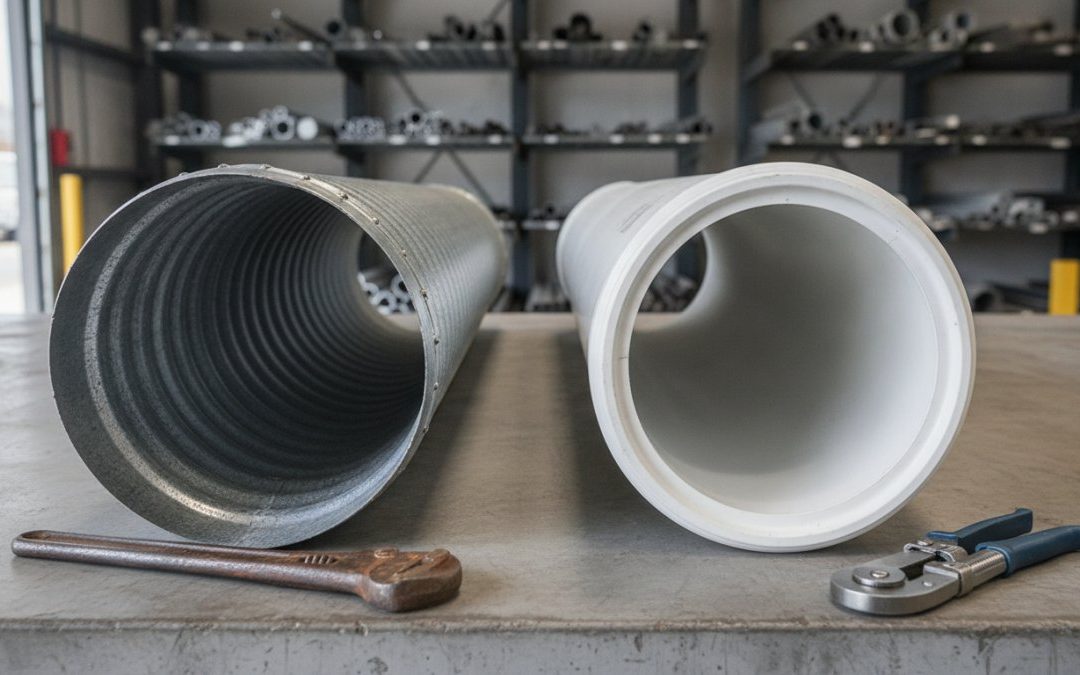
Steel pipe, typically galvanized or stainless steel for drainage applications, offers superior structural strength and can handle external loads that would crush standard PVC. PVC drainage pipe, particularly Schedule 40 and Schedule 80 varieties, provides excellent chemical resistance, lower material costs, and faster installation with minimal labor.
The real tension lies in the tradeoff between upfront affordability and long-term durability. PVC wins on initial price and ease of handling. Steel wins on lifespan in corrosive environments and load-bearing capacity in underground applications where heavy soil pressure or traffic loads exist.
Quick Comparison Table
| Factor | Steel Pipe (Galvanized) | PVC (Schedule 40/80) | Winner |
|---|---|---|---|
| Material Cost | Higher | Lower | PVC |
| Installation Labor | Moderate | Quick/Easy | PVC |
| Corrosion Resistance | Good (with coating) | Excellent | PVC |
| Tensile Strength | Very High | Moderate | Steel |
| External Load Bearing | Excellent | Limited | Steel |
| Lifespan (neutral soil) | 50+ years | 50-75 years | PVC |
| Lifespan (acidic soil) | 20-30 years | 50+ years | PVC |
| Heat Tolerance | Excellent | Limited (≤140°F) | Steel |
| Chemical Resistance | Moderate | Excellent | PVC |
| Noise Reduction | Poor | Good | PVC |
| Fire Rating | Better | Lower | Steel |
| Retrofit Ease | Difficult | Easier | PVC |
Material Cost Comparison for Drainage Pipe
PVC pipe typically costs 40-60% less per linear foot than galvanized steel pipe of equivalent diameter. For a 500-foot drainage line, this difference translates into thousands of dollars in material savings.
Steel pipe requires specialized couplings, transition fittings, and sometimes welding or threading, which adds labor expense. PVC uses simpler slip-fit or solvent-weld connections that most plumbers can execute quickly. A drainage system that takes two days to install with steel might take one day with PVC, reducing labor costs proportionally.
The hidden cost consideration: steel pipe in acidic soil can corrode through its galvanized coating within 20-30 years, requiring expensive replacement. PVC maintains structural integrity in the same conditions for 50+ years.
Request pricing for both materials at the same time. The labor cost difference often offsets much of the material price gap, especially for larger projects where installation efficiency matters.
Durability and Lifespan: PVC Pipe Lifespan for Drainage vs Steel
PVC pipe lifespan for drainage typically ranges from 50 to 75 years under normal soil conditions. Steel pipe lifespan depends heavily on coating integrity and soil chemistry. Galvanized steel maintains 50+ years of service in neutral or alkaline soil, but that timeline collapses to 20-30 years in acidic soil, common in regions with coniferous forests or naturally acidic groundwater.
Research shows that approximately 40% of North American soils fall below pH 6.5, creating an acidic environment that accelerates steel corrosion. In these regions, PVC’s resistance to soil acidity becomes a major advantage. Schedule 80 PVC, with thicker walls than Schedule 40, extends lifespan further and provides better resistance to mechanical damage during installation.
PVC doesn’t require maintenance coatings or cathodic protection systems. Steel pipe in aggressive soil sometimes requires these protective measures, adding ongoing costs.
Never assume a galvanized steel pipe installed 30 years ago is still protecting your drainage system. If your property has acidic soil, inspect for corrosion before problems develop.
Corrosion Resistance and Environmental Factors
PVC resists nearly all common soil contaminants, sulfates, chlorides, acids, and alkaline solutions. It doesn’t rust and doesn’t require protective coatings.
Steel pipe corrodes through general corrosion (surface rust that gradually thins the pipe wall) and galvanic corrosion (when dissimilar metals contact in the presence of moisture). Once the galvanized coating is breached through damage or chemical attack, corrosion accelerates rapidly.
Soil Acidity and Chemical Exposure
Acidic soil is the primary enemy of galvanized steel drainage. Soil pH below 6.0 attacks the zinc coating aggressively. Regions with naturally acidic groundwater or sulfate-rich soils require either stainless steel (expensive) or PVC (cost-effective).
PVC handles these environments effortlessly. It resists sulfates and soil acids. For above-ground sections, UV exposure is the concern. Unprotected PVC degrades under extended direct sunlight, becoming brittle over 10-15 years. Standard practice wraps or paints exposed PVC to extend its life indefinitely.
PVC becomes rigid and prone to cracking below 32°F and begins to soften above 140°F. Steel pipe handles both extremes. If your drainage system will carry hot water, steel or stainless steel is necessary.
Installation Labor Requirements and Ease
PVC dominates residential and commercial drainage because installation is fast and simple. PVC connections use solvent welding (gluing) or mechanical slip-fit couplings. A plumber can connect 20-30 PVC joints per day with minimal training.
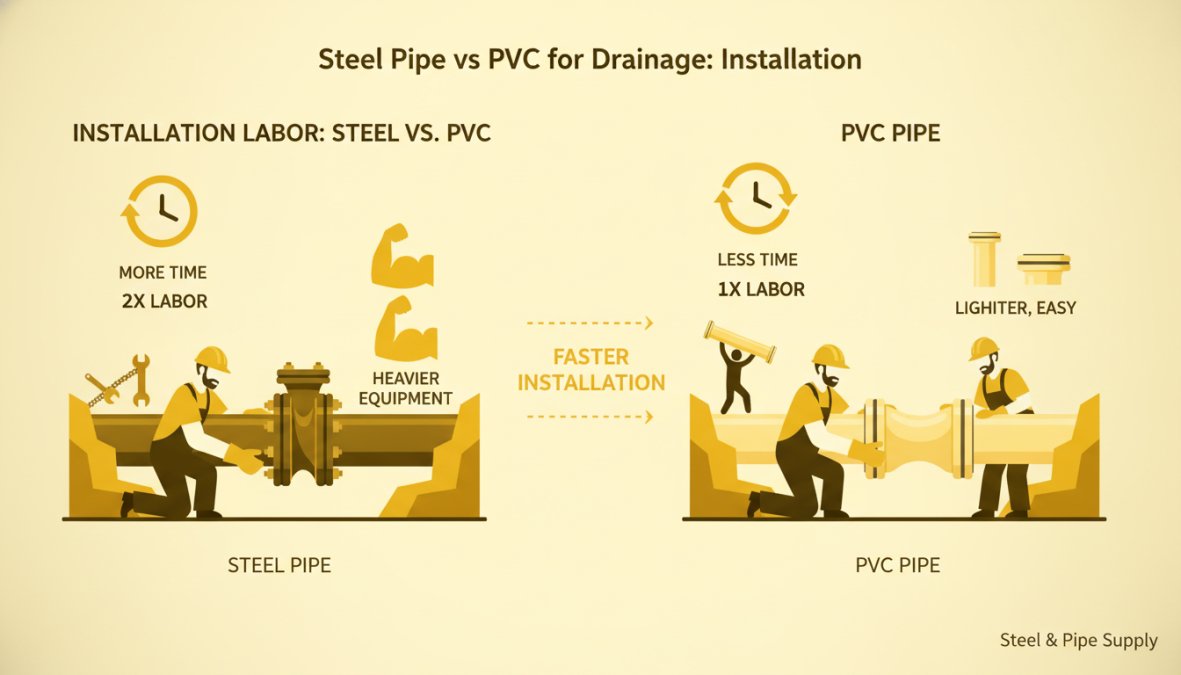
Steel pipe requires threading or welding for most connections. A steel drainage system that takes two days with PVC might require four to five days with steel, doubling labor costs.
Cutting and fitting is easier with PVC. A simple hacksaw handles diameter up to 4 inches. Steel pipe requires a bandsaw, angle grinder, or threading machine. A 20-foot section of 4-inch PVC weighs about 50 pounds; the same section of steel pipe weighs 400+ pounds, requiring mechanical handling equipment.
Transition fittings between PVC and other materials are readily available and inexpensive. For new construction, PVC installation costs roughly 30-40% less than steel in labor alone.
If your project involves retrofitting existing cast iron or steel drainage, PVC transition fittings make the job faster and cheaper than replacing the entire system with steel.
Best Pipe for Underground Drainage: Choosing the Right Material
In most residential and light commercial applications, PVC is the best choice. It’s cost-effective, durable, and installation is straightforward.
However, steel becomes the best pipe for underground drainage in specific scenarios:
Choose steel pipe when:
- The drainage system must support heavy external loads (under parking areas, roadways, or industrial facilities)
- Thermal requirements demand it (drainage carrying heated water or in high-temperature industrial processes)
- Above-ground sections are exposed to direct UV and cannot be protected
- Local building codes specifically require it for certain applications
- The system must integrate with existing steel infrastructure using welded connections
Choose PVC when:
- Soil is acidic (pH below 6.5) and steel corrosion is a concern
- Budget constraints are significant
- Installation speed is critical
- The system is fully underground with no thermal extremes
- Future modifications or repairs are likely
For most drainage applications, foundation drainage, storm sewers, sanitary sewers, roof drainage, PVC is the best pipe for underground drainage. It meets or exceeds code requirements in virtually all jurisdictions and lasts as long as or longer than steel in typical soil conditions.
Code Compliance and Local Regulations
Building codes govern drainage materials strictly. The International Plumbing Code (IPC) and local amendments specify which materials are acceptable for different applications. Most jurisdictions approve both PVC and steel for drainage, but some have restrictions.
Some codes require Schedule 80 PVC for certain underground applications, while others accept Schedule 40. Sanitary sewer applications sometimes have specific material requirements that differ from storm drainage. Before selecting a material, verify local code requirements with a contractor familiar with your jurisdiction.
Noise Insulation and Fire Rating Requirements
PVC excels at noise reduction. Its lower density and acoustic properties dampen water flow noise significantly. A drainage system using PVC produces noticeably less sound than steel.
Fire rating is where steel has the advantage. Steel pipe carries a fire rating of 0 (non-combustible). PVC has a fire rating of 1, meaning it’s combustible. Most building codes accept PVC for general drainage, but some jurisdictions restrict it in certain high-risk areas. If fire rating is a concern, confirm code requirements.
Retrofitting Challenges: When to Replace Drainage Systems
Retrofitting presents different challenges for steel versus PVC. Replacing steel pipe with steel pipe is straightforward but labor-intensive. Replacing steel with PVC is faster and cheaper. PVC transition fittings connect to existing steel, and you only need to replace the damaged section.
Retrofitting PVC with new PVC is the easiest scenario. Old PVC can often be cut and new sections inserted with couplings.
If you’re facing drainage problems in an older building, PVC replacement is often faster and more affordable than replacing with matching steel, even if the original system was steel.
Steel Pipe vs PVC: Pros and Cons Summary
When to Choose Steel Pipe
Pros:
- Exceptional structural strength handles heavy external loads
- Superior fire rating (non-combustible, required in some high-risk applications)
- Excellent thermal tolerance for hot water or industrial drainage
- Durable in neutral to alkaline soil conditions
- No UV degradation concerns for exposed sections
Cons:
- Higher material cost (40-60% more than PVC)
- Significant labor costs for threading, welding, or specialized connections
- Corrosion in acidic soil requires protective measures or frequent replacement
- Heavier weight requires mechanical handling equipment
- Difficult to retrofit or modify after installation
- Higher noise transmission than PVC
When to Choose PVC
Pros:
- Lower material cost reduces project budget significantly
- Fast installation with simple solvent-weld or slip-fit connections
- Excellent chemical and corrosion resistance, especially in acidic soil
- Lighter weight simplifies handling and reduces labor
- Durable lifespan (50-75 years) matches or exceeds steel in most conditions
- Minimal maintenance required
- Superior noise reduction properties
- Easy to retrofit, modify, or extend
Cons:
- Lower fire rating (combustible, restricted in some high-risk applications)
- Temperature sensitivity (becomes brittle below 32°F, softens above 140°F)
- UV degradation in unprotected above-ground sections
- Lower tensile strength cannot support heavy external loads without support
- Not suitable for high-temperature drainage
Choosing between steel pipe and PVC for your drainage system requires evaluating your soil conditions, load requirements, thermal needs, and local code restrictions. In most cases, PVC delivers superior value. When specialized conditions exist, steel provides the performance you need. Our team can help you select the right option for your specific project. Call for a free quote and let us help you maximize your project margins with the materials that fit your requirements.
Frequently Asked Questions
Is steel pipe better than PVC for drainage systems?
Neither is universally better, it depends on your project. Steel pipe offers superior external load bearing capacity and fire resistance, making it ideal for high-traffic areas and industrial settings. PVC excels in corrosion resistance, especially in acidic soil, and has lower material costs. For residential underground drainage, PVC is typically preferred. For commercial or high-load applications, steel pipe often wins. Check local plumbing codes, as some jurisdictions mandate specific materials for drainage, vent, and DWV (Drain-Waste-Vent) systems.
How long does PVC pipe lifespan for drainage compare to steel?
PVC pipe lifespan for drainage typically ranges from 50-70 years under normal conditions, with excellent resistance to chemical corrosion and UV exposure when properly installed. Steel pipe, especially galvanized steel, generally lasts 40-50 years before corrosion becomes problematic, depending on soil acidity and maintenance. Stainless steel offers superior longevity (70+ years) but at higher cost. PVC's longer lifespan, combined with lower maintenance requirements, makes it economically attractive for long-term drainage projects, though Schedule 40 and Schedule 80 ratings affect performance differently.
What is the cost of drainage pipe materials: steel vs PVC?
Cost depends on quantity, diameter, schedule rating, and delivery location. PVC is generally 30-50% cheaper upfront than galvanized steel and significantly less expensive than stainless steel. However, total project cost includes installation labor, PVC is faster to install (lower labor costs), while steel pipe installation often requires more specialized expertise. For pricing on steel and PVC drainage options in your area, contact Steel & Pipe Supply for a free quote to compare material and labor costs for your specific project needs.
Can you use steel pipe for best pipe for underground drainage?
Yes, steel pipe is suitable for underground drainage, particularly galvanized steel and stainless steel variants. Steel pipe excels in high external load environments (heavy traffic, structural loading) and offers excellent hydrostatic pressure tolerance. However, it requires careful installation to prevent corrosion, proper coating, joint sealing, and consideration of soil acidity are critical. PVC is often preferred for underground residential drainage due to lower cost and simpler installation, but steel pipe is the better choice when durability under extreme conditions or code requirements mandate it. Consult local plumbing codes before deciding.
What are the main disadvantages of using steel pipe for drainage?
Steel pipe's primary drawbacks include corrosion vulnerability in acidic or high-moisture soil, higher material cost compared to PVC, and greater installation complexity requiring specialized labor. Galvanized steel loses its protective coating over time, especially if damaged during installation. Steel pipe also has higher thermal expansion rates, which can cause stress at joints and couplings. Additionally, steel is heavier than PVC, increasing transportation and handling costs. Retrofitting existing systems with steel is more labor-intensive than PVC alternatives, and noise transmission through steel is higher unless properly insulated.