
Table of Contents
- Structural Steel vs Aluminum for Fencing: Key Differences
- Durability of Steel vs Aluminum Fence Materials
- Cost of Steel vs Aluminum Fence: Total Cost of Ownership
- Maintenance of Steel vs Aluminum Fence: What to Expect
- Best Fence Material for Security: Strength and Structural Integrity
- Regional Climate Suitability: Coastal and Humid Environments
- DIY vs Professional Installation for Steel and Aluminum Fencing
- Comparison Table: Steel vs Aluminum Fencing at a Glance
- Which Material Should You Choose?
- Conclusion
Structural Steel vs Aluminum for Fencing: 2026 Guide
Last Updated: July 31, 2026
When choosing fencing materials, the decision between structural steel vs aluminum shapes everything from installation costs to long-term maintenance demands. At Steel & Pipe Supply, we work with contractors and property managers across the Tampa Bay region who face this choice regularly. The answer depends far more on your specific environment and security needs than most guides suggest. This comparison covers durability under coastal salt spray, real installation labor costs, maintenance schedules that fit your budget, and whether you’re prioritizing security or aesthetics.
Structural steel fencing delivers superior tensile strength and lateral force resistance, critical for high-security applications and high-wind zones. Aluminum offers complete rust-proof performance and dramatically lower installation labor due to its lightweight nature. The total cost of ownership over 15-20 years often favors aluminum in humid coastal environments, while steel wins for industrial security and extreme-weather applications.
Structural Steel vs Aluminum for Fencing: Key Differences
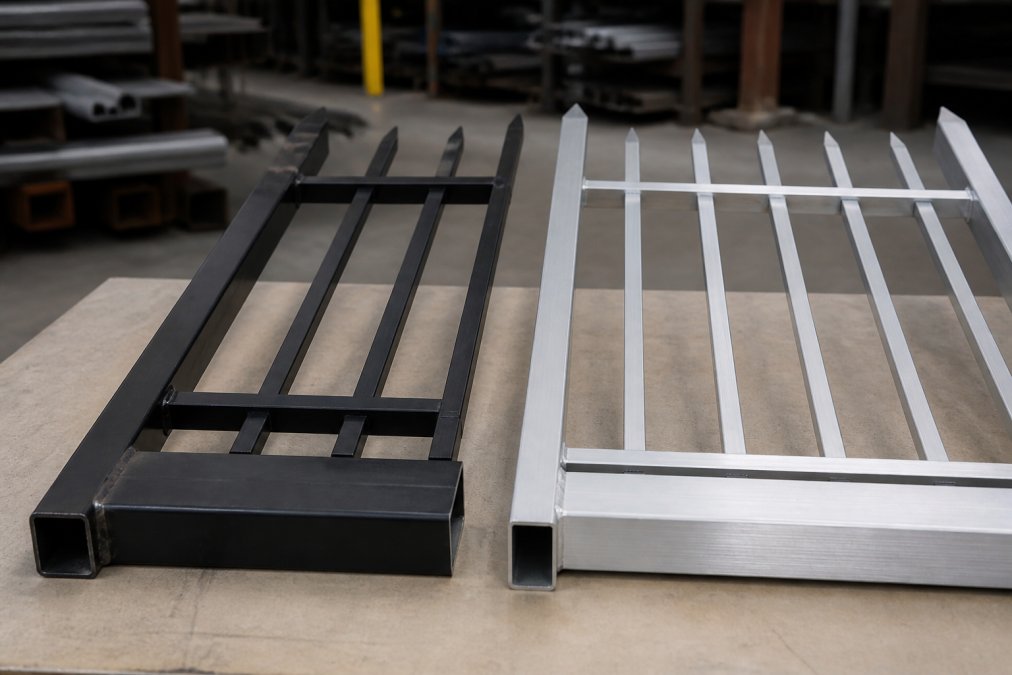
Structural steel is an iron alloy containing carbon and other elements that create exceptional tensile strength, the ability to resist pulling forces without deforming. This is why steel dominates in security fencing and industrial applications. Aluminum is a non-ferrous metal naturally resistant to oxidation and corrosion, making it ideal for environments where rust-proofing is the primary concern.
Weight differences fundamentally change installation requirements. A 6-foot ornamental steel panel weighs 80-120 pounds, while an equivalent aluminum panel weighs 20-35 pounds. This cascades into concrete footing depths, post diameters, installation labor hours, and equipment requirements. Heavier materials demand deeper post holes, stronger footings, and more labor time per linear foot.
(https://steelandpipesupply.com/blogs/news/galvanized-material-for-outdoor-use) Security: Strength and Structural Integrity]
Aesthetic profiles differ too. Ornamental steel fencing mimics elegant wrought iron with superior durability and lower maintenance. Aluminum typically offers cleaner, contemporary lines and more color options through powder-coating versatility. Neither material is inherently "prettier", the choice depends on your property’s architectural style.
| Characteristic | Structural Steel | Aluminum |
|---|---|---|
| Tensile Strength | 36,000-50,000 psi (high) | 20,000-35,000 psi (moderate) |
| Weight per Panel | 80-120 lbs (6’H x 8’W) | 20-35 lbs (6’H x 8’W) |
| Rust Resistance | Requires coating maintenance | Naturally rust-proof |
| Installation Labor | Higher (heavier, deeper footings) | Lower (lightweight, faster) |
| Typical Lifespan | 20-30 years (with maintenance) | 25-35 years (minimal upkeep) |
| Best For | Security, high wind, industrial | Coastal, humid, low-maintenance |
Durability of Steel vs Aluminum Fence Materials
Durability depends entirely on your environment. Steel fencing, when properly coated with e-coat or powder-coat systems, withstands extreme impacts far better than aluminum. A 2-inch diameter steel post handles lateral forces that would permanently bend an aluminum post of similar height. This is why steel dominates commercial security fencing and high-traffic industrial sites.
However, durability breaks down when steel’s protective coating is compromised. Once scratched or chipped, rust begins immediately. Steel requires vigilant maintenance: annual inspections, touch-ups to damaged areas, and potential full repainting every 7-10 years depending on climate. In Tampa Bay’s humid subtropical environment with salt-laden air, this maintenance cycle accelerates significantly.
Aluminum’s corrosion resistance is passive and permanent. The metal naturally forms a thin aluminum oxide layer that prevents further oxidation. While powder coating is applied for aesthetics and UV protection, no coating is required for structural protection. A fence installed 20 years ago in a salty climate will look nearly identical to one installed last year, provided the powder coat hasn’t faded cosmetically.
Impact resistance reveals the real trade-off. Steel panels absorb significant blows from falling branches, vehicles, or intentional strikes and remain structurally sound. Aluminum dents easily under the same impacts. For properties where fallen trees or vehicle strikes are realistic risks, steel’s impact resistance justifies the maintenance burden. For residential properties in stable environments, aluminum’s durability-to-maintenance ratio is superior.
The durability winner depends on climate and use case. Steel wins on impact resistance and structural rigidity; aluminum wins on corrosion resistance and maintenance-free longevity in coastal or humid regions.
Cost of Steel vs Aluminum Fence: Total Cost of Ownership
Material costs alone don’t tell the full story. Pricing depends on quantity, dates, and delivery. When you factor in installation labor, post requirements, and 15-20 year maintenance cycles, the total cost of ownership often narrows or reverses.
Installation labor represents 40-60% of total project cost for most fencing projects. Steel’s weight and installation complexity drive higher labor costs, deeper footings, heavier equipment, and more time per linear foot. Aluminum’s lightweight nature reduces installation time by 30-40% compared to steel. For a 200-linear-foot property fence, this difference can be significant in labor savings.
Long-term maintenance expenses diverge sharply. Steel fencing requires annual inspection and touch-up and full repainting every 7-10 years. Aluminum requires visual inspection every 2-3 years (minimal cost) and no rust remediation, ever.
Calculate your true cost of ownership by adding material cost + installation labor + (annual maintenance × years). For coastal and humid regions, aluminum typically wins. For high-security or high-wind applications, steel’s superior structural performance justifies higher maintenance costs.
Maintenance of Steel vs Aluminum Fence: What to Expect
Steel fence maintenance is predictable but demanding, with schedules varying by climate zone and salt-water proximity.
Steel Fence Maintenance Schedule (Inland Humid Climates):
- Spring inspection: check for rust spots, coating damage, loose fasteners (2-3 hours)
- Summer touch-ups: address rust using wire brush and touch-up paint (1-2 hours as needed)
- Fall inspection: prepare for winter weather, check post stability and concrete footing for cracks (2-3 hours)
- Every 7-10 years: full repainting or e-coat reapplication (professional service)
Steel Fence Maintenance Schedule (Coastal Environments, Salt Spray):
Coastal exposure accelerates corrosion dramatically. Properties within 1-2 miles of saltwater should follow an aggressive schedule:
- Quarterly inspections: salt spray initiates rust development in 6-8 weeks even on well-coated steel
- Biannual rinse: wash fence with fresh water to remove salt deposits
- Annual touch-ups: address rust spots immediately
- Repainting cycle: every 5-7 years instead of 7-10 years
- Post-storm inspection: after hurricanes or tropical storms, inspect for coating damage
Real-world data from Florida contractors shows that steel fencing in coastal Tampa Bay properties requires more annual maintenance per linear foot, compared to inland properties.
Aluminum Fence Maintenance Schedule (All Climates):
- Annual visual inspection: look for coating damage, debris buildup, or fastener corrosion (30 minutes)
- Occasional cleaning: rinse with water and mild soap if desired, particularly in coastal areas (1-2 hours annually, optional)
- Powder-coat touch-ups: only if cosmetic appearance matters (optional)
- No structural maintenance required: aluminum’s passive corrosion resistance means zero rust remediation
Aluminum’s maintenance advantage compounds over time. A property manager overseeing multiple residential properties with fencing would spend significantly less time annually maintaining aluminum compared to steel.
20-Year Maintenance Cost Comparison:
The 20-year maintenance cost gap between steel and aluminum can be substantial, depending on climate. In coastal environments, aluminum’s advantage is most pronounced.
Detecting Problems Before They Become Expensive:
Steel fencing owners should watch for coating bubbling or peeling (indicating moisture penetration), white powdery deposits (salt residue), fastener discoloration, weld seam discoloration, and concrete footing cracks.
Aluminum fencing owners should watch for powder-coat chalking or fading (cosmetic only), fastener rust (if mild steel fasteners were used), and salt deposits in coastal areas.
The maintenance cost gap between steel and aluminum over 20 years often exceeds the material cost difference. In coastal Tampa Bay, aluminum’s total cost of ownership is typically lower than steel when maintenance is factored in.
Best Fence Material for Security: Strength and Structural Integrity
Security performance depends on the material’s ability to resist climbing and its structural integrity under lateral force. Structural steel wins decisively on both counts.
Steel’s tensile strength of 36,000-50,000 psi creates a rigid barrier that resists cutting, bending, and climbing attempts. Products like Ameristar’s Montage Plus and Montage II are specifically engineered for high-security applications with fusion-welded panels that resist prying, climbing, and vehicle impact.
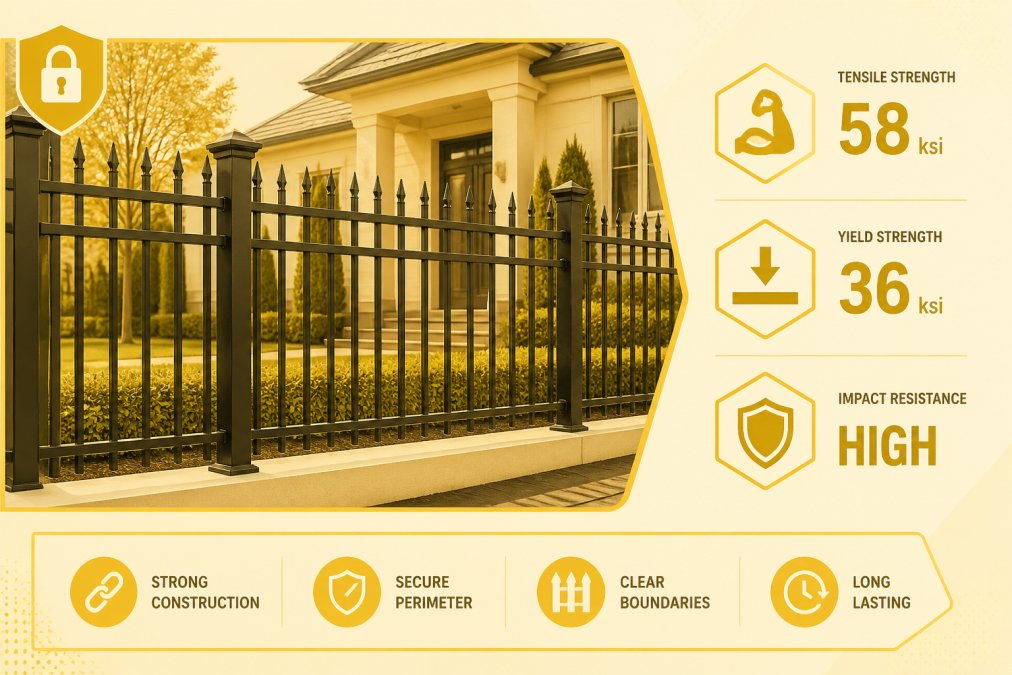
Aluminum’s lower tensile strength (20,000-35,000 psi) means it can be bent under sustained force. While adequate for boundary marking and aesthetic purposes, it’s not suitable for high-security applications where determined intrusion is a realistic threat.
Lateral force resistance, the ability to resist pushing or pulling forces perpendicular to the fence, is where steel’s superiority becomes obvious. A steel fence resists significant pounds of lateral force per linear foot without permanent deformation. Aluminum typically resists less before bending. For properties requiring true security, this difference is critical.
Aluminum fencing should never be specified for applications where security against determined intrusion is required. For residential security, steel is the only appropriate choice. For boundary marking and aesthetic purposes, aluminum is adequate and lower-maintenance.
Regional Climate Suitability: Coastal and Humid Environments
Material selection must account for regional climate. The Tampa Bay area’s subtropical humidity, salt spray from coastal proximity, and high summer temperatures create specific challenges for fencing materials.
In coastal environments (within 1-2 miles of saltwater), aluminum is dramatically superior. Salt spray accelerates steel corrosion exponentially. Even high-quality powder coats on steel fencing degrade faster in salt environments, typically requiring repainting every 5-7 years instead of 7-10 years inland. Aluminum’s natural corrosion resistance means salt spray has zero structural impact.
Humidity without salt spray (inland Tampa Bay) still favors aluminum but less decisively. Steel fencing can perform adequately with a rigorous maintenance schedule, though the maintenance burden remains significant.
For properties in the Tampa Bay region, aluminum is the pragmatic choice for minimizing long-term maintenance costs. Steel is appropriate only if security demands or wind-load requirements justify the ongoing maintenance burden.
DIY vs Professional Installation for Steel and Aluminum Fencing
Installation difficulty differs sharply between materials, affecting both cost and project feasibility.
Aluminum Fencing: DIY-Friendly for Homeowners
Aluminum fencing is genuinely DIY-accessible. The lightweight panels (20-35 pounds each) can be handled by one person without strain. Installation requires basic tools most homeowners own or can rent: post-hole digger, level, drill, tape measure, and concrete mix.
Aluminum’s screw-less or bolt-together design means no special tools or expertise required. A property owner with basic handyman skills can install 50-100 linear feet over a weekend: dig post holes 18-24 inches deep, set posts in concrete, slide panels into post channels, tighten fasteners.
Common DIY mistakes with aluminum:
- Insufficient post depth: posts set only 12-18 inches deep can shift in freeze-thaw cycles. Minimum depth is 18 inches; 24 inches is safer.
- Uneven post spacing: panels won’t fit if posts aren’t exactly 8 feet apart. Use a string line to keep posts aligned.
- Concrete not fully cured: attempting to install panels before concrete sets (24-48 hours) can shift posts.
- Over-tightening fasteners: aluminum is softer than steel; over-tightening can strip threads or crack material.
For boundary marking and aesthetic purposes, DIY aluminum installation is feasible and can result in labor savings on a typical 200-linear-foot residential property.
Steel Fencing: Professional Installation Strongly Recommended
Steel fencing demands professional installation for most property owners. The weight (80-120 pounds per panel) requires two people minimum, and improper installation has serious consequences for safety and long-term performance.
Why steel installation is more complex:
- Weight and handling: panels require coordination and strength to lift, position, and fasten
- Deeper footing requirements: structural engineers typically specify 24-36 inch depths for commercial-grade steel, compared to 18-24 inches for aluminum
- Concrete volume: deeper holes require more concrete and labor-intensive mixing and pouring
- Fusion-welded panels: commercial-grade steel fencing cannot be installed by homeowners
- Structural load calculations: steel fencing in high-wind zones requires proper post sizing and footing depth to resist lateral forces
Consequences of improper steel installation:
- Post failure under wind load: posts set too shallow can shift or topple during high winds
- Fastener failure: improper fastening can loosen, causing panels to sag or separate
- Rust acceleration: improper fastening can crack the powder coat, initiating rust
- Liability: improper installation may result in liability claims if fence fails and causes injury or property damage
Professional installation costs reflect this complexity: aluminum typically costs less per linear foot than steel. Professional installation ensures proper post sizing, correct fastener torque, warranty compliance, and code compliance.
When DIY is Appropriate vs. When Professional Installation is Mandatory:
| Scenario | Material | DIY Feasible? | Reason |
|---|---|---|---|
| Residential boundary fence, low wind zone | Aluminum | Yes | Lightweight, low structural demands, forgiving mistakes |
| Residential boundary fence, high-wind zone | Aluminum | Conditional | Requires deeper footings; verify local wind load requirements |
| Residential security fence | Steel | No | Structural performance demands professional installation |
| Commercial or industrial security fence | Steel | No | High liability, structural engineering required |
| Temporary or removable fence | Aluminum | Yes | Low structural demands, easy to modify |
| Fence with gates or automation | Steel or Aluminum | No | Gate hardware and automation systems require professional setup |
DIY Timeline and Effort Estimate:
Aluminum fence, 200 linear feet, 6 feet high, 25 panels: 13-19 hours over 2-3 weekends (accounting for concrete cure time), potentially saving on labor.
Steel fence, same dimensions: not recommended for DIY. Professional installation requires 2-3 days.
Steel fencing should never be installed by homeowners for security applications or in high-wind zones. The structural consequences of improper installation far outweigh the labor cost savings.
For aluminum fencing in low-wind residential zones, DIY installation is feasible and can result in labor savings. For steel fencing or any application where structural performance is critical, professional installation is mandatory.
Comparison Table: Steel vs Aluminum Fencing at a Glance
| Factor | Structural Steel | Aluminum |
|---|---|---|
| Tensile Strength | 36,000-50,000 psi | 20,000-35,000 psi |
| Weight | 80-120 lbs per panel | 20-35 lbs per panel |
| Corrosion Resistance | Requires coating maintenance | Naturally rust-proof |
| Coastal Suitability | Poor (accelerated rust) | Excellent |
| Impact Resistance | High (absorbs blows) | Low (dents easily) |
| Security Performance | Superior (high lateral force) | Adequate (boundary only) |
| Installation Labor | Higher | Lower |
| Annual Maintenance | 8-12 hours per 200 ft | 0.5-1 hour per 200 ft |
| Maintenance Cost (annual) | Can be significant | Minimal |
| Repainting Cycle | Every 7-10 years | Never required |
| DIY Installation | Not recommended | Feasible for homeowners |
| Typical Lifespan | 20-30 years (with care) | 25-35 years (minimal care) |
| Best For | Security, high-wind, industrial | Coastal, residential, low-maintenance |
Which Material Should You Choose?
The decision hinges on three questions: Is your primary concern security or low maintenance? What’s your climate, coastal, humid inland, or dry? Can you commit to annual maintenance?
Choose structural steel if:
- Security or lateral force resistance is your primary concern
- You’re in a high-wind zone or area prone to falling trees
- You have the budget and commitment for annual maintenance
- Your property is inland where rust development is slower
- You value the classic aesthetic of ornamental steel fencing
Choose aluminum if:
- You’re in a coastal or highly humid environment
- Maintenance-free longevity is your priority
- You want to minimize long-term costs over 15-20 years
- Your property doesn’t require high-security performance
- You prefer modern aesthetics and color options
For Tampa Bay region contractors and property managers, aluminum is the pragmatic default. Its natural corrosion resistance eliminates the maintenance burden that steel demands in this climate. However, if your project involves high-security requirements or extreme wind-load conditions, steel’s superior structural performance justifies the maintenance commitment.
At Steel & Pipe Supply, we work with contractors across the Tampa Bay area who specify both materials for different applications. Our team can help you source the structural components, posts, brackets, and fasteners that support either material choice. We stock the exact grades and wall thicknesses your engineers specify, and we lock in pricing on large orders so material cost spikes don’t kill your project margins. Whether you’re building a residential boundary fence or a commercial security perimeter, our competitive pricing and reliable delivery timelines ensure your project stays on schedule and on budget.
Choosing between structural steel and aluminum fencing is a long-term investment decision that affects your property for decades. The material that performs best depends on your climate, security needs, and maintenance capacity, not on marketing claims or aesthetic preference alone. Steel & Pipe Supply has helped contractors across the Tampa Bay region make this choice with confidence, sourcing the materials and components that match their specifications exactly. Call for a FREE Quote and let our team help you select the right material for your specific application and environment.
Frequently Asked Questions
Is aluminum fencing as strong as steel fencing?
No. Steel has significantly higher tensile strength and lateral force resistance than aluminum, making it superior for high-security applications and impact resistance. Aluminum is lighter and easier to install but softer and more susceptible to dents from significant impacts. For residential security, steel provides a stronger deterrent against forced entry and climbing, while aluminum excels in rust-proof coastal environments where strength is less critical.
What are the main differences in maintenance between steel and aluminum fences?
Steel requires regular maintenance to prevent oxidation and rust, including periodic inspection of the powder coating and touch-ups if damage occurs. Aluminum is virtually maintenance-free due to its inherent corrosion resistance, it won't rust even in coastal or humid environments. Both benefit from occasional cleaning, but aluminum eliminates the need for protective coatings and refinishing that steel demands over time, reducing long-term maintenance costs significantly.
Is aluminum fence cheaper than steel fence for fencing projects?
Aluminum typically has lower material costs and significantly lower installation labor costs due to its lightweight nature, reducing weight-to-strength ratio expenses. However, total cost of ownership depends on climate and maintenance needs. In coastal or humid regions, aluminum's rust-proof properties eliminate future maintenance expenses, improving overall value. Steel may cost more upfront and requires ongoing maintenance, but offers superior security, making it the better value for high-security applications despite higher initial investment.
Which fence material should I choose for a coastal environment?
Aluminum is the superior choice for coastal environments due to its inherent rust-proof and corrosion-resistant properties. Salt air and moisture cause rapid oxidation in steel, requiring frequent maintenance and coating reapplication. Aluminum's HS-35 alloy resists weathering without specialized coatings. If security is paramount in a coastal setting, consider galvanized steel alternatives, but expect higher maintenance costs. Aluminum offers the best long-term value for coastal properties by eliminating rust concerns while maintaining structural integrity.
Can I install steel or aluminum fencing myself, or do I need professionals?
Aluminum is DIY-friendly due to its lightweight nature and screw-less design, reducing installation complexity and physical demands. Steel requires professional installation in most cases because of its weight, need for deeper post footings, robust posts, and structural engineering considerations. Professional installation ensures proper post setting, lateral force stability, and structural rigidity. For aluminum, homeowners can handle basic installations; for steel, especially in commercial or high-security applications, professional installation is recommended to guarantee structural integrity and warranty compliance.
This article was written using GrandRanker